From tomfernandez28.com Tom’s Blog on: SEKULOW: Loretta Lynch Threatened FBI Informant on Uranium One Scandal With Prosecution DURING 2016 ELECTION

SEKULOW: Loretta Lynch Threatened FBI Informant on Uranium One Scandal With Prosecution DURING 2016 ELECTION
Posted on October 26, 2017 by tom
SEKULOW: Loretta Lynch Threatened FBI Informant on Uranium One Scandal With Prosecution DURING 2016 ELECTION

by Cristina Laila

An attorney for Trump Jay Sekulow and his son, attorney Jordan Sekulow of the ACLJ discussed the new Russian-Uranium One developments on their radio show Jay Live Tuesday, specifically focusing on the FBI informant.

As previously reported, not only was the FBI informant working on the Russian bribery case threatened by the Obama administration, he was blocked by the DOJ under then-AG Loretta Lynch from testifying to Congress.

Sara Carter of Circa News spoke to the FBI informant’s lawyer Victoria Toensing.

According to Circa News, the FBI informant wanted to testify to Congress about pertinent information that the Russian’s were attempting to gain access to former President Bill Clinton and his wife, then Secretary of State Hillary Clinton, to influence the Obama administration’s decision on the purchase of Uranium One, Toensing said.

Now this…

Jay and Jordan Sekulow were discussing the FBI informant on their radio show on Tuesday and said Obama’s DOJ and FBI didn’t threaten the FBI informant right away.

The FBI informant started providing information in 2009. It wasn’t until the 2016 presidential election that they threatened him with prosecution!

“This goes back to 2009 so I’m assuming this informant goes back to sometime around then. He was not threatened about speaking until the 2016 election. It was during the 2016 presidential election that the DOJ and FBI threatened to enforce the agreement with prosecution,” Jordan Sekulow said.

Video:

Follow
Cristina Laila @cristinalaila1
Loretta Lynch threatened to prosecute the FBI informant on Uranium One scandal DURING THE 2016 presidential election‼️ @JaySekulow
7:04 PM – Oct 24, 2017
6 6 Replies 89 89 Retweets 106 106 likes
Twitter Ads info and privacy
It seems like Loretta Lynch was busy during the 2016 presidential election making sure all of the skeletons stayed in the closet so her Queen Hillary would win the presidential election.

Loretta Lynch also forced James Comey to call Hillary Clinton’s FBI investigation a “matter” rather than a criminal investigation.

And the Dems want to investigate Trump for obstruction of justice? They should be investigating crooked lying Loretta Lynch, not Trump.

This FBI informant will speak one way or another. As reported earlier, Rep. Ron DeSantis said in a press conference on Capitol Hill that if the DOJ doesn’t lift the informant’s NDA, they will issue him a subpoena.

From Our Friends at Living Lies Weblog: CitiMortgage Must Face Class Action for False notarization of Documents in Foreclosures


CitiMortgage Must Face Class Action for False notarization of Documents in Foreclosures
https://wordpress.com/read/feeds/95852/posts/1614247594
Oct 3, 2017

Where is the prejudice in requiring the foreclosing party to prove its case with facts raather than presumptions?

There are two big takeaways: (1) Courts are getting more curious about what really happened in the mortgage meltdown and (2) this is one more example of how the TBTF banks are not entitled to any legal presumptions regarding their documents.

Research always shows that a fact is presumed in certain cases — but only in the absence of questions about the credibility of the party who proffers a document from which the legal presumption arises.
Get a LendingLies Consult and a LendingLies Chain of Title Analysis! 202-838-6345 or info@lendinglies.com.
https://www.vcita.com/v/lendinglies to schedule CONSULT, leave a message or make payments.
OR fill out our registration form FREE and we will contact you!
https://fs20.formsite.com/ngarfield/form271773666/index.html?1502204714426
THIS ARTICLE IS NOT A LEGAL OPINION UPON WHICH YOU CAN RELY IN ANY INDIVIDUAL CASE. HIRE A LAWYER.
—————-
see https://www.reuters.com/article/citimortgage-foreclosures/9th-circuit-revives-lawsuit-over-citimortgage-foreclosure-records-idUSL2N1MD245

What the banks have done is (1) create self-serving documents and then (2) fabricate other documents that rely upon the facts stated or implied in prior fabricated documents. The “greater weight” (piles of false documents) of the evidence falsely leads judges to presume that all that paper must mean something even when it is all trash.

Like other objections or motions in limine practicitioners should strive for a ruling that the foreclosing party must actually prove the facts that they want to be presumed. That includes the funding of the loan, the payment for the loan, and whether any so-called “transfers” were anything more than some words scratched on a piece of paper. They must prove facts not receive the benefit of a legal presumption or factual assumption.

Transfer documents (e.g., assignment of mortgage) and endorsements imply that a purchase took place. Whether such a purchase took place or not, the documents read the same. The error is in assuming the transaction took place when the source of the document has at least questionable credibility. Credibility questions arise whether it is Wells Fargo in creating fake financial accounts and then charging fees for them, Citi fabricating signatures and notarization, BofA or US Bank appearing as the injured party, or Chase claiming to own WAMU loans that not even WAMU had on its books. It’s obvious that the players are

Credibility questions arise whether it is Wells Fargo in creating fake financial accounts and then charging fees for them, Citi fabricating signatures and notarization, BofA or US Bank appearing as the injured party, or Chase claiming to own WAMU loans that not even WAMU had on its books. It’s obvious that the players are allin on the same “game,” to wit: keeping ivnestors and homeowners in the dark while the banks trade “paper.”

That includes the funding of the loan, the payment for the loan, and whether any so-called “transfers” were anything more than some words scratched on a piece of paper. They must prove facts not presume them. Transfer documents and endorsements imply that a purchase took place

Transfer documents and endorsements imply that a purchase took place because it is obvious that nobody goes around giving mortgage loans away. The “presumption” that the foreclosing parties want to use is that there must have been a purchase transaction in real life — facts — as opposed to the presumption that a transaction occurred in which one party purchased a loan from another party.

The presumption to the contrary in the context of hundreds of thousands (perhaps millions) of cases in which documents were fabricated, forged, robo-signed, and falsely notarized leads the courts to a false conclusion and the denial of the homeowner’s basic defense: this foreclosing party has no right, title or interest in my loan and doesn’t represent anyone who does have a right, title or interest in the debt, note or mortgage.

It is wrong for a court to ignore the 50 state settlement, the consent orders and the many cases in which borrowers were successful in undercutting the claim that the foreclosing party had legal standing.

Consider this: if the foreclosing parties really were acting legally, why wouldn’t they want to prove it? That would certainly discredit borrower defenses and send a message to foreclosure defense lawyers that these loans are real and the transfers were in fact purchases. Where is the prejudice in requiring the foreclosing party to prove its case with facts raather than presumptions?

Ah so! Gunny G on the Three Amigos


Gunny G
BLOGGIN’ BAD w/ Gunny G! ~ HEY! NO MORE PC, REMEMBER? ~AMERICA CANNOT BE GREAT AGAIN UNTIL THE STAIN, STIGMA, STENCH AND SHAME OF “THE PRINCE OF FOOLS” IS OFFICIALLY AND FINALLY UNDENIED, AINOs (AMERICANS IN NAME ONLY) EXPOSED, AND THE SWAMP FLUSHED! -POTUS TRUMP!…..-IF WE CAN KEEP HIM? ~ Illegitimi non carborundum…

News With Views | Mueller, Rosenstein And Comey: Three Amigos From The Deep State!!!!!!!!!!!!!!!!!!!!!!! ~
“…his co-worker James Comey, who was also making sure the Clintons were exonerated during the Whitewater affair. Here is Robert Mueller, sitting in the middle of his two wunderkinds, making sure the path before them is smooth and obstacle free, and practically shepherding their careers along the way….”!!!!!
Jul 4, 2017
Additional Articles By Roger Stone

Mueller, Rosenstein And Comey: Three Amigos From The Deep State

Jul 04, 2017 Read More Articles by Roger Stone

There is a longtime and incestuous relationship between the fixers who have been tasked with taking down President Trump, under the fake narrative of enforcing the law. James Comey worked in the DOJ directly under Mueller until 2005. Rod Rosenstein and Mueller go even further back.James Comey wasn’t just some associate of Mueller back then, but rather his protégé.

Under the George W. Bush presidency, when Comey was serving as Deputy Attorney General under John Ashcroft, Robert Mueller was Comey’s go-to guy when he needed help.

The two men, as it came to light years later, conspired to disobey potential White House orders to leave Ashcroft alone when he was incapacitated in March of 2004. These two men, when together, will not obey orders if they think they know better. Being filled with hubris and almost two decades of doing just about anything they want, they always think they know better. Rod Rosenstein, current Deputy Attorney General under Attorney General Jeff Sessions, is also a member of the Mueller Gang, having worked directly under Robert Mueller at the Department of Justice as far back as 1990.

When Comey was still working as the Deputy Chief of the Criminal Division for the U.S. Attorney’s office in New York, Mueller and Rosenstein were becoming thick as thieves.We look back at Rod’s loyal work for Hillary Clinton, when he became a clean-up man for the Clinton Administration as an Associate Independent Counsel from 1995 until 1997. He supervised the investigation that found no basis for criminal prosecution of White House officials who had obtained classified FBI background reports.

He did a great job covering for the Team Bill Clinton, including covering for Hillary, as she was one of the people who had access to the reports, and may have even requested them. Convenient for the Clintons, no indictments were filed.Having proven his loyalty to the powers that be, Rosenstein was appointed to work in the US Office of the Independent Counsel under Ken Starr on the Whitewater Investigation into then President Bill Clinton. By some miracle, or clever work by insiders, the Clintons escaped culpability once again. Rod wasn’t alone, he had help from his co-worker James Comey, who was also making sure the Clintons were exonerated during the Whitewater affair. Here is Robert Mueller, sitting in the middle of his two wunderkinds, making sure the path before them is smooth and obstacle free, and practically shepherding their careers along the way.

Is it any wonder that once Jeff Sessions shamelessly recused himself from the Russia Collusion Conspiracy investigation and turned it over to his deputy Rod Rosenstein, that Rosenstein would reach out to his old mentor for help? Who is surprised when three of the top lawman fixers for the Clinton/Bush cabal have axes in their eyes for President Donald J. Trump?Enter Lisa Barsoomian, wife of Rod Rosenstein.

Lisa is a high-powered attorney in Washington, DC, who specializes in opposing Freedom of Information Act requests on behalf of the Deep State, err, I mean, the Intelligence Communities. Lisa Barsoomian works for R. Craig Lawrence, an attorney who has represented Robert Mueller three times, James Comey five times, Barack Obama forty-five times, Kathleen Sebellius fifty-six times, Bill Clinton forty times, and Hillary Clinton seventeen times between 1991 and 2017.
Barsoomian participated in some of this work personally and has herself represented the FBI at least five separate times.

It would be great to research the specifics of the cases she worked in, many of the documents from the Court Docket relating to these cases have been removed from the D.C. District and Appeals Court, including her representation for Clinton in 1998’s case Hamburg. V. Clinton.Her loyalties are clearly with the entities that make up the Deep State, as are her husbands.They are a DC Globalist Power Couple, and they mean to destroy Donald Trump under the bidding of their Globalist Masters.

Rod Rosenstein should not have any position in President Trump’s administration, let alone one with so much power to harm the Office of the Presidency.

Mueller is also a Deep State lackey, even acting as delivery boy for Hillary’s State Department, hand transporting ten grams of highly enriched uranium under the auspices of counter-terror. It must only be coincidence that this happened at the same time as Hillary and her henchman John Podesta were nurturing the Uranium One deal that would see Russia take control over 20% of America’s proven uranium reserves.

Shortly after the Russia uranium deal closed, the Clinton Foundation was showered with many millions of dollars from Russian donors.

Source: News With Views | Mueller, Rosenstein And Comey: Three Amigos From The Deep State

The Nuclear State of the United States

Ocwen asks judge to throw out securities fraud lawsuit, By Dena Aubin


4/18/17 REUTERS LEGAL 20:51:34
REUTERS LEGAL
Copyright (c) 2017 Thomson Reuters
April 18, 2017
https://1.next.westlaw.com/Document/I7e567ed0247911e785d8d01a01423e7e/View/FullText.html?transitionType=CategoryPageItem&contextData=(sc.Default)

Ocwen asks judge to throw out securities fraud lawsuit
Dena Aubin
(Reuters) – Lawyers for mortgage servicer Ocwen Financial have asked a federal judge to toss a securities fraud lawsuit accusing it of misleading investors by hiding servicing misconduct and potential conflicts of interest in 2013 and 2014.
In a motion on Monday in a West Palm Beach federal court, Ocwen’s lawyers said they have produced over a million pages of documents in the long-running case and plaintiffs have still not been able to find evidence supporting their fraud claims. The lawyers asked for a judgment in Ocwen’s favor before trial.
Filed in 2014, the lawsuit accused Ocwen of artificially inflating the price of its shares by hiding the risk of regulatory action over its servicing practices.
Ocwen’s shares fell 27 percent in December 2014 when the company agreed to pay $150 million to resolve claims by New York’s Department of Financial Services of improper foreclosures and other servicing problems, the lawsuit said.
Based in West Palm Beach, Ocwen is one of the country’s largest mortgage servicers, with more than 1.5 million customers, according to its website.
The lawsuit seeks damages for investors who bought Ocwen’s stock between May 2013 and December 2014.
Plaintiffs’ lawyer David Kessler declined to comment. Lawyers for Ocwen could not immediately be reached for comment.
According to the complaint, Ocwen falsely assured investors that it was complying with the government’s mortgage servicing guidelines and that its compliance set it apart from peers.
Specifically, Ocwen stated at a December 2013 investor presentation that it complied with the 2012 national mortgage settlement, an agreement between the U.S. government and five major banks accused of mortgage servicing abuses. Ocwen was not part of that settlement but had to abide by it after it acquired mortgages from the participating banks.
In reality, Ocwen’s servicing system was not able to accommodate the huge numbers of mortgages it acquired while complying with the settlement’s servicing requirements, the investors’ complaint said.
Ocwen also assured investors it had procedures in place to prevent conflicts of interest involving its then-chairman William Erbey, according to the complaint.
While serving as Ocwen’s chairman, Erbey also was a major shareholder in four mortgage-related businesses that he created and spun off from Ocwen, the lawsuit said. Ocwen failed to assure that Erbey recused himself from any transactions between Ocwen and Erbey’s related companies, the investors alleged.
In Monday’s motion, lawyers for Ocwen said the company’s statements that it complied with the settlement were true when they were made. Plaintiffs had cited potential violations found by the settlement’s monitor in December 2014, but that was one year after Ocwen made the compliance statement, the lawyers said.
Ocwen’s statements that it had practices in place to avoid conflicts of interest with Erbey’s related companies also were true, the lawyers said. Erbey recused himself on numerous occasions from transactions with related parties and those transactions were also reviewed by Ocwen’s board to ensure they were in the company’s best interest, the lawyers said.
The case is In re Ocwen Financial Corporation Securities Litigation, U.S. District Court, Southern District of Florida, No. 14-81057.
For the plaintiffs: David Kessler, Lee Rudy and Sharan Nirmul at Kessler Topaz Meltzer & Check and Joshua Katz at Sallah Astarita & Cox
For the defendant: Jeffrey Hirsch at Greenberg Traurig and John Coffey at Kramer Levin Naftalis & Frankel
—- Index References —-
Company: GREENBERG TRAURIG LLP; KRAMER LEVIN NAFTALIS AND FRANKEL LLP
News Subject: (Crime (1CR87); Financial Fraud (1FI18); Fraud (1FR30); Funding Instruments (1FU41); Securities Law (1SE59); Social Issues (1SO05))
Industry: (Banking (1BA20); Consumer Finance (1CO55); Financial Services (1FI37); Investment Management (1IN34); Mortgage Banking (1MO85); Retail Banking Services (1RE38); Securities Investment (1SE57))
Region: (Americas (1AM92); Florida (1FL79); North America (1NO39); U.S. Southeast Region (1SO88); USA (1US73))
Language: EN

Health Ranger Article Reveals Truth on Vaccines

The 7 most dangerous vaccines injected into humans and exactly why they cause more harm than good

http://www.naturalnews.com/2016-12-14-the-7-most-dangerous-vaccines-injected-into-humans-and-exactly-why-they-cause-more-harm-than-good.html

Image: The 7 most dangerous vaccines injected into humans and exactly why they cause more harm than good

(NaturalNews) Oh, the theory of vaccines sounds great. Inject a tiny bit of the live virus into your blood so you can build antibodies and thus immunity against the “real deal” later. If that’s all there was to it, it could actually work. Then there’s the fear mongering that’s thoroughly “inflamed” and propagated by the press, pharma, and the medical doctors of quack Western medicine. This is where the real money is made. If you get measles you could die! If you get polio you’ll surely be paralyzed for life! If you get Zika, your baby’s head will be shrunken and deformed!

Yet, what if you found out today that the worst odds you or your children have of being infected with disease, disorder, and deformity exist in getting injected repeatedly with neurotoxins, genetically modified bacteria, live experimental strains of multiple viruses and pesticides? Consider this: not one single vaccine ever produced that is recommended by the CDC today has ever been proven safe or effective. Why? They don’t have to prove it. All they have to do is scare the living hell out of everyone using propaganda, and it’s worked for 75 years.

Presenting the 7 most dangerous vaccines injected into humans without any proof of safety or efficacy

#1. Gardasil HPV – Forget for a moment the fact that many girls who get the HPV vaccine beginning at age 9 for a sexually transmitted disease (diseases they don’t have) go into immediate anaphylactic shock and some into comas and die, and let’s just talk about the insane boatload of chemicals the manufacturers put in this concoction that belong nowhere in medicine, ever, especially that which is injected directly into muscle tissue and that which can penetrate the blood/brain barrier. Plus, remember to triple the amounts of these carcinogenic, dangerous, ludicrous chemical ingredients of Gardasil, because there are 3 of these toxic jabs required.

First we have sodium borate at 35mcg. Also known as “borax,” this is the main poisonous ingredient in boric acid that’s used to kill cockroaches. Is your little girl a cockroach? Is it coincidence that the side effects listed and reported with the Gardasil vaccine match those of sodium borate poisoning? No, it’s not a coincidence. Did you know that anything imported into the European Union that contains borax must carry a warning label stating, “May damage fertility” and “May damage the unborn child.” This is what America “recommends” for preteen and teenage girls who are just reaching the age of fertility. Unbelievable!

Then, Gardasil HPV contains aluminum at 225mcg, which causes nerve cell death and helps the vaccine chemicals enter the brain. Let’s not forget that Gardasil HPV contains polysorbate 80 at 50mcg. Polysorbate 80 is used as an emulsifier in foods, but when injected into animals (such as humans), causes rapid, unnatural growth of reproductive organs, causing sterility. This is population control through vaccines, just as Bill Gates once said at a TED conference would be ideal for reducing the world’s population by a few billion. Polysorbate 80 is what causes the anaphylactic shock and also causes cancer and birth defects, while we’re on that topic. Sorry, but there’s not enough time to talk about the sodium chloride at nearly 10mcg.

#2. Anthrax vaccine (biothrax) – The dreaded anthrax jab contains aluminum hydroxide, formaldehyde (yes, embalming fluid for the dead), and benzethonium chloride. In 2009, a study published in the Journal of Inorganic Biochemistry stated that aluminum hydroxide could be the primary cause of Gulf War Syndrome. Aluminum hydroxide causes apoptosis of motor neurons, leading to dementia. Go figure. Thousands of US soldiers given the mandatory anthrax jab are still sick or have died. It was never approved by the FDA, yet any soldier refusing it got dishonorably discharged, fines, and possible prison time. President Clinton’s executive order 13139 gave the DoD permission to experiment on the US military with the highly dangerous anthrax concoction.

#3. MMR II – Under Appendix B, listed on the CDC website, you can find the ingredients for the MMR (MMR-II), the combination vaccines that contain recombinant human albumin, sorbitol, hydrolized gelatin, chick (egg) embryo cell culture, human diploid lung fibroblasts, and fetal bovine serum, among other certain preservatives and chemical adjuvants. In the “ProQuad” version, or MMRV (w/vericella for chicken pox), they’ve added monosodium L-glutamate, neomycin, and MRC-5 cells. And although measles is a respiratory disease accompanied by an uncomfortable rash and fever illness that anyone with a normal immune system will likely survive, the media scares the public into getting jabbed with neurotoxins.

Sorbitol is a synthetic sweetener which metabolizes very slowly and aggravates IBS and gastrointestinal issues. Fetal bovine cow serum is extracted from cow skin and when injected causes connective tissue disorders, arthritis and lupus; also shortness of breath, low blood pressure, chest pain and skin reactions. Sodium chloride raises blood pressure and inhibits muscle contraction and growth. Human albumin is the protein portion of blood from pooled human venous plasma and when injected causes fever, chills, hives, rash, headache, nausea, breathing difficulty, and rapid heart rate. Injecting “pooled blood” can result in a loss of body cell mass and cause immunodeficiency virus infection, or contain SV40, AIDS, cancer or Hepatitis B from drug addicts. Still want that MMR vaccine? Didn’t think so.

#4. Swine Flu –  This loaded nightmare hoax vaccine contains inactivated H1N1 virus propagated in embryonated chicken eggs. The multi-dose vials contain over 24mcg of mercury per .5 ml dose! The jab also contains antibiotics polymyxin and neomycin that annihilate good gut bacteria, making the immune system highly vulnerable to infection. Add in some fluid from chicken eggs and you have one of the most experimental jabs ever created and a hoax perpetuated by WHO, GSK and the CDC to profit in the billions.

#5. Polio – This psycho-jab contains inactivated monkey kidney cells, newborn calf serum, embalming fluid, antibiotics, and bovine albumin. Salk didn’t invent the cure for polio–he invented new strains of it by haphazardly combining several. Get the facts!

#6. Influenza vaccine (a.k.a. the flu shot)Specifically, the “FluLaval” flu shot contains 25 mcg of mercury in one jab. The EPA safety limit for drinking water? Just 5 mcg. Do the math, then consider that shots bypass digestion, breathing, and skin filters. Common flu jabs also contain formaldehyde and polysorbate 80.

#7. RotaTeq for Rotavirus – Three oral doses of this Merck-made horror story cost about $200 and are mandated for about four million infants every year. Rotavirus vaccine contains 5 live strains, plus some fetal bovine serum and porcine circovirus–a volatile and dangerous virus that infects pigs. Side effects of RotaTeq? Difficulty breathing, vomiting and ear infection, followed by bloody stool. Then the intestines get blocked and twisted (known as intussusception) which can be deadly and requires surgery on infant’s intestines. Be sure and call your doctor right away if your child dies from RotaTeq.

Sources:

OffTheRadar.co.nz

TruthWiki.org

TruthWiki.org

TruthWiki.org

Vaccines.ProCon.org

WND EXCLUSIVE: 8 BLOODY TERROR ATTACKS IN U.S. IN 18 MONTHS HAVE 1 THING IN COMMON

When Abdul Ali Artan tried to run over a crowd of helpless students at Ohio State University, then got out of his car and slashed as many as he could with a butcher knife, media titans CNN, CBS and NBC treated it as an isolated incident.

Law enforcement, from the local level on up to the FBI, said they did not know what could have motivated the young Muslim student to act in such a premeditated, violent way against his fellow students on a chilly Tuesday morning in Columbus.

Artan, an 18-year-old freshman at OSU, had immigrated from his native Somalia through Pakistan, arriving in Columbus at the invitation of the U.S. government, which considered him a “refugee.”

But the media failed to connect any of the dots with a host of similar attacks on U.S. soil, let alone the even larger number of strikingly similar attacks in Europe committed by migrants from Muslim countries in the Middle East and Africa.

News outlets also failed to report that Columbus is America’s second-largest distribution point for Somali refugees after Minneapolis.

A simple perusal of some very recent history, roughly the previous 17 or 18 months, would have turned up the following incidents:

1. Chattanooga shooting: 24-year-old Muhammad Abdulaziz offers up mass shooting at Navy recruitment center, leaving five U.S. servicemen dead in July 2015.
2. University of California at Merced knife attack: 18-year-old student Faisal Mohammad slashes students, teacher in November 2015, four wounded.
3. San Bernardino shooting: Syed Farook and Tashfeen Malik attack office Christmas party, leaving 14 dead and several wounded in December 2015.
4. Orlando gay nightclub shooting: Omar Mateen on June 12, 2016, left 49 dead, 53 wounded.
5. Nazareth Mediterranean Restaurant knife attack: Mohamed Barry slashes diners in Columbus, Ohio, with machete in February 2016, four wounded.
6. St. Cloud Crossroads mall knife attack: Dahir Ahmad Adan seeks out non-Muslim shoppers with military-style knife on Sept. 17, 2016, 10 wounded.
7. Chelsea Manhattan bombing: Ahmad Rahimi plants pipe bombs that go off on Sept. 17, 29 wounded.
8. Ohio State knife/car attack: Abdul Ali Artan, rams his car into crowd of students, slashes them with butcher knife, 11 wounded, on Nov. 28.

A little further back, in 2013, the Boston Marathon bombing by the Tsarnaev brothers left three dead and more than 300 injured.

The one common denominator of all nine attacks is that each was carried out by Muslim immigrants or sons of Muslim immigrants.

And the last four attacks on the list – the knife attack at the restaurant in Columbus, the knife attack at the mall in St. Cloud, the bombing in Manhattan and the knife attack at OSU – were all carried out by Muslims who came to America through the United Nations refugee resettlement program overseen by the U.S. State Department. Three of the four used knives, a key component of global Islamic terror inspired by multiple verses in the Quran.

One of the primary responsibilities of any reputable journalist is to not only report the news of the day, but to report it in context. It is only through context that the consumers of the journalistic product can receive a full understanding of the events happening in the world around them. There was none of that going on Tuesday when the news broke of a knife attack on the campus of Ohio State. Not even the most-recent Muslim knife attack, carried out two months earlier by another Somali refugee in St. Cloud, was mentioned in connection with the Ohio story.

Why so little context? Why so little information about the refugee program and its recent failures to screen out bad apples?

Why do mainstream media, along with U.S. law enforcement, provide cover for the U.S. immigration system and the refugee program in particular?

The answer is clear, say several experts who follow the refugee program.

Get “See Something, Say Nothing: A Homeland Security Officer Exposes the Government’s Submission to Jihad,” by former DHS officer Philip Haney and WND Editor Art Moore, at the WND Superstore!

Keeping Americans in the dark

“Law enforcement and the media want to keep Americans in the dark about this threat,” says Pamela Geller, president of the American Defense Initiative who blogs at the Geller Report and authored the book “Stop the Islamization of America.”

“Law enforcement claims it’s to protect Muslims from a ‘backlash’ that never materializes,” Geller told WND. “The media is committed to dissembling about this threat.”

Geller revealed in an article several years ago that the Society of Professional Journalists has guidelines telling journalists never to associate Muslims or Islam with terrorism.

Activist/author Pamela Geller

“They’re willfully lying to the public,” she said.

“They seem to be committed to a globalist multiculturalist agenda that involves bringing large numbers of Muslims into the country,” Geller added. “Connecting the dots would wake too many people up to what is happening.”

Perhaps most disappointing is the failure of Christian pastors and teachers to give any concrete, accurate information to their church flocks about what Islam teaches from the Quran and other Islamic texts.

“They have been indoctrinated with the idea that it would be ‘racist’ to do so,” Geller says.

Robert Spencer, who edits the JihadWatch blog for the David Horowitz Freedom Center and has authored several best-selling books, including “The Politically Incorrect Guide to Islam and the Crusades,” said he believes U.S. law enforcement takes its cue from the Obama administration.

Author Robert Spencer

“And they are committed as a matter of policy to denying that there is any jihad threat at all,” Spencer said. “With each attack, they explain it away and defend Islam. They claim it will alienate moderate Muslims if we speak about the motivating ideology behind this threat; they never explain why they think moderate Muslims would be offended by discussing understandings of Islam that they ostensibly reject.”

Fitna: The root of modern ‘Islamophobia’

Phil Haney, co-author of “See Something Say Nothing,” tracked the OSU story from the time it started breaking Tuesday morning.

“Underneath all this hand-wringing about why did he do it, he already said why he did it,” Haney told WND. “On his Facebook page he said he’s sick and tired of Muslims being killed in different parts of world, and that is fitna. It always comes back to fitna.”

“Fitna” is an Arabic term used in the Quran to describe a yoke of oppression, a trial or an injustice thrust upon the Muslim believers by the non-believers. The modern word for a fitna would be “Islamophobia.”

By continuing the politically correct policy of avoiding the issue behind each new terror attack, the mainstream media enable the Muslim leaders to further their teaching of young Muslims to feel like they are part of a persecuted minority in America.

“Islamophobia” has become such a prevalent theme, widely taught within the American Muslim community today, that we can expect more backlash from angry Muslims who have had their minds poisoned by this indoctrination, Haney says.

“This stifling emphasis dominates the mindset of American Muslims, and their social-political allies [on the left], and it prevents us from honestly and courageously addressing the true nature of a global ideology that aggressively promotes its agenda of supremacy,” Haney said.

“Anyone who attempts to move beyond the ‘Islamophobia’ mantra is reflexively labeled as a bigoted racist,” he added, “while the Muslim community enjoys immunity from any responsibility for its communal actions.”

DHS agent Philip Haney’s blockbuster revelations of the federal government’s appeasement of supremacist Islam are told in his book, “See Something Say Nothing.”

Read more at http://www.wnd.com/2016/11/9-bloody-terror-attacks-in-u-s-in-18-months-have-1-thing-in-common/#itIHbKsd2MVUTbLH.99

Every day it seems, I read something about Judges in this Country, or someone contacts me about them, or I experience them first hand, or perhaps, one of the attorneys that I have worked with feels their wrath.

The judges hate pro se litigants.  The judges hate foreclosure defense lawsuits.  The judges hate almost everything and/or everyone, except their fellow judges, or people they knew while they were attorneys, or maybe their own families.  It has come to the point, that I told someone the other day, we need to get rid of all govt., and all judges, and start anew.

I’m serious.  Most people don’t encounter the crimes that the judges are committing.  Or so I thought.  I have read some things lately, where more and more people are noticing that unless you are a bank, an attorney on the judge’s good side, or a multi-billion dollar corporation, there is no justice for you in the US.

Read on, and see some of what I am talking about.  I have added in parts of articles supporting what I am claiming.  There will be links to the articles, so that you can see for yourself, where the information came from:

From:

Margaret Besen, 51, says that she was unfairly ruled against on multiple occasions by the judge in her divorce case.

Corrupt justice: what happens when judges’ bias taints a case?

Divorced mother Margaret Besen tells her five-year struggle to get justice, just one story in the hundreds of judicial transgressions across the US revealed in a Guardian and Contently Foundation for Investigative Reporting collaboration

https://www.theguardian.com/us-news/2015/oct/18/judge-bias-corrupts-court-cases

Judge William Kent’s preliminary ruling seemed like a first step toward compromise. Margaret and Stuart Besen, who agreed their marriage was beyond repair, would remain in their suburban Suffolk County house, living in separate rooms – and keeping away from each other – while sharing custody until a resolution could be reached.

But within weeks, the situation deteriorated. Stuart Besen, a politically connected attorney for the town of Huntington, had an anger problem, Margaret told authorities. The couple’s screaming matches left Margaret feeling intimidated and their children – a daughter, 11, and son, 7 – terrified, she said. So in August of that year she obtained an order of protection prohibiting Stuart from harassing her. Three weeks later, Stuart entered Margaret’s bedroom and hovered over her as she slept, she told police. They arrested him for violating the order, reporting that Stuart had stared down at Margaret with his arms folded on three consecutive nights. She got temporary possession of the family home.

In the years that followed, Besen’s hopes for an equitable settlement dwindled as she battled a series of harsh and hard-to-explain decisions against her. Though she could never prove anything, she suspected that the scales had tipped for reasons unrelated to the evidence in her case. If true, Besen faced what experts say is one of the most troubling threats to our nation’s system of justice: judges, who, through incompetence, bias or outright corruption, prevent the wronged from getting a fair hearing in our courts.

“The decorum and bias and the perfectly unethical behavior of the judges is really rampant,” said Amanda Lundergan, a defense attorney in Royal Palm Beach, Florida, who confronted a nest of judicial conflicts in her state’s rapid-fire foreclosure rulings – dubbed the “rocket-docket” – following the housing market collapse. “It’s judicial bullying.”

Judges in local, state and federal courts across the country routinely hide their connections to litigants and their lawyers. These links can be social – they may have been law school classmates or share common friends – political, financial or ideological. In some instances the two may have mutual investment interests. They might be in-laws. Occasionally they are literally in bed together. While it’s unavoidable that such relationships will occur, when they do create a perception of bias, a judge is duty-bound to at the very least disclose that information, and if it is creates an actual bias, allow a different judge to take over.

All too often, however, the conflicted jurist says nothing and proceeds to rule in favor of the connected party, while the loser goes off without realizing an undisclosed bias doomed her case.

Hundreds of judicial transgressions have been uncovered during the last decade, with results that cost the defeated litigants their home, business, custody, health or freedom.

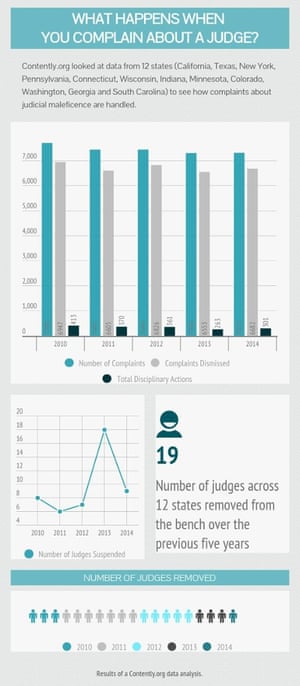
But court critics say that one reason judicial violations are common is because they frequently go unpunished. When litigants ask a judge to back away because of a conflict, they risk being told no, then face possible retaliation, so many don’t bother. If a litigant or an attorney files a complaint with an oversight body, there’s only about a 10% chance that state court authorities will properly investigate the allegation, according to a Contently.org analysis of data from 12 states.

Judges state-by-state
Photograph: Contently.org

The analysis shows that a dozen of these commissions collectively dismissed out of hand 90% of the complaints filed during the last five years, tossing 33,613 of 37,216 grievances without conducting any substantive inquiry. When they did take a look – 3,693 times between 2010 and 2014 – investigators found wrongdoing almost half the time, issuing disciplinary actions in 1,751 cases, about 47%.

The actions taken ranged from a letter of warning to censure, a formal sanction that indicates a judge is guilty of misconduct but does not merit suspension or removal.

Actually removing a judge was a rarity. Just 19 jurists in 12 states were ordered off the bench for malfeasance, which is about three per decade for each state. And even that result is becoming less common, with only one removal in 2014 and three in 2013 among all 12 states.

The states examined – California, Texas, New York, Pennsylvania, Connecticut, Wisconsin, Indiana, Minnesota, Colorado, Washington, Georgia and South Carolina – were chosen because they comprise a representative sample from different populations and areas of the country and because they had matching data for the years 2010 through 2014.

Judicial discipline at the federal level is almost non-existent. A Contently.org examination of the most recent five years of complaint data shows that 5,228 grievances were lodged against federal jurists between 2010 and 2014, including 2,561 that specifically alleged bias or conflict of interest. But only three judges were disciplined during those years and each got the mildest rebuke on the books: censure or reprimand. None was suspended or removed.

Margaret won a court order of protection barring Stuart from contact with her children for a year. But when Kent issued his final decree less than six weeks later, he awarded Stuart full custody, while Margaret was allowed only supervised visits. And he ordered Margaret to pay back half the cost of her nursing degree and to sell her diamond engagement ring and split the proceeds with Stuart. The judge also reversed the support arrangements. While Stuart would pay $1,500 a month in maintenance to Margaret, she now owed Stuart $153.90 a week for the children, even though she was earning about $13,000 a year as a part-time aide in an assisted-living facility.

Margaret began to look into her husband’s dealings and discovered, through searching public records, that he and judge Kent had possible connections. In 2010, Stuart was appointed as the Suffolk County representative on a statewide commission for vetting local judicial candidates. That same year, an organization based at Stuart Besen’s Garden City law office, the Long Island Coalition for Responsible Government, donated $7,500 to candidate Richard Ambro, who got elected and became one of Kent’s fellow Supreme Court judges in Suffolk’s 10th district. In his role as Huntington’s town lawyer, Besen argued cases before these very judges. He’d entered a circle of judicial insiders.

“I’m in the middle of a large group of people who’ve got money and influence and who are all connected,” said Margaret Besen. “I’m not being afforded an opportunity to get a fair shake.”

Margaret Besen stands in front of the former Besen family home, now unoccupied in Commack, Long Island.

Above:  Margaret Besen stands in front of the former Besen family home, now unoccupied in Commack, Long Island. Photograph: Alan Chin

Margaret had no way of knowing whether the connections she uncovered played any role in how Kent ruled in her case. But her concern deepened when she made an additional discovery about her house. Kent had ordered the Besen home, the most valuable marital asset, to be sold and the proceeds divided, putting Margaret in line to receive possibly hundreds of thousands of dollars. Then she found an online listing offering the property for sale – with the judge’s wife, Patricia Kent, as broker. The home, which was listed for $749,999 with Patricia Kent’s photo and contact information on Realty Connect USA, is currently more than $15,000 in arrears on its property taxes and no longer appears to be actively offered. Margaret was evicted from the house in 2013 and lives in a modest apartment a few miles away. She has yet to receive a penny for her interest in the property.

Scott L Cummings, a professor of legal ethics at UCLA law school, said the case raised “significant ethical red flags”, because of the judge’s wife’s alleged involvement in offering the Besen family home for sale. “Not knowing the details of how his spouse might have been assigned as broker, the idea that a judge might benefit financially from the sale of a property in dispute in a pending matter seems to raise a serious question of impartiality.”

Ronald Rotunda, a professor at Chapman University law school in Orange, California, said: “What judge Kent did here seems odd. The husband makes over a half million a year, she makes $13,000 a year, and the judge orders her to pay child support (which is tax free to him and not deductible for her).”

But a culture of judicial impunity extends far beyond Long Island’s county courts. Indeed, even the US supreme court has been tarnished on this issue.

Justice Steven Breyer owned $215,000 in health-care stocks when deciding on the legality of the Affordable Care Act in 2012. Justice Samuel Alito’s portfolio included $2,000 in stock in The Walt Disney Co. in 2008, the year the court heard Disney, FCC v. Fox Television Stations. And perhaps most famously, justice Antonin Scalia has participated in the Bush v. Gore case, even though his son Eugene’s law firm represented one of the parties. In another case, Scalia remained in the panel despite having gone on a duck hunting trip with former Vice-President Dick Cheney while he was being sued to reveal the details of secret meetings he held with oil company executives in the run-up to the 2003 invasion of Iraq.

The online vitriol directed at unscrupulous judges, which began in the mid- 2000s, has built to a howling digital crescendo. Websites including The Robe Probe, The Judiciary Report and The Robing Room, which rate judges the way Yelp rates restaurants, are rife with railing as embittered, mostly anonymous plaintiffs rip into judicial decisions they feel were biased or corrupt.

In an appeal of a case in West Virginia court, A.T. Massey Coal Co. CEO Don Blankenship spent $3m to elect Brent Benjamin, who ultimately provided the swing vote that overturned a $50m judgment against his company. Benjamin rebuffed repeated demands that the newly elected justice recuse himself because of his obvious conflict.

The US Supreme Court ruled that Benjamin’s bias was so extreme that his failure to step aside violated Caperton’s right to due process under the Constitution’s Fourteenth Amendment. The case, which spawned Grisham’s 2008 best-seller, “The Appeal,” underscored the kind of underhanded dealing that has stained the judiciary.

A further nudge for reform came last year when the Center for Public Integrity published a report on financial conflicts of interest. Among its findings: on 26 occasions in the preceding three years, federal appellate judges ruled on cases involving companies in which they owned stock or where they had a financial tie to an attorney appearing before them.

A further nudge for reform came last year when the Center for Public Integrity published a report on financial conflicts of interest. Among its findings: on 26 occasions in the preceding three years, federal appellate judges ruled on cases involving companies in which they owned stock or where they had a financial tie to an attorney appearing before them.

It also created a grading system to gauge how diligent each state was in collecting personal financial information from its judges, including stock ownership and outside sources of income, and how accessible that data was to the public. The center said that 42 states, plus the District of Columbia, failed its test. Six others earned a D grade, while two – California and Maryland – got Cs. California’s score, 77, the highest of any state, was seven points below the federal government’s grade of 84.

The report highlighted the type of conflict that can be most readily identified and that doing so requires full disclosure from the judges. Stock ownership, even if minimal, should automatically disqualify a judge from hearing a case, many experts believe. “If a judge owns a single share in a company involved in a case, he should recuse himself instantly,” says Rotunda, a leading law scholar.

It’s been more than two years since Margaret Besen has seen her children, who are now 12 and 16. There’s no money to pay the court supervisor, so they can’t visit. Nor does Besen have the funds to continue fighting. Kent retired shortly after making his decision.

“The hardest thing in my life is that I can’t be with my children and I can’t have an impact on my children’s upbringing,” Besen said over coffee at a Long Island diner. “A lot of people do not have any idea how the judicial system works or doesn’t work until you’re in it. We think we’re in a democratic society. We think we’re run by rules. But they are not being upheld by the court at all.”

This story was produced in collaboration with The Contently Foundation for Investigative Reporting.


In recent years, America’s corporations have created a private system for handling disputes that benefits them greatly while denying consumers their day in court.

Worse, according to a recent series in The Times, that system has become vast and more entrenched as companies increasingly require customers, employees, investors, patients and other consumers to agree in advance to arbitrate any disputes that arise in their dealings with a company, rather than sue in a court of law.

Such forced-arbitration clauses, found in the fine print of contracts, also typically bar aggrieved parties from pressing their claims as a group in a class action, often the only practical way for individuals to challenge corporations. In addition, corporations effectively control the arbitration process, including the selection of the arbitrator and the rules of evidence, a stacked deck if ever there was one.

As if that is not troubling enough, it is extremely difficult to avoid or get out of forced-arbitration clauses and class-action bans, particularly since they were upheld by two misguided Supreme Court decisions in 2011 and in 2013.

Photo

Richard Cordray, director of the Consumer Financial Protection Bureau, center, with colleagues at a hearing in Denver last week.CreditBrennan Linsley/Associated Press

From 2010 to 2014, corporations prevailed in four out of five cases where they asked federal judges to dismiss class-action lawsuits and compel arbitration, according to The Times’s articles. People who were blocked from going to court as a group usually dropped their claims entirely, in part because class actions are often the only affordable way to file lawsuits. If successful, they can deter future corporate wrongdoing because even small payouts, multiplied over all similarly mistreated customers, can be very large.

Indeed, faced with arbitration, it appears that most people do not pursue remedies to their grievances at all. Verizon, with more than 125 million subscribers, faced 65 consumer arbitrations between 2010 and 2014, The Times’s report found. Sprint, with more than 57 million subscribers, faced six. Time Warner Cable, with 15 million subscribers, faced seven.

Even more disturbing, the shift away from the civil justice system has gone beyond disputes about money. Nursing homes, obstetrics practices and private schools increasingly use forced-arbitration clauses to shield themselves from being taken to court over alleged discrimination, elder abuse, fraud, hate crimes, medical malpractice and wrongful death.

For the most part, Congress has looked the other way. Federal regulators, however, are starting to fight back. The Consumer Financial Protection Bureau is expected to propose a rule soon to forbid arbitration clauses that ban class actions in cases involving financial services and products. The Centers for Medicare and Medicaid Services, which is expected to issue updated nursing home regulations next year, is considering a ban on forced arbitration clauses in nursing home contracts.

Reversing the broader trend of forced arbitration, however, will require public outcry loud and long enough to stir the White House and Congress to action. Many people interviewed in The Times’s series did not realize that their right to sue had been lost until they needed it. A common refrain was the disbelief that this could happen in America. But it is happening, and it needs to stop.


2 million phony accounts Wells Fargo!

Together we'll go far Wells Fargo Home Page

5,300 Wells Fargo employees fired over 2 million phony accounts

Everyone hates paying bank fees. But imagine paying fees on a ghost account you didn’t even sign up for.

That’s exactly what happened to Wells Fargo customers nationwide.

On Thursday, federal regulators said Wells Fargo (WFC) employees secretly created millions of unauthorized bank and credit card accounts — without their customers knowing it — since 2011.

The phony accounts earned the bank unwarranted fees and allowed Wells Fargo employees to boost their sales figures and make more money.

“Wells Fargo employees secretly opened unauthorized accounts to hit sales targets and receive bonuses,” Richard Cordray, director of the Consumer Financial Protection Bureau, said in a statement.

Wells Fargo confirmed to CNNMoney that it had fired 5,300 employees over the last few years related to the shady behavior. Employees went so far as to create phony PIN numbers and fake email addresses to enroll customers in online banking services, the CFPB said.

Related: Who owns Wells Fargo? You, me and Warren Buffett

The scope of the scandal is shocking. An analysis conducted by a consulting firm hired by Wells Fargo concluded that bank employees opened over 1.5 million deposit accounts that may not have been authorized.

The way it worked was that employees moved funds from customers’ existing accounts into newly-created ones without their knowledge or consent, regulators say. The CFPB described this practice as “widespread.” Customers were being charged for insufficient funds or overdraft fees — because there wasn’t enough money in their original accounts.

Additionally, Wells Fargo employees also submitted applications for 565,443 credit card accounts without their customers’ knowledge or consent. Roughly 14,000 of those accounts incurred over $400,000 in fees, including annual fees, interest charges and overdraft-protection fees.

The CFPB said Wells Fargo will pay “full restitutions to all victims.”

Related: ATM and overdraft fees top $6 billion at the big 3 banks

Wells Fargo is being slapped with the largest penalty since the CFPB was founded in 2011. The bank agreed to pay $185 million in fines, along with $5 million to refund customers.

“We regret and take responsibility for any instances where customers may have received a product that they did not request,” Wells Fargo said in a statement.

Wells Fargo has the highest market valuation among any bank in America, worth just north of $250 billion. Berkshire Hathaway (BRKA), the investment firm run legendary investor Warren Buffett, is the company’s biggest shareholder.

Of the total fines, $100 million will go toward the CFPB’s Civil Penalty Fund, $35 million will go to the Office of the Comptroller of the Currency, and another $50 million will be paid to the City and County of Los Angeles.

“One wonders whether (the CFPB) penalty of $100 million is enough,” said David Vladeck, a Georgetown University law professor and former director of the Federal Trade Commission’s Bureau of Consumer Protection. “It sounds like a big number, but for a bank the size of Wells Fargo, it isn’t really.”

Wells Fargo confirmed to CNNMoney that the 5,300 firings took place over several years. The bank listed 265,000 employees as of the end of 2015.

Related: Barclays fined $109 million for trying to hide a deal with rich clients

“At Wells Fargo, when we make mistakes, we are open about it, we take responsibility, and we take action,” the bank said in a memo to employees on Thursday.

The CFPB declined to comment on when the investigation began and what sparked it, citing agency policy. “We don’t comment on how we uncover these matters,” a spokesman said.

As part of the settlement, Wells Fargo needs to make changes to its sales practices and internal oversight.

Customers are fuming. Brian Kennedy, a Maryland retiree, told CNNMoney he detected an unauthorized Wells Fargo account had been created in his name about a year ago. He asked Wells Fargo about it and the bank closed it, he said.

“I didn’t sign up for any bloody checking account,” Kennedy, who is 57 years old, told CNNMoney. “They lost me as a banking customer and I have warned family and friends.”

“Consumers must be able to trust their banks,” said Mike Feuer, the Los Angeles City Attorney who joined the settlement.

Feuer’s office sued Wells Fargo in May 2015 over allegations of unauthorized accounts. After filing the suit, his office received more than 1,000 calls and emails from customers as well as current and former Wells Fargo employees about the allegations.

Wells Fargo declined to say when it hired a consulting firm to investigate the allegations. However, a person familiar with the matter told CNNMoney the bank launched the review after the L.A. lawsuit was filed.

Even though the Wells Fargo scandal took place nationally, the settlement with L.A. requires the bank to specifically alert all its California customers to review their accounts and shut down ones they don’t recognize or want.

“How does a bank that is supposed to have robust internal controls permit the creation of over a half-million dummy accounts?” asked Vladeck. “If I were a Wells Fargo customer, and fortunately I am not, I’d think seriously about finding a new bank.”

–To reach the author of this article email Matt.Egan@cnn.com

Massachusetts churches sue over transgender bathroom bill

The U.S. Supreme Court, file. REUTERS Gary Cameron
10/12/16 REUTERS 00:22:49
REUTERS
Copyright (c) 2016 Thomson Reuters
October 12, 2016

Massachusetts churches sue over transgender bathroom bill

Curtis Skinner
(Reuters) – Four Massachusetts churches on Tuesday filed a lawsuit asking to be exempted from a state law that requires public places to allow transgender people to use bathrooms in line with their gender identity.
Access to public bathrooms has become a flashpoint in the battle over transgender rights in the United States, after North Carolina earlier this year enacted a measure mandating that bathrooms and locker rooms be restricted according to a person’s biological gender.
The Horizon Christian Fellowship, the Swansea Abundant Life Assembly of God, the House of Destiny Ministries and the Faith Christian Fellowship of Haverhill filed the federal civil rights lawsuit in Massachusetts, arguing the law violates their constitutional rights to freedom of religious expression and free speech.
“The Churches’ policies and practices regarding access to their changing rooms and restrooms flow logically and directly from their religious beliefs concerning God’s design for biological sex,” the lawsuit said.
The law did not provide exemptions for religious organizations, with the Massachusetts Attorney General’s Office saying on its website that “houses of worship” are public places.
The lawsuit is seeking an injunction from the law for religious organizations and attorneys fees.
Massachusetts Attorney General Maura Healey and the Massachusetts Commission Against Discrimination were named as defendants in the case. Neither could be reached for comment on Tuesday night.
Jillian Fennimore, a spokeswoman for Healey’s office, told the MassLive news website the office would not comment on the lawsuit as they are still reviewing it.
Fennimore added however, “We are pleased that we finally have a law in place that protects transgender people from discrimination in public places. This law is about civil rights and is critical for people who were without full protection and equality under the law for too long.”
The lawsuit makes Massachusetts the latest battleground for transgender rights.
A U.S. judge in August blocked an Obama administration policy that public schools should allow transgender students to use the bathrooms of their choice, granting a nationwide injunction sought by 13 dissenting states.
Meanwhile, lawmakers elsewhere have moved to expand protections for transgender people. Late last month California Governor Jerry Brown signed a bill opening single-stall public restrooms to anyone, regardless of gender. The state already bars discrimination against transgender people, including in public bathrooms.
—- Index References —-
Company: CITY OF HAVERHILL MASSACHUSETTS
News Subject: (Civil Rights Law (1CI34); Gay & Lesbian Issues (1GA65); Intellectual Freedoms & Civil Liberties (1IN08); Legal (1LE33); Social Issues (1SO05))
Region: (Americas (1AM92); Massachusetts (1MA15); North America (1NO39); U.S. New England Region (1NE37); USA (1US73))
Language: EN
Other Indexing: (Destiny Ministries; Jillian Fennimore; Lucy NicholsonA; Jerry Brown; Lucy Nicholson; Maura Healey)
Keywords: (MCC:a); (N2:US); (N2:AMERS); (N2:NAMER); (N2:USA); (MCCL:OVR)
Word Count: 433
Massachusetts churches sue over transgender bathroom bill

North Georgia newspaper publisher jailed over open records request

North Georgia newspaper publisher jailed over open records request

July 1st, 2016 by Associated Press in Local Regional News Read Time: 4 mins.

A North Georgia newspaper publisher was indicted on a felony charge and jailed overnight last week – for filing an open-records request.

Fannin Focus publisher Mark Thomason, along with his attorney Russell Stookey, were arrested on Friday and charged with attempted identity fraud and identity fraud. Thomason was also accused of making a false statement in his records request.

Thomason’s relentless pursuit of public records relating to the local Superior Court has incensed the court’s chief judge, Brenda Weaver, who also chairs the state Judicial Qualifications Commission. Weaver took the matter to the district attorney, who obtained the indictments.

Thomason was charged June 24 with making a false statement in an open-records request in which he asked for copies of checks “cashed illegally.” Thomason and Stookey were also charged with identity fraud and attempted identity fraud because they did not get Weaver’s approval before sending subpoenas to banks where Weaver and another judge maintained accounts for office expenses. Weaver suggested that Thomason may have been trying to steal banking information on the checks.

But Thomason said he was “doing his job” when he asked for records.

“I was astounded, in disbelief that there were even any charges to be had,” said Thomason, 37, who grew up in Fannin County. “I take this as a punch at journalists across the nation that if we continue to do our jobs correctly, then we have to live in fear of being imprisoned.”

Thomason and Stookey are out on $10,000 bond and have a long list of things they cannot do or things they must do to avoid going to jail until their trials. On Thursday, for example, Thomason reported to a pretrial center and was told that he may have to submit to a random drug test – a condition of the bond on which he was released from jail last Saturday.

Alison Sosebee, district attorney in the three counties in the Appalachian Judicial Circuit, and Judge Weaver say the charges are justified. Weaver said she resented Thomason’s attacks on her character in his weekly newspaper and in conversations with her constituents.

“I don’t react well when my honesty is questioned,” Weaver said.

She said others in the community were using Thomason to get at her. “It’s clear this is a personal vendetta against me,” she said. “I don’t know how else to explain that.”

But legal experts expressed dismay at the punitive use of the Open Records Act.

“To the extent these criminal charges stem from the use of the Open Records Act undermines the entire purpose of the law,” said Hollie Manheimer, executive director of the Georgia First Amendment Foundation. “The Open Records Act is the vehicle by which citizens access governmental information Retaliation for use of the Open Records Act will inhibit every citizen from using it, and reel us back into the dark ages.”

Another expert said the charges against attorney Russell Stookey may also be unfounded. Robert Rubin, president of the Georgia Association of Criminal Defense Lawyers, said it was wrong for the grand jury to indict a lawyer who “is using the legitimate court process for a subpoena to get records relevant for his case.” The dispute grows out of a March 2015 incident involving another judge who is no longer on the bench. Judge Roger Bradley was presiding over several cases and asked the name of the next defendant. The assistant district attorney announced next up was “(Racial slur) Ray.” Bradley, who resigned earlier this year, repeated the slur and also talked about another man whose street name started with the same slur.

Thomason asked for the transcript after he was told courtroom deputies also used the slur.

But the transcript only noted that Bradley and the assistant district attorney used the word.

According to Thomason, the court reporter told him that it was “off the record” when others in the courtroom spoke the word so it would not be recorded in the transcript. He asked to listen to the audio recording, but his request was rejected.

In an article Thomason quoted the court reporter as saying the slur was not taken down each time it was used.

And then Thomason asked Stookey to file paperwork with the court to force the the stenographer, Rhonda Stubblefield, to release the recording.

Stubblefield responded with a $1.6 million counterclaim against Thomason, accusing him of defaming her in stories that said the transcript she produced may not be accurate. Two months later a visiting judge closed Thomason’s case, concluding that Thomason had not produced evidence the transcript was inaccurate.

Last April, Stubblefield dropped her counterclaim because, her lawyer wrote, it was unlikely Thomason could pay the award if she won.

The next month, however, Stubblefield filed paper work to recoup attorney’s fees even though last last year she was cut a check for almost $16,000 from then-Judge Bradley’s operating account.

“She was being accused of all this stuff. She was very distressed. She had done absolutely nothing wrong,” Weaver said of the judges’ decision to use court money to cover Stubblefield’s legal expenses. “She was tormented all these months and then had to pay attorneys’ fees. And the only reason she was sued was she was doing what the court policy was.”

Stubblefield’s lawyer, Herman Clark, said in court Stubblefield was asking for the money from Thomason or his attorney so she could replace the funds taken out of the court bank account. Clark said it was unfair to expect taxpayers to pick up the cost.

To fight Stubblefield’s claim for legal fees, Stookey filed subpoenas for copies of certain checks so he could show her attorneys had already been paid. One of those two accounts listed in a subpoena had Weaver’s name on it as well as the Appalachian Judicial Circuit.

Weaver said the identify fraud allegations came out of her concern that Thomason would use the banking information on those checks for himself.

“I have absolutely no interest in further misappropriating any government monies,” Thomason said. “My sole goal was to show that legal fees were paid from a publicly funded account.”

It Finally Dawned on Me! An Epipheny

James and I were talking the other night, about foreclosure hell.  And as we talked, we were listening to Alex Jones’ InfoWars.  It suddenly all made sense.  All of the foreclosures.  That is not what the show was talking about, at all.  It came to me suddenly, out of the blue.

Think about it.  While thinking about the foreclosures, think about all the illegal immigrants. Where the hell are they all supposed to go, where are they going to live?

Anyone that lives in a house, anywhere, every day, passes by foreclosed upon homes.  How long some of those houses been vacant.  Really now, how long?  We have houses around here that were foreclosed upon pretty early on, most of them are still vacant, and new ones being foreclosed upon every day still.

Do you get it now?  George Soros, with his shit stirring stick, funds Black Lives Matters, and who knows what else.  The banks are still gathering houses, and letting them sit.  Of course, they have lost no money, because they never funded the loans.

This has been a long time coming.  One only needs to sit back and think about it.  They now say that Detroit has been bought by Soros, for the immigrants to live there.  It all makes sense to me now.  We are being replaced by illegal immigrants.  All the people who lost their homes, and wondered why, can now know that it was a long term plan to get rid of Americans.

Just like has happened in Germany, the Germans are moving out, leaving everything for the immigrants.  The immigrants have never lived in a society like that which the Americans are used to.  They don’t want to get along with you.  They treat women like shit.  Throwing them on the ground, kicking them, kicking them in the face and stomping on their heads.  How long do you think it will be  before the same thing is happening here?

I always said the Bank with the most homes in the end wins.  Now I know what it is they have been attempting to win.  The downfall of the American people.  What better way to do it?  Reign in 100’s of thousands of illegal immigrants that hate Americans and the western way of life, brought here to destroy each and every one of us….

Scott Bernstein: Largest mass shooting in history happened December 29, 1890 by US Federal Agents

Largest mass shooting in history happened December 29, 1890 by US Federal Agents and the 7th Cavalry at Wounded Knee

THE LARGEST MASS SHOOTING IN US HISTORY HAPPENED December 29, 1890.  When 297 Sioux Indians at Wounded Knee Creek on the Pine Ridge Indian Reservation in South Dakota were murdered by federal agents & members of the 7th Cavalry who had come to confiscate their firearms “for their own safety and protection”.  The slaughter began after the majority of the Sioux had peacefully turned in their firearms.  The Calvary began shooting, and managed to wipe out the entire camp.  200 of the 297 victims were women and children.

Wounded Knee was among the first federally backed gun confiscation attempts in United States history. It ended in the senseless murder of 297 people.

The Second Amendment, the right of the people to take up arms in defense of themselves, their families, and property in the face of invading armies or an oppressive government.  The Second Amendment was written by people who fled oppressive and tyrannical regimes in Europe, and it refers to the right of American citizens to be armed for defensive purposes, should such tyranny arise in the United States.

Wounded Knee is the prime example of why the Second Amendment exists, and why we should vehemently resist any attempts to infringe on our Rights to Bear Arms.  Without the Second Amendment we will be totally stripped of any ability to defend ourselves and our families.

History just keeps repeating and repeating itself!!!

Recent mass shootings, and of course, with perfect timing with Democrats wanting to take away our arms.  We should learn from our history.

Live to Learn – Learn to Live

About the author: Scott Bernstein is the CEO of Global Security International LLC headquartered in NYC.  He has extensive experience as an Counter terrorist Consultant, International Apprehension Operative, Human & Sex Trafficking Expert and a Military and Law Enforcement Trainer. He is available as a Consultant and as a Speaker. In addition to his LinkedIn profile, you can also interact with Scott on his LinkedIn group http://bit.ly/1LMp2hj.

Monsanto Wins 1st Senate Vote on Roberts-Stabenow DARK Act!

mooney
online photo storage

Thank-or-Spank?
Monsanto Wins 1st Senate Vote on Roberts-Stabenow DARK Act!
https://action.organicconsumers.org/content_item/oca-email?email_blast_KEY=1352333
Dear Friend,
On June 29, Monsanto scored a preliminary victory, winning a Senate “test vote” on a bill known as the DARK Act that Senate Agriculture Committee Chair Pat Roberts (R-Kansas) and Ranking Member Debbie Stabenow (D-Mich.) introduced to Deny Americans the Right to Know about GMOs.

TAKE ACTION: Call your Senators at 888-897-0174 to tell them what you think of their votes! Calls are the fastest, and most effective way to get your message through to Congress.

Scroll down for the vote count. There were 68 “yeas” and 29 “nays”. We’ve also included the amount of money each Senator has received from agribusiness. The average agribusiness contribution for “yes” voters ($867,518) is two-and-a-half times more than the average for “no” voters ($350,877).

Thank your Senators who voted “No”. “Spank” your Senators who voted “Yes”. Call 888-897-0174.

Here are some talking points you can use when you call:

“The Roberts-Stabenow GMO labeling bill would kill the Vermont law that labels GMO foods as “produced with genetic engineering.” Vermont’s law is working. GMOs are being labeled. Food prices are staying the same. The labels are being used nationwide. The Roberts-Stabenow bill wouldn’t require words on the package. It exempts nearly all GMOs from labeling. It would take at least 2 years to take effect. And, it’s essentially voluntary because there would be no enforcement for non-compliance.”

NO Votes
Total: $10,175,439 Average: $350,877
Blumenthal D-CT NO $43,033
Booker D-NJ NO $215,250
Boxer D-CA NO $517,498
Cantwell D-WA NO $273,246
Cardin D-MD NO $230,103
Gillibrand D-NY NO $627,514
Heinrich D-NM NO $128,927
Hirono D-HI NO $108,150
Kaine D-VA NO $140,825
Leahy D-VT NO $356,995
Markey D-MA NO $118,144
Menendez D-NJ NO $647,774
Merkley D-OR NO $222,442
Mikulski D-MD NO $255,439
Murkowski R-AK NO $463,144
Murphy D-CT NO $132,650
Murray D-WA NO $667,307
Paul R-KY NO $416,761
Reed D-RI NO $110,550
Reid D-NV NO $691,398
Sanders I-VT NO $750,242
Schatz D-HI NO $88,750
Schumer D-NY NO $814,930
Sullivan R-AK NO $157,541
Tester D-MT NO $476,153
Udall D-NM NO $338,055
Warren D-MA NO $91,243
Whitehouse D-RI NO $98,408
Wyden D-OR NO $992,967

TOTAL: $10,175,439 AVERAGE: $350,877

YES Votes
Total: $58,991,192 Average: $867,518
Alexander R-TN YES $980,283
Ayotte R-NH YES $235,956
Baldwin D-WI YES $160,709
Barrasso R-WY YES $207,250
Bennet D-CO YES $473,397
Blunt R-MO YES $2,069,365
Boozman R-AR YES $646,471
Brown D-OH YES $379,952
Burr R-NC YES $1,933,705
Capito R-WV YES $456,720
Carper D-DE YES $203,662
Casey D-PA YES $405,550
Cassidy R-LA YES $504,933
Coats R-IN YES $527,927
Cochran R-MS YES $2,333,394
Collins R-ME YES $596,291
Coons D-DE YES $86,858
Corker R-TN YES $664,527
Cornyn R-TX YES $1,688,149
Cotton R-AR YES $508,940
Crapo R-ID YES $1,170,466
Cruz R-TX YES $1,647,662
Daines R-MT YES $596,781
Donnelly D-IN YES $363,199
Enzi R-WY YES $350,502
Ernst R-IA YES $256,998
Feinstein D-CA YES $1,645,599
Fischer R-NE YES $536,262
Flake R-AZ YES $535,102
Franken D-MN YES $286,547
Gardner R-CO YES $946,349
Graham R-SC YES $1,131,590
Grassley R-IA YES $1,929,489
Hatch R-UT YES $725,633
Heitkamp D-ND YES $236,975
Heller R-NV YES $258,140
Hoeven R-ND YES $405,020
Inhofe R-OK YES $938,853
Isakson R-GA YES $1,227,649
Johnson R-WI YES $489,435
King I-ME YES $74,515
Kirk R-IL YES $718,270
Klobuchar D-MN YES $720,592
Lankford R-OK YES $226,040
Lee R-UT YES $77,950
McCain R-AZ YES $4,496,004
McCaskill D-MO YES $383,024
McConnell R-KY YES $3,373,204
Moran R-KS YES $2,284,551
Nelson D-FL YES $873,540
Perdue R-GA YES $489,830
Peters D-MI YES $238,147
Portman R-OH YES $1,011,940
Risch R-ID YES $367,154
Roberts R-KS YES $2,808,111
Rounds R-SD YES $258,600
Rubio R-FL YES $1,141,265
Sasse R-NE YES $329,935
Scott R-SC YES $403,300
Shaheen D-NH YES $167,474
Sessions R-AL YES $927,652
Shelby R-AL YES $843,957
Stabenow D-MI YES $1,565,978
Thune R-SD YES $1,900,160
Tillis R-NC YES $437,750
Toomey R-PA YES $682,904
Vitter R-LA YES $657,365
Wicker R-MS YES $789,690
TOTAL YES:$58,991,192 AVERAGE YES: $867,518

Durbin D-IL
Not Voting $951,130
Manchin D-WV Not Voting $196,850
Warner D-VA Not Voting $518,317

TAKE ACTION: Call your Senators at 888-897-0174 to tell them what you think of their votes!

Thanks!

-Alexis for the OCA team

Google CEO Sundar Pichai told thousands of his vision for a future in which his company, extends its reach into nearly every aspect of its users’ lives.

Google Pushes for Bigger Role in Smart Homes

Google CEO Sundar Pichai told thousands of developers last week his vision for a future in which his company, once known just as a way to search the Internet, extends its reach into nearly every aspect of its users’ lives.

He envisions people telling a voice-activated device called Google Home to turn on lights or play music. And when people chat with friends on Google’s new messaging app, Allo, they won’t have to leave the app to make a restaurant reservation. Allo will actually suggest where they should dine based on the context of the conversation.

“We are pushing ourselves really hard so Google is evolving and staying a step ahead of our users,” Pichai said to a crowd of more than 7,000 people at the Google I/O conference at Mountain View’s Shoreline Amphitheatre.

Google Home will directly compete with the $180 Amazon Echo. While Amazon has a head start, Google is betting that its dominance of the Internet search market will give consumers a reason to buy Home instead. The device, which will hit the market this year, can play music, answer questions such as “How much fat is in an avocado?” and operate Web-connected “smart home” appliances.

“Google Home could be a major force and could also dramatically decrease the sales potential of Amazon Echo,” said Patrick Moorhead, president of Moor Insights & Strategy. “The biggest sales determinant could be the quality of the (artificial intelligence) experience, and in the end, Google will likely win over Amazon.”

Google did not reveal the price of the small device, which will have a white top. Customers will choose their own color for the bottom to blend in with their home.

Many Google users are already using voice commands to search the Internet. In the United States, about 20 percent of the queries in Google’s mobile app are voice queries, according to the company.

The device will be a cornerstone of a concept that Pichai on Wednesday described as “Google assistant,” an ongoing dialogue between the company and users.

Google already helps them in many facets of their daily lives, from turning on a thermostat to translating words and searching for selfies in their digital photo collections. And Google’s expanding universe of products and services can learn their users’ preferences over time.

“The Google assistant not only knows about the world, it will also stand apart with how well it gets to know you over time, with your permission of course,” said Mario Queiroz, a Google vice president of product management.

Even though few people own smart-home devices, like Google’s Nest thermostat, some analysts are bullish that this will become a major tech market in the future. Just 19 percent of U.S. broadband households have smart-home devices, according to a report this year by research firm Parks Associates.

“Adoption of the connected lifestyle continues to expand as the supporting technologies mature and the value propositions of smart, connected devices and streaming services are better understood by consumers,” said analyst Brad Russell with Parks Associates.

Google also unveiled video chat app Duo and messaging app Allo, available on Android and Apple devices this summer.

Allo has similar features to Facebook Messenger, where users can chat with friends and add stickers. But it also has an option to have an “incognito” chat that is encrypted. While users are chatting on Allo, they can call on Google to suggest restaurants and book reservations through OpenTable without leaving the app.

Google also renewed its commitment to virtual reality, announcing a platform that will bring the budding medium to smartphones, headsets and apps.

The company has worked with phone manufacturers such as Samsung and Huawei to produce phones that will meet the specifications of Google’s new virtual reality platform. Google also said it has made a prototype design for a virtual reality headset and controller that will work with the Android operating system and shared that design with Android manufacturers. The headset would work with a smartphone.

“There are so many things you need to get just right,” said Clay Bavor, a Google vice president overseeing virtual reality, regarding the headset. “It has to be comfortable.”

More information on Google’s virtual reality plans will be revealed on Thursday, company representatives said.

Gene Munster, an analyst with Piper Jaffray, argues that VR devices could replace smartphones in the future, adding that he believes the ability to do computing hands-free and through eye movement is better than typing or tapping on a screen.

“This is the equivalent of talking about smartphones in 1995,” Munster said.

OPINION: The heightened pleading standard established in 2009 is based on faulty propositions. Arthur H. Bryant, The National Law Journal


National Law Journal
http://www.nationallawjournal.com/printerfriendly/id=1202758245088

‘Iqbal’ Brings Seven Years of Bad Luck for Plaintiffs

OPINION: The heightened pleading standard established in 2009 is based on faulty propositions.
Arthur H. Bryant, The National Law Journal
May 23, 2016

The seventh anniversary of the U.S. Supreme Court’s 2009 decision in Ashcroft v. Iqbal was May 18. It’s a date that should live in infamy.
A 5-4 decision, Iqbal ignored reality — and the fact that truth is stranger than fiction. It flouted the process for amending the Federal Rules of Civil Procedure. And it particularly limited access to justice for civil rights, employment discrimination and individual plaintiffs.
Seventy years before Iqbal, in 1938, the Federal Rules were adopted to get rid of “fact” pleading, which the rule-makers thought “led to wasteful disputes about distinctions that … were arbitrary or metaphysical, too often cutting off adjudication on the merits.” Under the new Rule 8, to start a lawsuit, the plaintiff had to file a complaint with “a short and plain statement of the claim showing the pleader is entitled to relief.”
As the court later explained in Conley v. Gibson, the complaint did not have to “set out the facts in detail.” It just had to give the defendant “fair notice of what the plaintiff’s claim is and the grounds upon which it rests.” A motion to dismiss would only be granted if “it appears beyond doubt that the plaintiff can prove no set of facts in support of his claim which would entitle him to relief.” Then, the plaintiff could take discovery, to find out what the defendant and other relevant people knew and when they knew it. After that, the court would determine whether there was sufficient proof to require a trial.
In Iqbal, the court rejected a complaint alleging that high-level U.S. officials had a Pakistani Muslim and thousands of other Arab men illegally arrested and detained after the 9/11 attacks because of “their race, religion, and national origin … and not because of any evidence” of their “involvement in supporting terrorist activity.”
To do so, the court changed the rules. It held that, from now on, to “survive a motion to dismiss, a complaint must contain sufficient factual matter, accepted as true, to state a claim to relief that is plausible on its face.” Dismissal no longer turned on whether the complaint provided “fair notice” to the defendant; it turned on whether the claim was “plausible on its face.” How were judges to determine that? By drawing on their “judicial experience and common sense.”
Motions to dismiss were immediately filed throughout the federal courts. Judges’ and lawyers’ workloads increased enormously. The lower courts and lawyers are still struggling to figure out how the new system is supposed to work — and, if they can, make it fair.
For three reasons, however, it’s become increasingly clear that Iqbal was a mistake.
First, whatever one thinks about the allegations in the case, the Iqbal pleading standard is based on a proposition — allegations probably aren’t true if they’re not plausible on their face — that is false. Reality keeps teaching us that. None of us, including federal judges using their “judicial experience and common sense,” would have believed that any of the following was plausible a few years ago:
• Donald Trump would be the presumptive Republican Party nominee for president of the United States of America.
• A prominent candidate for president would propose banning all Muslims from entering America or call women “fat pigs,” “dogs” and “disgusting animals.”
• Same-sex marriage would be legal nationwide.
• The U.S. government would obtain and be able to search virtually all Ameri­cans’ phone records.
• Olympic champion Bruce Jenner would become a woman, Caitlyn Jenner.
• Federal, state and local governments would battle over what kind of bathroom people such as Caitlyn Jenner could use.
Similar implausible things happen every day.
Second, Iqbal effectively rewrote the Federal Rules without following the legally established rules for amending them. Under the Rules Enabling Act, before rules are changed, detailed procedures must be followed involving the Advisory Committees to the U.S. Judicial Con­ference’s Standing Committee on Rules of Practice and Procedure; the Standing Committee itself; notice to and comment from lawyers, judges and the public; the U.S. Judicial Conference; the Supreme Court; and Congress — so the changes are fully considered and fair.
In 2002, the court unanimously rejected a company’s plea for a heightened pleading standard in employment discrimination cases, saying that result “must be obtained by the process of amending the Federal Rules, and not judicial interpretation.” It should have said that in Iqbal, too.
Third, Iqbal is especially harmful to civil rights, employment discrimination and individual plaintiffs. Last year, the most comprehensive study of Iqbal’s effects, “Measuring the Impact of Plausi­bility Pleading,” was published in the Virginia Law Review. It found that Iqbal increased dismissals of most cases by 10 percent, but employment discrimination and civil rights cases much more (16 percent and 19 percent, respectively). Cases filed by individuals were also dismissed far more often (18 percent), but not cases filed by corporations.
In theory, this could mean that only bad cases were dismissed more promptly. But, if that were true, a higher percentage of the cases remaining in court would succeed. They didn’t. These plaintiffs were just disproportionately denied a chance to prove their claims.
The high court should reverse the Iqbal decision. Whether cases proceed should turn on the facts and the law, not on whether judges think the allegations are plausible.
Arthur H. Bryant is the chairman of Public Justice, a national public interest law firm dedicated to advancing and preserving access to justice. His practice focuses on consumers’ rights, workers’ rights, civil rights, environmental protection, and corporate and government accountability.

Judge Says FBI’s Hacking Tool Deployed In Child Porn Investigation Is An Illegal Search

Judge Says FBI’s Hacking Tool Deployed In Child Porn Investigation Is An Illegal Search

http://abovethelaw.com/2016/04/judge-says-fbis-hacking-tool-deployed-in-child-porn-investigation-is-an-illegal-search/

The judicial system doesn’t seem to have a problem with the FBI acting as admins for child porn sites while conducting investigations. After all, judges have seen worse. They’ve OK’ed the FBI’s hiring of a “heroin-addicted prostitute” to seduce an investigation target into selling drugs to undercover agents. Judges have, for the most part, allowed the ATF to bust people for robbing fake drug houses containing zero drugs — even when the actual robbery has never taken place. Judges have also found nothing wrong with law enforcement creating its own “pedophilic organization,” recruiting members and encouraging them to create child pornography.
So, when the FBI ran a child porn site for two weeks last year, its position as a child porn middleman was never considered to be a problem. The “network investigative technique” (NIT) it used to obtain identifying information about anonymous site visitors and their computer hardware, however, has resulted in a few problems for the agency.
While the FBI has been able to fend off one defendant’s attempt to suppress evidence out in Washington, it has just seen its evidence disappear in another case related to its NIT and the “PlayPen” child porn site it seized (and ran) last year.
What troubles the court isn’t the FBI acting as a child porn conduit in exchange for unmasking Tor users. What bothers the court is the reach of its NIT, which extends far outside the jurisdiction of the magistrate judge who granted the FBI’s search warrants. This decision benefits defendant Alex Levin of Massachusetts directly. But it could also pay off for Jay Michaud in Washington.
The warrants were issued in Virginia, which is where the seized server resided during the FBI’s spyware-based investigation. Levin, like Michaud, does not reside in the district where the warrant was issued (Virginia – Eastern District) and where the search was supposed to be undertaken. As Judge William Young explains, the FBI’s failure to restrict itself to the location where the NIT warrants were issued makes them worthless pieces of paper outside of that district. (via Chris Soghoian)

The government argues for a liberal construction of Rule 41(b) that would authorize the type of search that occurred here pursuant to the NIT Warrant. See Gov’t’s Resp. 18-20. Specifically, it argues that subsections (1), (2), and (4) of Rule 41(b) are each sufficient to support the magistrate judge’s issuance of the NIT Warrant. Id. This Court is unpersuaded by the government’s arguments. Because the NIT Warrant purported to authorize a search of property located outside the Eastern District of Virginia, and because none of the exceptions to the general territorial limitation of Rule 41(b)(1) applies, the Court holds that the magistrate judge lacked authority under Rule 41(b) to issue the NIT Warrant.

The government deployed some spectacular theories in its effort to salvage these warrants, but the court is having none of it.

The government advances two distinct lines of argument as to why Rule 41(b)(1) authorizes the NIT Warrant. One is that all of the property that was searched pursuant to the NIT Warrant was actually located within the Eastern District of Virginia, where the magistrate judge sat: since Levin — as a user of Website A — “retrieved the NIT from a server in the Eastern District of Virginia, and the NIT sent [Levin’s] network information back to a server in that district,” the government argues the search it conducted pursuant to the NIT Warrant properly can be understood as occurring within the Eastern District of Virginia. Gov’t’s Resp. 20. This is nothing but a strained, after-the-fact rationalization.

As the government attempts to portray it, the search was wholly contained in Virginia because the NIT was distributed by the seized server in the FBI’s control. But, as the judge notes, the searchitself — via the NIT — did not occur in Virginia. The NIT may have originated there, but without grabbing info and data from Levin’s computer in Massachusetts, the FBI would have nothing to use against the defendant.

That the Website A server is located in the Eastern District of Virginia is, for purposes of Rule 41(b)(1), immaterial, since it is not the server itself from which the relevant information was sought.

And, according to Judge Young, that’s exactly what the FBI has now: nothing.

The Court concludes that the violation at issue here is distinct from the technical Rule 41 violations that have been deemed insufficient to warrant suppression in past cases, and, in any event, Levin was prejudiced by the violation. Moreover, the Court holds that the good-faith exception is inapplicable because the warrant at issue here was void ab initio.

The judge has more to say about the FBI’s last ditch attempt to have the “good faith exception” salvage its invalid searches.

Even were the Court to hold that the good-faith exception could apply to circumstances involving a search pursuant to a warrant issued without jurisdiction, it would decline to rule such exception applicable here. For one, it was not objectively reasonable for law enforcement — particularly “a veteran FBI agent with 19 years of federal law enforcement experience[,]” Gov’t’s Resp. 7-8 — to believe that the NIT Warrant was properly issued considering the plain mandate of Rule 41(b).

The court doesn’t have a problem with NITs or the FBI’s decision to spend two weeks operating a seized child porn server. But it does have a problem with the government getting warrants signed in one jurisdiction and using them everywhere but.
The decision here could call into question other such warrants used extraterritorially, like the DEA’s dozens of wiretap warrants obtained in California but used to eavesdrop on targets located on the other side of the country. And it may help Jay Michaud in his case, seeing as he resides a few thousand miles away from where the search was supposedly performed.

ENENews: “70% of Japan’s agricultural and marine products are contaminated.”

Top Official: Over 60 million Japanese irradiated by Fukushima — Nuclear Expert: 50,000 sq. miles of Japan highly contaminated… Many millions need to be evacuated… Gov’t has decided to sacrifice them, it’s a serious crime — TV: More than 70% of country contaminated by radiation (VIDEOS)

 http://enenews.com/top-official-60-million-japanese-irradiated-fukushima-nuclear-expert-50000-square-miles-country-highly-contaminated-many-millions-be-evacuated-govt-decided-sacrifice-serious-crime-professor-70-l?utm_source=feedburner&utm_medium=feed&utm_campaign=Feed%3A+ENENews+%28Energy+News%29
Published: April 12th, 2016 at 3:31 pm ET
By

Interview with nuclear engineer Hiroaki Koide (translation by Prof. Robert Stolz, transcription by Akiko Anson), published Mar 8, 2016 (emphasis added): [Radioactive] material has been dispersed, contaminating Tohoku, Kanto [Tokyo area], and western Japan… [The law says] that absolutely nothing may be removed from a radioactive management area in which the levels exceed 40,000 Becquerels per square meter… [H]ow much area has been contaminated beyond 40,000 Bq/m2… that answer is 140,000 km^2 [54,054 square miles]… Indeed, while centered on Fukushima, parts of Chiba and Tokyo have also been contaminated. The number of people living in what must be called a radiation-controlled area is in the millions, and could exceed ten million… I believe the government has the responsibility to evacuate these entire communities… the government decided to leave them exposed to the real danger of radiation. In my view, Fukushima should be declared inhabitable… but if that were to be done, it would likely bankrupt the countryThey’ve decided to sacrifice people… In my view, this is a serious crime committed by Japan’s ruling elite… [F]undamentally, people must not be forced to live in contaminated areas… First must come complete evacuation… [W]hen it comes to radiation… “removal of contaminants” is impossible… This stuff contaminates everything.

Naoto Kan, former Prime Minister of Japan, Apr 11, 2016 (at 2:15 in): The molten material broke through the pressure vessel and accumulated low down in the containment. Now what would have happened if this molten material had escaped from the containment?… A radius of 250 kilometers — which includes the city of Tokyo — anyone living in this area, if you count them up it comes to 50 million or 40% of the Japanese population, and they would all have had to be evacuated. As we know from Chernobyl, not just a couple of weeks, but 30 years or 40 years — it would have virtually meant the end of Japan. [Note: Many nuclear experts believe the molten fuel did in fact escape from the containment] Half the population was subject to radiation [Japan Population: 127 million]. That’s something that could just be imagined, for instance the event of losing a major war.

Arirang (Gov’t-funded Korean TV network), ‘Fukushima and Its Aftermath’, Mar 16, 2016 (at 6:45 in) — Prof. Kim Ik-Jung, Medical College at Dongguk Univ.: “When you look at the contamination map, about 70% of Japan is contaminated by radiation. That means that 70% of Japan’s agricultural and marine products are contaminated.”… According to PNAS, one of the five major scientific journals, over 70% of the land in Japan is contaminated by radiation.

Watch: Prime Minister Kan | Arirang’s Fukushima Special

Judicial Corruption at its Finest

Reprimanded judge says presiding over his own divorce case for several months ‘made no difference’


Reprimanded last month for presiding over his own divorce case for four months after it was randomly assigned to his own court, a Texas judge told a local newspaper that doing so did no harm.

“This was my personal divorce,” said 383rd District Judge Mike Herrera to the El Paso Times on Tuesday, explaining that there was “no rush” to transfer the case to another judge because he and his wife were trying at the time to work things out.

Hence, “the fact that it was in this court made no difference. It stayed there,” Herrera said of the divorce case. “I wasn’t actively doing anything. Me and my former spouse were working on everything. She and I were working on everything carefully.”

The Texas Commission on Judicial Conduct noted that Herrera had filed motions in the case while it was in his own court. The commission said that the judge “failed to comply with the law, demonstrated a lack of professional competence in the law, and engaged in willful and persistent conduct that was clearly inconsistent with the proper performance of his judicial duties,” the newspaper reports.

In addition to reprimanding Herrera, the commission ordered him to get six hours of training.

Wells Fargo Agrees to pay $1.2 Billion (yes, with a B) to resolve claims by Justice Dept. & other federal agencies for the origination of “shoddy loans” insured by FHA


Compliance & Regulation
Why Wells Fargo Blinked in Its FHA Fight with the Government
Kate Berry
By Kate Berry
February 3, 2016
http://www.nationalmortgagenews.com/news/compliance-regulation/why-wells-fargo-blinked-in-its-fha-fight-with-the-government-1071213-1.html?utm_medium=email&ET=nationalmortgage:e4010451:a:&utm_source=newsletter&utm_campaign=-feb%205%202016&st=email

The long arm of the government is tough to elude, even if you are the nation’s largest home lender.

Wells Fargo stunned the mortgage industry Wednesday by tentatively agreeing to pay $1.2 billion to resolve civil claims by the Justice Department and other federal agencies that it originated shoddy loans insured by the Federal Housing Administration.

The proposed settlement could prove a bellwether for other banks that have outstanding investigations of FHA loans including PNC Financial Services Group, Regions Financial and BB&T.

Wells had been the lone big bank holdout willing to go to trial as a potential test of the government’s pursuit of banks for violations of the False Claims Act. That Civil War-era law allows the government to collect triple damages for fraud against the government. The law also has been a lightning rod for banks, causing some to pull out of FHA lending entirely.

Some observers said they were surprised at the size of the deal. Wells had put up a fight, claiming it has always been a prudent and responsible FHA lender. But some observers said the risk to its reputation and the cost of continuing the litigation was just too great.

“Nobody’s put [the government] to the test like Wells,” said Allen Jones, an independent mortgage consultant who managed Bank of America’s FHA business from 2005 to 2009. “They definitely made a run like no one else has. But there comes a point in time where you add it up and have to quantify the downside risk.”

The $1.8 trillion-asset bank reached an “agreement in principle” on Monday to resolve the FHA claims but could not provide any additional details until the deal is finalized, said Catherine Pulley, a Wells spokeswoman.

The agreement is forcing Wells to shave $134 million, or three cents a share, off its previously reported net income for 2015, the bank said in a Securities and Exchange Commission filing. Wells said its revised profit for 2015 is $22.9 billion, or $4.12 a share.

The San Francisco bank had to provide for an additional legal accrual because of the settlement, which increased its operating losses within noninterest expense by $200 million, the filing said.

The deal appears to provide Wells some future protections. It would resolve “other potential civil claims relating to the company’s FHA lending activities for other periods,” the filing said.

Prosecutors had alleged that Wells “engaged in a regular practice of reckless origination and underwriting of its retail FHA loans” from 2001 to 2010.

Theoretically lenders are required to indemnify FHA for loans that contain mistakes or are defective, essentially self-insuring the loan so taxpayers are not on the hook for potential losses. In this case, Wells not only failed to report material violations to the Department of Housing and Urban Development, but HUD also paid insurance claims on thousands of defaulted loans that it later found had significant violations, the lawsuit alleged.

Last year the government added a Wells executive in charge of quality control, Kurt Lofrano, as a defendant to the lawsuit, which was originally filed in 2012. Lofrano was responsible for reporting loans with material defects to HUD, which oversees the FHA.

Prosecutors were preparing to use Wells’ own internal quality control reports to prove that executives knew some loans were of poor quality but did nothing about it. Wells failed to report the errors or change its practices because of pressure to fund more loans, the government claimed.

Patricia McCoy, a professor at Boston College Law School who specializes in banking law, said that because details of the settlement have not yet been released, there is no way to gauge the severity of Wells’ lending errors.

“Part of the problem is, there is a continuum of different types of conduct that would have led to a False Claims Act claim, and depending on the lender it could have been really bad, or a mixture with innocuous errors that slipped through,” McCoy said. “We don’t know where Wells Fargo fell along that continuum. At worst, it was a mix, some bad and probably a lot of innocuous errors.”

A bigger problem, McCoy said, is that the Justice Department has used the False Claims Act and its potential for treble damages for each violation as a tool to get banks to settle FHA violations. That threat has caused many to flee the program, she said.

“It’s a very heavy sledgehammer, and that’s not a constructive approach because in the course of underwriting innocent mistakes can happen and often they can be cured or fixed,” she said. “If the FHA is saying as a condition of a lender doing FHA loans, they have to be 100% perfect or else they are automatically going to face this threat of treble damages — that’s not a viable lending program.”

The Bank With the Most Homes in the End Wins!!!!!

Fukushima fallout: Throwing radioactive caution to the wind – and sea Cynthia McKinney

Fukushima fallout: Throwing radioactive caution to the wind – and sea
Cynthia McKinney
https://www.rt.com/op-edge/319053-fukushima-fallout-radioactive-japan/

After serving in the Georgia Legislature, in 1992, Cynthia McKinney won a seat in the US House of Representatives. She was the first African-American woman from Georgia in the US Congress. In 2005, McKinney was a vocal critic of the government’s response to Hurricane Katrina and was the first member of Congress to file articles of impeachment against George W. Bush. In 2008, Cynthia McKinney won the Green Party nomination for the US presidency.
Published time: 19 Oct, 2015 11:08


An aerial view shows No. 4 (front L), No. 3 (front R), No. 2 (rear L) and No. 1 reactor buildings at Kansai Electric Power Co.’s Takahama nuclear power plant in Takahama town, Fukui prefecture, in this photo taken by Kyodo November 27, 2014. © Kyodo
An aerial view shows No. 4 (front L), No. 3 (front R), No. 2 (rear L) and No. 1 reactor buildings at Kansai Electric Power Co.’s Takahama nuclear power plant in Takahama town, Fukui prefecture, in this photo taken by Kyodo November 27, 2014. © Kyodo / Reuters
In the aftermath of Japan’s Fukushima nuclear power meltdown following the tsunami of March 11, 2011, the international community has totally failed in keeping the public properly informed and protected from the fallout.

Scientists and environmental officials continue to express concern, even now, at the unusual events and wonder about the causes. At the same time, the media present the facts, but fail to make any connection whatsoever to the ongoing state of affairs stemming from the tragic 2011 events at Fukushima.

Here are a few recent examples:

Seabird die-off reported around Kodiak, Alaska: A September 2015 audio report from Robin Corcoran, biologist from the Kodiak Wildlife National Refuge, confirms local reports that “emaciated” bird carcasses are washing up on Kodiak Island shores. Corcoran states that the birds were “showing up in places where people don’t normally see them . . . foraging, trying to find forage fish.”

© Toru Hanai
© Toru Hanai / Reuters

The KMXT narrator quoted Corcoran as saying it was unclear what caused the deaths but “could be related to the birds’ inability to catch forage fish,” while it was evident “the birds have no fat on their bodies and they don’t have any food in their digestive systems which indicates that they starved.”

Corcoran confirms that the last major bird die-off experienced in the region was January through March of 2012. The program concluded by stating that multiple species of birds have declined in number in other Alaska regions, according to surveys taken by the Wildlife Refuge. The next day, KTOO reported that Corcoran speculated on several causes for the die-off: “flight feather molt,”“whale die-offs,” or “harmful algal blooms . . . related to warm ocean temperatures.”

A few days before the Kodiak reports, The Daily Astorian headlined: “Scientists Searching for Answers in Bird Die-Off.” Julia Parish, speaking on behalf of the University of Washington’s Coastal Observation and Seabird Survey Team, states that the spikes in deaths are two to three times higher than normal. Josh Saranpaa of the Wildlife Center of the North Coast was quoted as saying, “Every bird we’re seeing is starving to death. It’s pretty bad.” Saranpaa added, “When you see so many starving, something is not quite right out there.”

The warming ocean and the toxic algae bloom are offered as possible explanations for the die-offs. Warming oceans, it is explained, cause the fish to swim deeper than the birds can dive while the toxic algae bloom runs from California straight up to Alasak. Parish concludes that it has been a really “odd” year with multiple regional scale events. She says that there is not much that researchers can do except wait and watch.

Julia Reis of the Half Moon Bay Review writes with understatement, “There have been noticeable changes in the Pacific Ocean that have caused difficulties for marine life of late.”


© Shizuo Kambayashi
© Shizuo Kambayashi / Reuters

Gerry McChesney of the Farallon National Wildlife Refuge says that the die-off has him all the more “baffled” because of the strip of cold water in his area full of food for these birds. In my mind’s eye, I can see McChesney scratching his head as I read that he considers poisoning, starvation, and El Nino as possible causes for the die-off. The article ends with the following comment by McChesney, “We might have to see some other problem in the ocean before we understand what’s causing the die-off.”

ENENews.com points to the problem of the massive die-off happening from San Diego to Alaska—all along the West Coast of the U.S. It highlights in various reports words like “strange,” “unprecedented,” “crazy,” “worst,” with this iconic quote from The Sacramento Bee: “Our gut tells us there is something going on in the marine environment.”

Behrens [1] published an open access 2012 model simulation of cesium 137 (137Cs) released into the Pacific Ocean as a result of the Fukushima incident and found that after the first two to three years, tracer elements descended to depths of more than 400 meters, reached the Hawaiian Islands after about two years, and North American territorial waters after about five to six years.

Although in decreased rates of concentration from the initial injection, the entire northern Pacific basin becomes saturated with tracer fluids in this simulation. This study finds that the radioactivity remains at about twice pre-Fukushima levels until about Year Nine when radioactivity tapers to pre-Fukushima levels. This research specifically does not investigate the biological effects of increased radioactivity in the Pacific Ocean.

In 2011, Lozano [2] investigated reports of man-made cesium atmospheric detection as far away as the Iberian Peninsula. Mangano and Sherman [3] take their 2015 investigation of Fukushima radiation exactly into a potentially politically uncomfortable, but essential space: biological effects. They look at “congenital anomalies” that occurred in the U.S. western states after the arrival of radioactive Fukushima Fallout. And they found that while in the rest of the U.S., birth defects decreased by almost four percentage points, on the U.S. West Coast, defects increased by thirteen percent.

View Dr. Sherman’s interview by Russia Today’s Thom Hartman where she explains the research.

Even U.S. soldiers are now experiencing Fukushima Fallout with exposure hitting home in health effects and birth defects. The Woods Hole Oceanographic Institution explains how Fukushima radioactivity reaches ocean life from both air and sea discharges. These air, ground, or sea discharges, by the way, continue twenty-four hours a day, seven days a week. Arne Gundersen of Fairewinds.org estimates that by 2015 at least 23,000 tanker truckloads of radioactive water have been released into the Pacific Ocean “with no end in sight.”

Please tell me whatever happened to the Precautionary Principle in public policy? [4] Is profit more important than prudence? Finally, a 2015 study by Synolakis and Kanoglu [5] finds that the Fukushima tragedy was preventable. They conclude that due to design flaws, regulatory failures, and “arrogance and ignorance,” and concludes that Fukushima Daiichi was “a sitting duck waiting to be flooded.”

With all of this as background, the media provide coverage of marine anomalies mentioning global warming, even El Nino and toxic algae, while the elephant in the room is Fukushima radiation. It is this silence that is deafening! It makes me wonder who are the beneficiaries of the nuclear power business? Why is the nuclear power lobby so strong when the dangers are clearly so evident? Instead, we are told: “It is fossil fuels that are destroying the planet. Nuclear power is clean and safe.” I’m also told that nuclear power is a sign of modernity; it is the future. But solar, geothermal, and wind are rarely given a mention by these same individuals. I’m also told that by posing these questions, I’m fearmongering.

I do want to know why in the face of what appear to be Pacific Ocean die-offs, El Nino is mentioned and not the Fukushima-related elevated levels of radiation. As long as there is a palpable lack of transparency in the mainstream media’s ordinary coverage of extraordinary environmental events, that includes what one senses as a reticence to discuss the obvious, I predict that there will be a proliferation of citizen journalists and citizen scientists seizing upon each piece of new data trying to make sense out of a government-approved narrative that just doesn’t make sense—again.
US President Obama stated, “We do not expect harmful levels of radiation to reach the West Coast, Hawaii, Alaska, or U.S. territories in the Pacific.”

We should not rely on government officials to tell us the truth about the full extent of Fukushima’s fallout: Incredibly, Obama advised the people of the U.S. not to take precautionary measures beyond “staying informed.” Canada immediately suspended measurements of radiation around Vancouver. The government of Japan has not been trustworthy from the very beginning about the extent of the tragedy.

The statements, views and opinions expressed in this column are solely those of the author and do not necessarily represent those of RT.

ENENews: Gov’t Report: Plutonium detected in recent California air samples — “Fallout from Fukushima nuclear accident”

Gov’t Report: Plutonium detected in recent California air samples — “Fallout from Fukushima nuclear accident” may be to blame

Published: December 28th, 2015 at 6:54 pm ET
By ENENews
Email Article Email Article
156 comments

Lawrence Livermore National Laboratory (pdf), Sept 28, 2015 (emphasis added):

Ambient Air Radioactive Particulates
Composite samples were analyzed by alpha spectroscopy for plutonium-239+240, which was detected in 2 out of 206 samples taken in 2014. Detections at the Livermore Site and Livermore off-site locations [in California] for plutonium-239+240 are attributed to a number of factors including the following: resuspension of plutonium-contaminated soil (see Chapter 6); ambient air from historical operations; resuspended fallout from previous atmospheric testing; or fallout from the Fukushima nuclear accident.
The highest values and percentage of the DCS for the plutonium-239+240 detections were as follows: Livermore Site perimeter: 13.4 nBq/m3 (0.36 aCi/m3)… Livermore off-site locations: 10.4 nBq/m3 (0.28 aCi/m3).

See also: Official data shows U.S. hit with huge spike of ‘most dangerous’ radiation from Fukushima — Levels far exceeded federal regulatory limits — Alpha particles nearly 1,000 times normal; Includes plutonium — Gov’t workers in “fear of radiation”

I hope yall aren’t waiting around for the govt. to tell you that all will be ok. There is no health threat. It takes four or more years for cancer to set in. Fukushima has been pouring 400 tons of radioactive waste cocktail into the Pacific every day since 03/2011. Almost five (5) years now. Tell me, what do you think 5 years of waste cocktail did to the Pacific Ocean?

ENENews: Mutations in nearly every fir tree by Fukushima plant — Insects with missing legs or crooked — Abnormalities also found in monkeys, fish and frogs

http://s25.postimg.org/t8rky7gb3/mousseau_map.jpg
Major Japan Newspaper: Mutations in nearly every fir tree by Fukushima plant — Insects with missing legs or crooked — Abnormalities also found in monkeys, fish and frogs

http://enenews.com/major-japan-newspaper-mutations-every-fir-tree-fukushima-plant-insects-missing-crooked-legs-abnormalities-found-monkeys-carp-frogs

Published: December 23rd, 2015 at 7:09 pm ET
By ENENews

http://ajw.asahi.com/article/0311disaster/fukushima/AJ201512220004
Asahi Shimbun, Dec 22, 2015 (emphasis added): More than 90 percent of the fir trees in forests close to the site of Japan’s 2011 nuclear disaster are showing signs of abnormality, and plant lice specimens collected in a town more than 30 kilometers from the crippled facility are missing legs or crooked. But it remains unclear whether the mutations in plants and animals are definitively connected to the disaster at the Fukushima No. 1 nuclear power plant. All that scientists in Japan are prepared to say is they are trying to figure out the effects of radioactive cesium caused by the release of huge amounts of radioactive materials from the triple meltdown at the Fukushima plant… Scientists are seeking… signs of mutation in plants and animals in areas close to the stricken nuclear plant… Scientists have reported on mutations and abnormalities among species varying from fir trees and plant lice to Japanese monkeys, carp and frogs. The National Institute of Radiological Sciences (NIRS), a government-affiliated entity, said in late August that the trunks of fir trees are not growing vertically. Fir trees are among the 44 species that the Environment Ministry asked the NIRS and other research organizations to study in trying to determine the effects of radiation on living creatures. The NIRS reported that the frequency of these mutations corresponds to a rise in natural background radiation. More than 90 percent of fir trees in the town of Okuma, just 3.5 kilometers from the crippled plant, showed signs of abnormal growth… Among other changes reported: the legs of plant lice collected in Kawamata, a town more than 30 km from the plant, were found to be missing or crooked and the white blood cell count of Japanese monkeys was lower in Fukushima, the prefectural capital, which is about 60 km from the plant… There is also a possibility that some animals, even if they exhibited signs of radiation’s effect, may no longer be alive for analysis.

See also: Japan Reporter: Mutations increasing in Fukushima — TV: “Strange things are happening to the plants and animals” — Gov’t News Agency: “Long list of mutated life forms reported” (VIDEO)
http://enenews.com/reporter-mutations-started-increasing-fukushima-locals-reporting-insect-populations-decline-tv-strange-happening-plants-animals-living-fukushima-video

And: Former Japan TV News Anchor: The mutations have begun in Fukushima; Birds found blind, unable to fly — Magazine: “Birds in tailspin 4 years after Fukushima… the proverbial canary in a coalmine” — Professor: Birds with mutations popping up all over in contaminated areas (VIDEO)
http://enenews.com/former-japan-tv-news-anchor-mutations-begun-fukushima-birds-found-fly-magazine-birds-tailspin-4-years-after-fukushima-proverbial-canary-coalmine-professor-partial-albinos-popping-all-place-conta

And: Professor: “It’s really a dead zone” in areas of Fukushima — “Huge impacts… there are no butterflies, no birds… many dramatically fewer species” — “Why does it matter to you (in the U.S.)? The reason is, it’s coming, it is coming” (VIDEO)
http://enenews.com/professor-really-dead-zone-areas-fukushima-huge-impacts-butterflies-birds-many-dramatically-fewer-species-matter-reason-coming-coming-video

Agendas Acc0rding to the Federal Bar Association


I ran across this tonight, looking for something else, but it caught my eye and so I read it.
Knowing what I know about this country and being “awake”, I find the following pretty fucking interesting. What are your thoughts?:

FEDERAL BAR ASSOCIATION
2015-16 ISSUES AGENDA
http://www.fedbar.org/Advocacy/Issues-Agendas.aspx

Active Issues | Monitored Issues
ACTIVE LEGISLATIVE ISSUES

Independence of the Federal Judiciary

The Federal Bar Association reaffirms the importance of the independence of the judiciary, recognizing that judicial decisions are not immune from scrutiny, but are to be made solely on the basis of the law.

Funding for the Federal Courts

The Federal Bar Association supports adequate funding for the general and continuing operations of the federal courts, including an equitable level of rent and facilities expense consistent with actual costs, budgetary constraints, staffing needs and security considerations, to permit the courts to fulfill their constitutional and statutory responsibilities

Federal Judgeships and Caseloads

The Federal Bar Association supports the authorization and establishment of additional permanent and temporary federal judgeships, including bankruptcy judgeships, along with support personnel, as proposed by the Judicial Conference of the United States, when rising caseloads in the federal courts threaten the prompt delivery of justice. The Federal Bar Association also supports efforts to educate Congress, the legal profession and the general public about how the overwhelming case loads threaten the ability of the Third Branch of the federal government to function.

Federal Judicial Vacancies

The Federal Bar Association calls upon the President and Congress to act promptly and responsibly in nominating and confirming nominees to the federal appellate and district courts. The Federal Bar Association supports the development of strategies to reduce the time required to fill federal judicial vacancies.

Courthouse Security

The Federal Bar Association supports the adoption of adequate security measures to protect the federal judiciary, their families and court personnel in and outside the courthouse, while preserving meaningful public access to judicial proceedings.

Federal Judicial Pay

The Federal Bar Association support equitable compensation and regular periodic adjustments for the federal judiciary, as well as senior officials of the Executive Branch and Members of Congress, to promote the recruitment and retention of the highest quality public servants.

Respect for the Federal Courts

Declining public confidence in our courts undermines public respect for the courts and the legitimacy of their rulings. To counter that influence, the Federal Bar Association supports programming and other efforts to educate the public about the federal courts and the role they serve in assuring a just society.

Professionalism and Stature of Federal Attorneys

The Federal Bar Association supports and promotes efforts to improve the professionalism and stature of attorneys employed by the federal government, including: enhancements to the compensation packages of federal attorneys, including pay and retirement benefits, to assist in recruitment and retention; the expansion, consistent with applicable conflict of interest laws, of policies encouraging full participation of attorneys employed by the federal government in professional organizations and pro bono legal activities, including approval for use of administrative leave; enhanced federal funding for participation in continuing legal education and training programs, including paid tuition and administrative leave; and the establishment of programs for student loan deferral and repayment assistance for all federal attorneys, including federal law clerks, federal defenders and judge advocates of the Armed Forces, in support of recruitment and retention efforts.

Social Security Disability Appeals Backlog

The Federal Bar Association supports adequate funding and resources for the Social Security Administration to remove the significant backlog of disability benefit appeals awaiting adjudication and to assure the fair and timely administration of justice for all appellants.

Authority of Bankruptcy Judges in “Core Proceedings”

The Federal Bar Association supports amendment of bankruptcy law to expressly allow bankruptcy judges to issue proposed findings of fact and conclusions of law in core proceedings in which they are otherwise barred from entering final judgments under Article III of the United States Constitution.

Commission on Nazi-Confiscated Art Claims

The Federal Bar Association supports the Congressional creation of a commission to address identification and ownership issues related to Nazi-confiscated artworks, pursuant to the Washington Conference Principles on Nazi-Confiscated Art, as signed by the United States and the international community.

Article I Immigration Court
The Federal Bar Association supports the transfer of responsibilities for the adjudication of immigration claims from the Executive Office of Immigration Review within the Department of Justice to a specialized Article I court, as established by Congress, for the adjudication of claims under the Immigration and Naturalization Act.

Federal Criminal Sentencing
The Federal Bar Association supports efforts to advance fairness and consistency in federal sentencing, while preserving judicial independence and discretion to deal with the particular circumstances of individual cases.

Military Spouse Attorney Mobility
The Federal Bar Association supports state-level legal licensing accommodations, including bar admission without additional examination, for attorneys who are spouses of service members, i.e., members of the uniformed services of the United States as defined in 10 USC §101(a)(5), when: (1) those “military spouse attorneys” are present in a particular state, commonwealth, or territory of the United States or District of Columbia due to their service members’ military assignment; (2) they are graduates of accredited law schools; and (3) they are licensed attorneys in good standing in the bar of another state, commonwealth, or territory of the United States or District of Columbia.

Patent Litigation Reform
The Federal Bar Association supports legislation that curbs abusive patent litigation practices and other responsible measures to improve the quality and clarity of patents. The FBA opposes legislation that reduces judicial discretion in adjudicating patent actions or circumvents the Rules Enabling Act by mandating changes that depart from the Federal Rules of Civil Procedure in patent cases.

MONITORED LEGISLATIVE ISSUES

Courthouse Construction

The Federal Bar Association supports the full funding of courthouse construction proposed by the Judicial Conference of the United States.

Cameras in the Courts

The Federal Bar Association encourages a discussion of the competing considerations vis-a-vis proposed legislation which would authorize federal judges, in their discretion, to permit photographing, electronic recording, broadcasting, and televising of federal court proceedings in appropriate circumstances.

Division of the Ninth Circuit Court of Appeals

The Federal Bar Association opposes the division of the Ninth Circuit Court of Appeals, consistent with its capacity to effectively and efficiently render justice.

Continuing Legal Education Funding for the Federal Judiciary

The Federal Bar Association supports the expansion of and enhancement of federal funding for continuing legal education and training programs for the federal judiciary.

Expansion of Federal Jurisdiction Over State and Local-Prosecuted Crimes

The Federal Bar Association advocates strict scrutiny of legislation proposing to grant original jurisdiction to federal authorities over crimes traditionally reserved to state and local prosecution.

Criminal Justice Act Panel Attorney Compensation

The Federal Bar Association supports Congressional funding to permit an increase in compensation rates for Criminal Justice Act panel attorneys.

National Security and Civil Liberties

The Federal Bar Association encourages the discussion of the competing considerations in the nation’s war against terror between the protection of civil liberties and the interests of national security.

Prevention of Epidemics and Civil Liberties

The Federal Bar Association encourages and contributes to a discussion of the competing considerations between governmental restrictions to guard against epidemics and pandemics and the preservation of individual rights, as well as the use of technology to ensure the continuance of participatory governance.

Safety of Administrative Judges

The Federal Bar Association supports the efforts by the Social Security Administration and the Executive Office of Immigration Review to take appropriate steps to ensure the security of their administrative law judges and immigration judges, and all others who participate in its proceedings.

Veteran Disability Claims Adjudication

The Federal Bar Association supports legislative and administrative improvements to the veterans disability claims process in the Department of Defense and Department of Veterans Affairs to assure equitable and expeditious determinations.

Attorney Fee-Based Representation of Veterans

The Federal Bar Association supports proposals to expand the availability of fee-based representation of veterans in the disability claims process and to oppose any efforts to repeal the authority of attorney representation to veterans in the furtherance of such claims.

Frivolous Litigation

The Federal Bar Association opposes legislative proposals to eliminate judicial discretion in the imposition of sanctions for frivolous litigation, including proposals to revise Rule 11 of the Federal Rules of Civil Procedure by imposing mandatory sanctions and preventing a party from withdrawing challenged pleadings on a voluntary basis within a reasonable time.

Adopted by the Board of Directors
Federal Bar Association
July 10, 2015

The compass of FBA’s government relations program is its Issues Agenda, a roster of policy priorities to which the Association devotes its advocacy resources. The policy priorities embraced by the Issues Agenda are associated with active issues that concern the health and welfare of the federal judicial system and effective federal legal practice. For example, they concern the preservation of judicial independence, adequate funding and facilities for the federal courts, sufficient numbers of federal judgeships, equitable compensation for the federal judiciary, fairness and consistency in federal sentencing and a host of other matters

Daily Report and Andrew Phillips: Analyzing the Suit Over Georgia Voters’ Personal Data Leak

Analyzing the Suit Over Georgia Voters’ Personal Data Leak
Andrew Phillips, Daily Report
November 20, 2015
http://www.dailyreportonline.com/id=1202743008663/Analyzing-the-Suit-Over-Georgia-Voters-Personal-Data-Leak?mcode=0&curindex=0&curpage=ALL


Andrew Phillips
Andrew Phillips is senior counsel in McGuireWoods’ Atlanta office, where he is editor of the firm’s “Password Protected” blog, in which a version of this article first appeared. His practice focuses on representing and counseling clients in a variety of class action and high stakes civil litigation.

John Disney/Daily Report

Did the Georgia secretary of state release the Social Security numbers, driver’s license numbers, and dates of birth of every registered Georgia voter? Those are the allegations first made by putative class representatives Elise Piper and Yvette Sanders in a recently filed Fulton County Superior Court lawsuit and confirmed by recent statements by the secretary of state.

The office of Secretary of State Brian Kemp attributes the data leak to a “clerical error,” which it alleges involved the dissemination of CD-ROMs containing extraneous data to only 12 recipients and that the disks are in the process of being recovered.

Piper and Sanders also allege that, despite being on notice of the leak, the state failed to notify the affected voters, or credit reporting agencies, in violation of the Georgia Personal Identity Protection Act of 2007 (GPIPA).

As troubling as the release of this information may be to voters—who may be dubious that the leak has been contained and are concerned about the risk of identity theft or fraud—it is unclear what, if any, legal remedy is available to plaintiffs.

The Data Leak
Per the complaint, the Social Security and driver’s license numbers were collected as part of the voter registration process. However, the suit alleges that although the voter registration process only required the last four digits of each voter’s Social Security number, the Secretary of State’s Office nonetheless maintained “each voter’s complete Social Security and driver’s license number.”

Some voter identification information, such as names and addresses—but not Social Security and driver’s license numbers—is regularly maintained in a “voter file” which is routinely provided on CD-ROM to media members and political parties free of charge. The voter file is also available to the general public for a $500 fee. However, plaintiffs allege, when the October 2015 voter file was distributed, it not only contained standard voter identification information but also the Social Security number, driver’s license number, and date of birth for all 6,184,281 registered Georgia voters.

The Georgia Personal Identity Protection Act
Legally, the type of data released is a distinction with a difference. GPIPA—like many similar state data breach notification statutes—defines “personal information,” in relevant part, as “an individual’s first name or first initial and last name in combination with any one or more of the following data elements,” including a Social Security number or driver’s license number. Thus, while the dissemination of the standard voter file containing voters’ names and addresses alone likely did not constitute a release of protected personal information, the alleged release of that information in conjunction with Social Security and driver’s license numbers could be deemed a breach.
Of course, even if the information was—as it appears to be—”personal information,” that is not the end of the inquiry. Other key questions include whether the Georgia Secretary of State is an “information broker or data collector” subject to the act, whether the release of the information was a “breach of the security of the system” within the meaning of the act, and whether the state failed to comply with the notice requirements of GPIPA.

Based on what we know, it would appear the answers to the first two questions are yes. GPIPA defines a data collector to include state agencies and actors as long as they are not maintaining records “primarily for traffic safety, law enforcement or licensing purposes or for purposes of providing public access to court records or to real or personal property information.” Assuming the Office of the Secretary of State cannot meet any of these exceptions—as seems likely—it is a “data collector.”

Likewise, the act defines “breach of the security of the system” to mean “unauthorized acquisition of an individual’s electronic data that compromises the security, confidentiality or integrity of personal information.” Again, based on the available information, this definition would appear to have been met by the dissemination of the personal information to media and political parties.

That said, the secretary of state may argue that the release of the information to a mere dozen people, followed by prompt efforts to recover the disks and contain the leak, did not jeopardize “the security, confidentiality, or integrity of personal information.” Of course, the fact that plaintiffs’ counsel apparently ended up with one of the disks undermines these arguments.

Turning to the next question, if GPIPA applies and the release was a breach, what was the Office of the Secretary of State required to do?
Under GPIPA, any information broker or data collector “shall give notice of any breach of the security of the system following discovery or notification of the breach” to Georgia residents whose unencrypted personal information was “acquired by an unauthorized person.”
With regard to timing, the notice shall be made “in the most expedient time possible and without unreasonable delay, consistent with the legitimate needs of law enforcement.” Law enforcement may delay notification if “a law enforcement agency determines that the notification will compromise a criminal investigation.”

Finally, where, as here, a breach requires notification to more than 10,000 residents, the data collector must also inform “all consumer reporting agencies.” Per the complaint, the secretary of state’s office did not provide notice to affected voters or consumer reporting agencies in the approximately one-month since the release, which could constitute a lack of notice.

On the other hand, perhaps the state can argue that the length of time that has passed since the potential breach without notification was not an “unreasonable delay” in light of the facts surrounding the release.

As for the type of notice required, the act typically requires written, telephonic, or, with prior permission, electronic notice. However, where the cost of the notice, as here, would exceed $50,000 or the breach affected more than 100,000 individuals, “substitute notice” may be appropriate. This can include notice by email (when known), conspicuous notice on the entity’s website, and notification via statewide media.
Thus, in this case, the statute could likely be satisfied with a press release and conspicuous notification on the Secretary of State web page—an embarrassment, perhaps, but not a huge logistical hurdle.

Do Plaintiffs Have a Case?
Despite the possibility that the secretary of state’s office may have violated GPIPA, plaintiffs’ remedy, if any, is unclear. Notably, plaintiffs have not sued for damages—likely because GPIPA does not expressly allow damages, and, regardless, seeking damages would likely trigger a sovereign immunity fight. Rather, the suit seeks equitable relief requiring the secretary of state to comply with GPIPA’s notification requirements and “prevent future harm due to the disclosure,” and attorneys’ fees.

While it is difficult to imagine that GPIPA was enacted without any enforcement mechanism or remedy—unlike many other states’ data privacy laws—GPIPA does not expressly create an independent civil cause of action, contain any statutory remedies or provide for an award of attorneys’ fees.

Moreover, while the only two published cases that have examined the act have not foreclosed a private right of action, neither has expressly found one, either. In the first, Willingham v. Global Payments, the Northern District of Georgia held the act inapplicable because the plaintiffs in that case were not residents of Georgia.
More recently, in an opinion arising out of the In re Target data breach litigation, the court allowed plaintiffs’ GPIPA claim to survive a motion to dismiss because “Georgia’s data-breach-notice statute is silent as to enforcement” and “neither party cites any case regarding how a court should interpret silence as to enforcement under Georgia law.”

The plaintiffs’ chance of success is unclear based on the paucity of case law examining GPIPA—and the fact that no court has affirmatively found a private cause of action.

Lessons for Government and Industry
Although the merits of plaintiffs’ suit are an open question—both because the secretary of state may have a viable defense and because GPIPA may be relatively toothless—it still carries important lessons for businesses and others collecting and processing personal information.

First, the Secretary of State Office’s “clerical error” illustrates the risk of collecting more data than needed. If only the last four digits of voters’ Social Security numbers were necessary, then the retention of complete Social Security and driver’s license numbers appears to have been an unnecessary risk that, in this case, led to a substantial data leak and litigation.

Second, those collecting and processing personal information should know—and comply with—data breach notification laws. For larger companies, this likely means compliance with various states’ disclosure laws—many of which have much clearer penalties and enforcement mechanisms than GPIPA.

Finally—and perhaps most fundamentally—data collectors and custodians should have a robust information management program in place that is commensurate with the volume and sensitivity of the data at issue. Simply put, a data management system with sufficient checks and safeguards should prevent a “clerical error” from potentially putting millions at risk.

Andrew Phillips is senior counsel in McGuireWoods’ Atlanta office, where he is editor of the firm’s “Password Protected” blog, in which a version of this article first appeared. His practice focuses on representing and counseling clients in a variety of class action and high stakes civil litigation.

Read more: http://www.dailyreportonline.com/id=1202743008663/Analyzing-the-Suit-Over-Georgia-Voters-Personal-Data-Leak#ixzz3sCITf37b

Fire At Missouri Nuclear Site!!! Heads Up! Yall Be Safe!!!

CBS: Fire erupts at another U.S. nuclear site near major city — Witness: Flames within feet of radioactive waste — TV: “You can see the smoke for miles… A big-time scare” — EPA emergency response specialists deployed (PHOTO & VIDEOS)

Published: October 28th, 2015 at 11:19 pm ET
By
Email Article

http://enenews.com/fire-another-nuclear-site-major-city-witness-flames-feet-radioactive-waste-tv-smoke-could-be-miles-epa-emergency-response-specialists-deployed-photo-videos?utm_source=feedburner&utm_medium=feed&utm_campaign=Feed%3A+ENENews+%28Energy+News%29

KTVI, Oct 24, 2015 (emphasis added): Brush fire at West Lake Landfill sparks concernSmoke could be seen for miles as fire crews responded to a brush fire at the West Lake Landfill in Bridgeton Saturday… The fire was started by a faulty switch… inside the landfill’s perimeter. The switch overheated, causing hot metal to drop below and ignite a fire… Arearesidents and elected officials gathered near the scene of the fire Saturday to see if it would move into a restricted area where an underground fire is burning. Residents were concerned that the fire would reach area whereradioactive waste is buried

KTVI Transcript, Oct 24, 2015: You can see the smoke for miles… A big-time scare for residents out there tonight… Dawn Chapman, resident: “This fire came within feet of it,within feet of radioactive waste“…

CBS News, Oct 27, 2015: No one knows for sure what will happen if the fire comes into contact with it… some low-level radiation has moved into neighborhoods… But it’s not just the underground fire that is a concern – this weekend a grass fire erupted within some 75 yards of the radioactive waste. This region also sits near an earthquake fault line.

AP, Oct 26, 2015: On Saturday, a fire blamed on a faulty utility pole ignited brush on the West Lake Landfill’s grounds… [EPA official Mark] Hague said testing showed no immediateevidence residents were in peril.

St Louis Public Radio, Oct 27, 2015: Stoking many fears was [a] brush fire at the Bridgeton Landfill… which was first called in to the fire department by a resident. Some took that as asign that the landfill’s owner, Republic Services, does not have an adequate handle on the site… [EPA] sent a letter reprimanding Republic Services for the incident.

St. Louis American, Oct 25, 2015: Saturday’s fire supposedly resulted from a malfunctioning electrical switch… EPA emergency response specialists were deployed to the site of the fire, according to the EPA’s statement. “Personnel will be in the field today taking samples from the surrounding area to confirm there is not a release of contaminants,” it stated… “Pattonville Fire District conducted air monitoring during the event.” The Missouri Department of Natural Resources (MDNR)… reviewed data from its monitors located near the landfills, “and the readings stayed consistent with background,” according to the EPA.

CBS St Louis, Oct 25, 2015: Missouri Attorney General Chris Koster [said] “the fire at the Bridgeton Landfill is ever changing”… Koster says Saturday’s fire is a reminder flames can surface in unexpected places without warning.

See report from earlier this month here:  AP: Catastrophic event could release radioactive fallout over major U.S. metropolitan area — Gov’t issues emergency plan as fire burns near nuclear site — Senator: “What we have… could end up as Chernobyl” (VIDEO)

See last week’s reports from Las Vegas-area here: EPA data shows radiation spike in major US city soon after explosions at nuclear waste facility — AP: Drums of buried waste were blasted over site’s fence; Large crater reported (VIDEO)

Watch broadcasts: CBS News | KTVI

A Must See For Every True American

I just watched a very, very short video at: http://www.conservativewarchest.com/

 It really made one hell of a statement.  Every true American needs to see this video, to see where we stand in this country.  A true eye-opener.  

<a href="

“>

king obama 300x224

Everyone has 2 minutes to see this.  It last only two minutes:


Cynthia J Becker, Longtime Member of the Black Robed Mafia, Shown in Article by TinaTrent.com, http://crimevictimsmediareport.com/?p=1

Becker’s excuse for her failings that caused the death of a special cancer research specialist, was that she liked the wedding dress website that the felon had told her was his website. How that woman’s family must have felt, and had to deal with her death.

TinaTrent.com ●

February 21, 2009 2:40 pm

The Anatomy of Yet Another Unnecessary Murder: How the Justice System Failed Eugenia Calle and Is Failing Us All

by Tina in Atlanta,Citizens Fight Back,Crime and Justice Blog,Judges,Recidivism

Introduction

What follows is a preliminary effort to piece together Shamal (aka Jamal) Thompson’s long and troubling journey through Georgia’s broken criminal justice system prior to February 17, 2009, the day he murdered* an innocent cancer researcher named Eugenia Calle. Ten months earlier, a DeKalb County Superior Court Judge named Cynthia J. Becker let Thompson walk free from what should have been a ten-year sentence for burglary. She did so on the grounds that he was a first-time offender.

He was not.

I gathered the records of Thompson’s many other criminal charges and pleas merely through Internet searches and a few phone calls to court clerks in Fulton, DeKalb and Gwinnett Counties in Georgia. These counties and jurisdictions vary quite significantly in their commitment to making public safety information available to the public. Fulton County’s public records system is almost uniquely shameful in comparison to similar courts throughout the country, while DeKalb County’s records are impressively detailed and easy to access on-line.

This information is preliminary, based only on a few phone calls and web searches. If you choose to reproduce or quote this article, please understand that I am unable to guarantee its absolute accuracy at this point. Court records themselves often contain errors, and I can only reproduce what is entered on-line by the courts. However, I include the public records case numbers for every case I cite, and if anyone involved in the justice system (or not) wishes to offer corrections or add to this account, please contact me through this website.

Why Didn’t Judge Cynthia Becker Do What I Did?

I am not a lawyer. I don’t even live in Georgia anymore, though I lived in southeast Atlanta for twenty years. Yet I managed to look up Shamal Thompson’s criminal history while sitting at a computer in Florida. From 500 miles away, with no press credentials or official status or legal secretary or law clerk, I was able to easily discover what several judges in Georgia apparently did not care enough to find out: Shamal Thompson was no “first-time offender,” or mere “troubled kid” when he strolled into courtrooms throughout Metro Atlanta and was repeatedly given a slap on the wrist and a fourth, or tenth, second chance. He was no first-time offender when he strolled into Eugenia Calle’s condominium and beat her to death on Tuesday.

He was clearly no first-time offender in 2006, when he walked away from felony charges of aggravated assault in DeKalb County after the ADA declined to present the case against him to the Grand Jury (DeKalb County on-line Judicial System, #D0170113). He was no first-time offender in 2007, when State Court of Fulton County Judge John Mather let him take a plea on theft-by-taking (State Court of Fulton County #06CR314782). And he was certainly no first-time offender ten months ago, when DeKalb County Superior Court Judge Cynthia J. Becker let him walk out of prison with time served on a ten-year sentence for Burglary that she chose to reduce to a six-month “first offender” sentence, and then reduced, even more, to time served (DeKalb County On-Line Judicial System #07CR3936).

How does ten years become six months become time served? How does somebody who has bonded out of several courts and been charged with multiple crimes multiple times keep getting defined as a “first-time offender?” Why do judges keep releasing him, and DAs keep declining to prosecute him? How many innocent people have to die before we acknowledge that our courts are so de-funded and functionally broken that predators have little or nothing to fear from being arrested over and over and over again?

How many people have to die before we say that we’ve had enough?

Here is the burglary sentence delivered to Shamal Jerome Thompson on April 3, 2008 in a courtroom in DeKalb County, Georgia. Think of it as Eugenia Calle’s death sentence:

Docket Text Details

Case ID 07CR3936
Description Sentence
Docket Filing Date 03-APR-2008
Associated Party SHAMAL JEROME THOMPSON
Text
AS TO THOMPSON, FIRST OFFENDER SENTENCE, 10 YEARS TO SERVE 6 MONTHS IN JAIL AS TO COUNT 1. CREDIT FOR TIME SERVED FROM 9/30/2006 – 10/4/2006 AND FROM 2/11/2008 TO PRESENT, TIME TO SERVE REDUCED TO TIME SERVED. MUST PAY $32/M PROBATION FEE AND $50 INDIGENT DEFENSE FEE, RESTITUTION IN THE AMOUNT OF $350, RESTITUTION NEEDS TO BE PAID WITHIN 12 MONTHS, IF PROBATION IS DONE CORRECTLY AND RESTITUTION IS PAID CASE MAY CLOSE AFTER 5 YEARS. SIGNED BY JUDGE BECKER ON 4/3/2008
Why did Judge Becker give Thompson First Offender status? His adult record stretches back virtually to the day he ceased being a juvenile, which certainly suggests that he committed crimes that we, the public, cannot even know about before he turned 18. And why, once again, was I able to find these things on-line, hundreds of miles away, while the courts in Atlanta kept letting Shamal Thompson back onto the streets?

WSB Atlanta offers some truly gut-wrenching insight into what Judge Becker was using her Internet for when she should have been looking into Thompson’s criminal history before sentencing him on those burglary charges. She was looking at the bridal gown website Thompson claimed to have designed. According to WSB (and WSB was the only news station that reported this), “Judge Becker cited the Web site and the ‘beautiful designs’ on the site as part of the reason for the light sentence she gave Thompson in the burglary case.”

Let’s take a moment to let that sink in.

Perhaps because I wasn’t busy looking at bridal gowns, what I found on-line about Shamal Thompson had less to do with taffeta than serial identity theft. And fraud. Little clues that should have led the Judge to ask herself: “Is this guy even telling me the truth when he tells me he’s a bridal fashion designer?” Cynthia Becker needs to resign, out of embarrassment if not some deeper comprehension of the grotesquely ironic lack of judgment she displayed.

Am I the only person who thinks Cynthia Becker needs to quit her day job? Well, here’s a good way for you to decide. Because DeKalb County keeps such stellar on-line records, you can actually go to their website, the Online Judicial System of DeKalb County.

Go to Shamal Thompson’s case, #07CR3936, and you will see a list of documents – a case docket. Some of the documents are on-line, and some, like the court transcripts, aren’t on-line, but you can go to the court and request to see those. Or pick some other offender – someone who has been terrorizing your neighborhood, or someone who has been in and out of the courts, or another of Becker’s cases. Take a look at the dockets and think about all of the money we’re wasting on truly baroque and foolish things, while the crimes themselves – the point of the courts – seem to literally disappear in the endless processing and pleading and not prosecuting, or “nolle prosequi.”

Nolle prosequi can occur because nobody had the resources to even investigate the case, or because there are too many defendants, or too many crimes, or because the public has become so gob-smacked with the idea that they are freeing innocent men that it is practically impossible to get most people put away anymore. Nolle prosequi might as well be translated: we’re losing this game every day.

And don’t expect critical news about the broken court system from the daily paper. They run personality pieces on criminals and mash notes about defense attorneys and never, ever, challenge judges. The AJC hasn’t done a substantive series questioning sentencing in the courts since 1993. They’ll go after the police, and some of the time when they do they should, but the courts get treated with real kid gloves.

So I encourage you to go to the courthouse and see how things work. But please remember, court clerks are busy people. The good ones rank among the un-noticed heroes of our dysfunctional courts. They don’t get the cushy no-show jobs like Juanita Hicks, former Fulton County Clerk of Court, who appointed her crony, Cathelene Robinson, who then turned around and paid Juanita to “write a history of the Clerk’s Office,” which Hicks of course, didn’t get around to writing.

But she did take the money, which is just one reason why Fulton County says it can’t afford to put criminal records on-line, so you can’t go on-line and find information about the dirt-bag who just kicked in your back door.

Just remember that when you’re standing in the hallway of the courthouse with a paper in your hand on which Judge Cynthia Becker prattles on about Shamal Thompson’s design skills: it wasn’t the clerk behind the counter who let Thompson walk out the door you’re about to walk out through. The clerk behind the counter probably would have thrown him in prison, where he belonged.

Who is Shamal Thompson?

I know nothing of Thompson’s life story. For that type of “color coverage,” you’ll have to wait for the AJC to run long, plaintive stories about his difficult youth. Meanwhile, here is what I was able to find out about Shamal Thompson’s crimes and history, so far:

Thompson was born either on 3/11/86 or 11/3/86, and he may well have used different birthdates, as well as different names, to avoid detection of his other crimes. Of course, with technology like the In-ter-net, and fingerprint databases, such simple ploys should not have worked at all. Did they? Interesting question.

On May 18, 2005, a warrant was issued for Thompson in Gwinnett County on the charge of theft by receiving stolen property (#05W-17152). It would be two years before the courts addressed these charges. He also apparently committed an act of theft on December 9, 2005 (#06CR314782). The information I received was confusing, but the State Court of Fulton County wouldn’t address those charges, either, until 2007.

Meanwhile, on September 28, 2005, Thompson was arrested in DeKalb County. He was released on October 5. Charges included felony aggravated assault, fleeing/attempt to elude, and reckless driving. Eight months later, on July 25, 2006, an Assistant District Attorney declined to present the case to a Grand Jury in DeKalb, and Thompson walked (#D0170113, or use the name Shamal Thompson, and be sure to hit the “all” button on the “case status” prompt).

Why did the ADA decline to go forward with the case? Why didn’t the jurisdictions of Gwinnett and DeKalb communicate with each other and deliver Thompson to Gwinnett to face his outstanding warrant there?

In any case, on August 26, 2006 (note, we’re up to 2006 now – the dates get confusing: there’s so many of them), Thompson committed a felony burglary in DeKalb County. He was arrested and spent five days in jail – from September 30 to October 4, 2006. This case wouldn’t reappear until 2008, in Judge Becker’s court.

About ten weeks later, December 5, 2006, Thompson was in trouble again, this time in the State Court of Fulton County. I have little information on this case, and the on-line database from the State Court of Fulton County is ridiculously unusable. The charge was forgery-in-the-first-degree; Thompson was the second defendant in the case, and it is “still open,” according to a helpful clerk on the phone. The case number is #06CP5770.

Next, on or around December 18, 2006, Thompson was either charged with theft-of-services and identity fraud or appeared in court on those charges. Again, the information I have is confusing, but the clerk told me that the case is still open; the “last court date scheduled for it was January 2, 2007; and that the Fulton DA “hasn’t scheduled another court date.” The case number is #06CP60870.

All of this could be made clear to us on-line, of course, if there were any functioning leadership at the Clerk of Court during the expensive and ruinous years of Juanita Hicks and Cathelene Robinson.

The next day, December 19, 2006, Thompson had 11 counts of identity fraud “dismissed at jail.” Whatever that means. It could be that some overworked cop didn’t show up, or didn’t show up the sixth time, after Thompson’s defense attorney managed to spin the date a half-dozen times before. It could mean some paperwork disappeared. Or was disappeared. It could be that the overworked DA’s office couldn’t cope, that the case seemed insignificant compared to the thousands of others they were investigating and preparing. In any case, in case #06CP60926, Thompson walked out the door. Free again.

For forty days, at least. On January 30, 2007, the State Court of Fulton County got around to addressing Thompson’s 12/9/2005 theft charge. Judge John Mather accepted a plea, and Thompson walked. The case number is #06CR314782.

It would be great if somebody in Atlanta would go to the State Court of Fulton County and take a look at Judge Mather’s sentence and any other materials related to the case. For if Thompson accepted a plea, why is it that Judge Becker gave him a first-time offender’s break, and Judge Michael Clark (we’ll get to him next) simply dropped charges against him and let him walk?

Onward and upward. On April 23, 2007, Judge Michael Clark of the Gwinnett Superior Court cut Thompson a deal: in exchange for Thompson pleading guilty to theft by receiving, Clark dropped another charge of theft by taking and gave him five years probation — as a first offender. Case #06-B-02474-4, Gwinnett Courts.

Questions arise. If Thompson pleaded guilty on January 30, 2007, why did he get to plead guilty, again, as a first offender, some seven weeks later? For that matter, had Judge Mather give him a first-offender deal, too, those seven weeks prior to his second first-offender plea, despite his juvenile record, if it exists, and all the other confirmed charges floating around? The head swims. But, then again, I’m sitting here in Florida, getting paid nothing to watch the dolphins cavort, dreaming of crime victims.

I’m not some judge in her chambers in DeKalb County getting paid to enforce the law. Dreaming of wedding gowns.

Some time around February 11, 2008, Shamal Thompson was back in jail again in DeKalb County, where he stayed until April 3, when he convinced Judge Cynthia J. Becker that his bridal gown web design skills entitled him to a third first-offender sentence, a further reduction in that sentence, and immediate release with time served, justice be damned.

And 319 days later it was, wasn’t it?

What Will Happen Now?

What will happen now is that Shamal Thompson has just bought himself (on our tab) a very expensive and high-profile defense team who will use our money to accuse us as a society of failing this talented /troubled/ mentally unstable/ promising/ neglected/ sensitive/ misunderstood young man while using every trick they’ve embedded in the criminal justice system to try to get him off again as they grandstand to enhance their public personas while lining their pockets and wailing that they do all this in order to defend justice from its enemies.

Lapdogs in the daily press will breathlessly report this.

Eugenia Calle’s family and loved ones will bury her body and remember all the good she did while she was alive.

Her colleagues will go back to trying to cure cancer.

Who Was That Who Saw it Coming?

In 2005, a writer named Coley Ward published a startling article in Atlanta’s Creative Loafing. Called “Case Dismissed: Accused Felons Often Are Released When Officers Fail to Testify,” Ward interviewed Fulton County Magistrate Judge Richard Hicks, who complained that more than half of the felony cases scheduled in his courtroom had to be dismissed, usually when police officers didn’t show up to testify. The police argued back that they didn’t always receive subpoenas in time, or that they were on duty elsewhere or off the clock – working for free. DA Paul Howard (whose own staff is stretched beyond human means) argued that most of those felons eventually got re-arrested for something else and thus indicted, an argument Judge Hicks called statistically untrue. Even if it were true, Coley Ward points out, what type of system lets out half its felons, or more, on the grounds that they’ll be back again soon?

Everybody agreed on one thing, though: the justice system is so broken that the chance of a felon even getting indicted once he has been caught, if he is caught, is so small in Fulton County that it hardly seems worth worrying about.

Now picture Shamal Thompson boldly strolling through Dr. Eugenia Calle’s condominium lobby, trying to get back into her apartment, where he knew her body lay, after killing her and going on a cold-blooded shopping spree with her credit card. No consequences. No fear.

We should have all seen it coming. Thompson appears before Judge Richard Hicks on March 3, four years after Hicks pulled the fire alarm on his own courthouse.

And the Mayor and the Chief of Police continue to say that there’s no problem, that it’s all in people’s heads, that crime is down.

I once had a defense attorney say: “Geez, you take this stuff so personally.” Well, I’m a victim of violent crime, and so is my husband and many, many of my friends in Atlanta. I matriculated from Emory University’s Graduate School, and as a public health worker and lobbyist, I occasionally worked with the epidemiologists, including those involved in seeking the links between hormones and cancer that defined Eugenie Calle’s research (I never met her). My dear friend, Toni, lost her life to cancer two years ago. Another dear friend and mentor, Vicki, has been fighting breast cancer for years. I lost a beloved male friend suddenly to cancer last year. And since Christmas, my mother has been waging a valiant fight against late-stage lung and brain cancer.

So, yeah. As someone who prays daily for those gone to cancer and those fighting it now, I take the loss of a brilliant and dedicated cancer researcher personally. God rest.

As a crime victim, I take crime personally.

As an Emory alum, I take their community’s safety personally, and I would expect all members of the campus, even those faculty of the offender-besotted-ilk, to take the murder of a member of their community seriously.

As a woman, I take the vulnerability of women personally. As a former Atlantan who worked hard to make the city a safer place for women and children, I take crime in Atlanta seriously.

It’s up to us – black and white, neighbor by neighbor by neighbor, to come together to demand that criminals be removed from the streets. Permanently. The only way to break the cycle of violence — to save the younger brothers and sisters of all the Shamal Thompsons out there, is to change what the courts have been doing for the last thirty years.

Stop letting the predators out. All of them.

Start prosecuting crimes. All of them.

Start telling us the truth, the whole truth, and nothing but the truth about what is happening in our courts. They are the problem. And that is what this blog will be about.

I am so, so sorry for Eugenia Calle and for the people who loved her.

Tomorrow: What citizens in Atlanta are doing to fight crime and monitor the courts.

*Of course, Thompson has not yet been convicted of the crime.

Radioactive Cobalt 60 Properties, Dangers, FROM AGreenRoad Project – Teaching A Science Of Sustainable Health/Success What works for 7 f

Radioactive Cobalt 60 Properties, Dangers, Half Life, Weapons Application

AGreenRoad Project – Teaching A Science Of Sustainable Health/Success

What works for 7 f

http://agreenroad.blogspot.com/2012/12/radioactive-cobalt-60-properties.html

I
n the video above, viewers can watch as a Geiger Counter measures radiation from a Cobalt 60 source. Putting glass, aluminum and even lead sheets in between the Cobalt 60 and the detector makes no difference, as the Gamma radiation passes through all of them. This is what makes Gamma radiation so dangerous. It takes a very dense, very thick layer of lead (many feet thick) to stop Gamma radiation. Imagine what a particle of Gamma radiation will do INSIDE the human body, if this is the power it has OUTSIDE the human body.
According to Wikipedia; “Cobalt-60, 60Co, is a synthetic radioactive isotope of cobaltwith a half-life of 5.27 years. It is produced artificially by neutron activation of the isotope59Co.[3] 60Co decays by beta decay to the stable isotope nickel-60 (60Ni). The activated nickel nucleus emits two gamma rays with energies of 1.17 and 1.33 MeV, hence the overall nuclear equation of the reaction is
59
27Co + n → 60
27Co → 60
28Ni + e− + gamma rays.
Corresponding to its half-life the radioactive activity of one gram of 60Co is 44 TBq(about 1100curies). The absorbed dose constant is related to the decay energy and time. For 60Co it is equal to 0.35 mSv/(GBq h) at one meter from the source. This allows calculation of the equivalent dose, which depends on distance and activity.
Activity
Example: a 60Co source with an activity of 2.8 GBq, which is equivalent to 60 µg of pure 60Co, generates a dose of 1 mSv in one meter distance within one hour. The swallowing of 60Co reduces the distance to a few millimeters, and the same dose is achieved within seconds. (Inhaling or ingesting ANY radioactive materials makes them MUCH MORE DANGEROUS and increases the speed of a LETHAL or cancer causing dose, with even small particles that would not be lethal if exterior to the body.)
The high γ-energies result in a significant mass difference between 60Ni and 60Co of 0.003 u. The short lifetime contributes further to the high decay energy. This amounts to nearly 20 watts per gram, nearly 30 times larger than that of 238Pu.
Decay
decay scheme of 60Co and 60mCo.
The diagram shows a (simplified) decay scheme of 60Co and 60mCo. The main β-decay transitions are shown. The probability for population of the middle energy level of 2.1 MeV by β-decay is 0.0022%, with a maximum energy of 665.26 keV. Energy transfers between the three levels generate six different gamma-ray frequencies.[4] In the diagram the two important ones are marked.
Weapons Application
Car scanning using Co-60 gamma-ray device.
Cobalt has been discussed as a “salting” element to add to nuclear weapons, to produce a cobalt bomb, an extremely “dirty” weapon which would contaminate large areas with 60Co nuclear fallout, rendering them uninhabitable. In one hypothetical design, thetamper of the weapon would be made of 59Co. When the bomb exploded, the excess neutrons from the nuclear fission would irradiate the cobalt and transmute it into 60Co. No nation is known to have done any serious development of this type of weapon.
(For more information about the dangers of Cobalt 60 in ‘dirty’ bombs, and the horrors of having a substance like this out in the world, easily available to ANYONE who really wants it, via food irradiation plants, and testing devices such as the one shown above, click on the following link)… http://youtu.be/pkoEwZtemnc?t=1m39s
Occurrence
There is no natural 60Co in existence; thus, synthetic 60Co is created by bombarding a 59Co target with a slow neutron source, usually californium-252 moderated through water to slow the neutrons down, or in a nuclear reactor such as a CANDU reactor, where the control rods usually made of steel are instead made of 59Co [10]59Co + n → 60Co
Safety
After entering a living human ( in food, air or water), some of the 60Co is excreted infeces. The remainder is taken up by tissues, mainly the liver, kidneys, and bones, where the prolonged exposure to gamma radiation can cause bone, liver, kidney or other cancers. Over time, some of the absorbed radioactive cobalt is eliminated in urine.[7]
Cobalt is an element of steel alloys. Uncontrolled disposal of 60Co in scrap metal is responsible for the radioactivity found in several iron-based products.[11][12] (This happens more often than you think)
In the above video an incident involving radioactive cobalt is discussed in India.
In 2000, a disused radiotherapy head containing a 60Co source was stored at an unsecured location in Bangkok, Thailand and then accidentally was sold to scrap collectors. Unaware of the dangers, a junkyard employee dismantled the head and extracted the source, which remained unprotected for a period of days at the junkyard. Ten people, including the scrap collectors and workers at the junkyard, were exposed to high levels of radiation and became ill. Three of the junkyard workers subsequently died as a result of their exposure, which was estimated to be over 6 Gy. The source was safely recovered by the Thai authorities.[13]
This does not happen just in foreign countries. It also happens in the USA. In August, 2012, Petco recalled several models of steel pet food bowls after US Customs and Border Protection determined that they were emitting low levels of radiation. The source of the radiation was determined to be 60Co that had contaminated the steel.[14] Many other incidents like this have happened in the USA, but there is no one tracking these, or monitoring where radioactive substances go that are sold for scrap.
Source; Wikipedia
Food and other items are often irradiated with Cobalt 60. These food items are often NOT LABELED.
Food Irradiation; Consequences and Negative Health Effects; via A Green Road
Here is how the radiation of foods and other items works… The item is sent into a chamber where Cobalt 60 is then exposed to it, killing all bacteria on or in the food item. But there is much more to this story. Click on link above to find out more…
End
Radioactive Cobalt 60 Properties, Dangers, Half Life, Weapons Application; via A Green Road

Former Top IAEA Official: Actually, Fukushima “is a catastrophe for every citizen of the world… radiation doesn’t recognize borders”

Former Top IAEA Official: Actually, Fukushima “is a catastrophe for every citizen of the world… radiation doesn’t recognize borders” — Dose from Fukushima fallout in Europe many times higher than California gov’t claimed for West Coast (VIDEO)

 
Published: October 5th, 2014 at 7:42 pm ET
By
Email Article http://enenews.com/former-iaea-official-actually-fukushima-catastrophe-every-citizen-world-radiation-doesnt-recognize-borders-dose-fukushima-fallout-europe-many-times-higher-california-govt-reported-west-coast-video
 

Interview with Olli Heinonen, former IAEA deputy director general, former Finland Reactor Laboratory senior officer and senior fellow at Harvard University (emphasis added): “[We] have a potential catastrophe on our hands… I think that when this thing is over — this is certainly a national catastrophe for Japan — but actually this a catastrophe for every citizen of the world… Russians, Americans, they are also subject radiation. The radiation doesn’t recognize borders… It looks to be a very dire situation.”

United Nations (pdf), 2014: Estimated doses in the first year following the [Fukushima] accident

> Italy — External exposure, inhalation and ingestion of 131I, 134Cs, 137Cs

  • 1-year-old: 180 microsieverts/year
  • Adult: 35 microsieverts/year
  • Very conservative assumptions were applied as the highest concentration values measured for each radionuclide in rainwater were used to calculate the dose from ingested water.

> Serbia — Effective doses from 131I concentrations in food, milk, air and rainwater

  • Adult estimated effective dose: 7.2 microsieverts/month
  • [Does NOT include: Inhaled 134Cs/137Cs; Ingested 134Cs/137Cs; External doses]

Nuclear Physics Workshop (pdf), Apr. 12, 2014: Data discussed in the present work includes the observations of Fukushima related radionuclides in… Italy… [transported] from Japan, across the Pacific and to Central Europe… Estimated committed doses for population related to the contributions of Fukushima fallout due to different pathways were at least one order of magnitude [i.e. around ten times] less of the limit of 1 [millisievert a year] even if the calculations are made using high conservative assumptions… caesium and iodine were found above their detection limits in all environmental samples, but well below levels of concern.

Dr. Steve Wing, Univ. of North Carolina epidemiologist: “What we know about radiation is any amount increases risk of cancer… [At Fukushima] there’s a spectrum of types of radiation being emitted… Risks to populations exposed will play out over the rest of their lives. Even after the radiation is gone, genetic damage could lead to cancer many years later.”

Watch the interview with the former IAEA deputy director here