Wells Fargo’s 17-month nightmare, by Jackie Wattles, Ben Geier and Matt Egan

Wells Fargo’s 17-month nightmare
by Jackie Wattles, Ben Geier and Matt Egan @CNNMoney
February 5, 2018: 7:28 AM ET

http://money.cnn.com/2018/02/05/news/companies/wells-fargo-timeline/index.html

Wells Fargo draws bipartisan anger from Congress
Regulators fined Wells Fargo in September 2016 for repeatedly creating fake customer accounts to juice the bank’s books. The fine was big — $185 million — but the allegations were shocking.

On Friday night, Wells Fargo was hit with one of the harshest punishments ever handed down by the Federal Reserve. Wells Fargo, one of the nation’s largest banks, won’t be allowed to expand its business until it convinces the Fed it has cleaned up its act. The bank agreed to replace four members of its board of directors.

The Fed cited Wells Fargo’s “pervasive and persistent misconduct.” The past 17 months have brought one bad headline after another. The bank’s culture of misconduct extended well beyond the original revelations.

Wells Fargo was dragged before Congress, put under the microscope by government officials, and embarrassed before its customers. A new CEO and management team were brought in, and the old regime lost millions of dollars in docked pay.

2016

September 8: Fake account scandal breaks wide open. Federal regulators reveal Wells Fargo employees secretly created millions of unauthorized bank and credit card accounts without their customers knowing it. The bank is hit with a $185 million fine. Wells Fargo says 5,300 employees were fired for related reasons.

September 14: A government official tells CNN the Department of Justice has issued subpoenas in a probe related to the fake account scandal.

September 27: Wells Fargo CEO John Stumpf forfeits pay. Stumpf says he will give up much of his 2016 salary, including a bonus and $41 million in stock awards. The first major executive leaves the company over the scandal. Carrie Tolstedt, who headed the division that created the fake accounts, steps down and forfeits some pay.

September 28: Wells Fargo is accused of illegally repossessing service members’ cars. The company agrees to pay $24 million to settle charges. The DOJ claims the bank took 413 cars without a court order, which violates federal law. The company apologizes and commits to refunds.

September 29: Wells Fargo promises to abandon unrealistic sales goals. Wells Fargo employees blamed their bosses for effectively encouraging fake accounts. Before lawmakers on Capitol Hill, CEO John Stumpf is accused of running “a criminal enterprise.”

October 5: California’s attorney general opens an investigation into possible identity fraud related to the fake accounts scandal.

October 12: CEO John Stumpf steps down. The company announces he will retire effective immediately.

November 3: SEC probe revealed. A new public filing from the bank discloses that the Securities and Exchange Commission is investigating the bank for issues related to the creation of as many as 2 million fake accounts.

December 13: Wells Fargo is punished by federal regulators for actions unrelated to the fake accounts. The bank is dinged for failing to comply with certain provisions of Dodd-Frank, the post-2008 law meant to better regulate big banks and protect consumers.

2017

January 23: Wells Fargo acknowledges potential worker retaliation. The bank says there are signs it retaliated against workers who tried to blow the whistle on the fake accounts.

February 20: Four senior bank employees are fired. The employees either worked or used to work in Wells Fargo’s community banking division, which is at the center of the fake account scandal.

March 27: Federal agency accuses Wells Fargo of “egregious,” “discriminatory and illegal” practices. In an unusual move, a top federal banking regulator severely downgrades Wells Fargo’s community lending rating. The decision stems from factors beyond the fake account scandal.

March 27: Wells Fargo settles class action suit. The preliminary deal promises $110 million for wronged consumers.

April 10: Former executives are asked for money back. The bank claws back $75 million from two former executives for their roles in the fake accounts scandal, including another $28 million from former CEO John Stumpf. A new report from independent directors on the Wells Fargo board reveals the bank prepared an internal report in 2004 about practices that may encourage employees to create fake accounts.

April 21: The bank’s cost of a settlement goes up. The settlement in the class action suit is increased to $142 million.

June 14: New allegations about mortgages are leveled. In a new lawsuit, Wells Fargo is accused of modifying mortgages without authorization from the customers. That means some customers could have ended up paying the bank more than they owed. It’s unclear how many customers were affected. Wells Fargo says it “strongly denies” the claims.

July 27: New allegations about auto insurance are revealed. The bank admits it charged at least 570,000 customers for auto insurance they did not need. Wells Fargo says an internal review found about 20,000 customers may have defaulted on their car loans for related reasons.

August 4: Wells Fargo is sued for allegedly ripping off small businesses. A lawsuit accuses Wells Fargo of overcharging small businesses for credit card transactions by using a “deceptive” 63-page contract to confuse them.

August 31: More fake accounts are discovered. Wells Fargo says it has found 1.4 million additional phony accounts. This brings the total number of fake accounts to 3.5 million.

October 3: Wells Fargo says it wrongly fined mortgage clients. Wells Fargo admits that 110,000 mortgage holders were fined for missing a deadline — even though the delays were the company’s fault. The company pledges to refund the customers.

October 16: Regulators say Wells Fargo sold dangerous investments it didn’t understand. Regulators order the bank to pay back $3.4 million to brokerage customers because advisers recommended products that were “highly likely to lose value over time.” Wells Fargo does not admit to nor deny the charges.

November 13: Wells Fargo admits it illegally repossessed more service members’ cars. The company says it found that it had taken vehicles from another 450 service members. Wells Fargo agrees to pay an additional $5.4 million, according to the Justice Department. The company promises refunds.

2018

February 2: The Federal Reserve punishes Wells Fargo. In an unprecedented move, the Fed says the bank won’t be allowed to grow its assets until the bank cleans up its act. The bank also agrees to overhaul its board of directors.

–CNNMoney’s Donna Borak, Danielle Wiener-Bronner and Jill Disis contributed to this report.

2015 AJC Article About Georgia’s Corrupt Judges. Nothing Has Changed, But They Aren’t Still Going After Judges

A 2015 article, in AJC about Georgia Judges:
http://www.myajc.com/news/local/justice-for-judges-you-have-the-right-remain-silent-your-honor/x4ICZOux5H5B5MVG6LCeaJ/

Justice for judges: You have the right to remain silent, your honor
atlanta-news …
Posted: 1:06 p.m. Wednesday, July 29, 2015


More than five dozen Georgia judges have stepped down from the bench in disgrace since the state’s judicial watchdog agency began aggressively policing ethical conduct eight years ago.

More lately, however, the jurists aren’t just leaving the court in disgrace. Some are leaving in handcuffs.

Earlier this month, former North Georgia magistrate Bryant Cochran was sentenced to five years in prison by a federal judge who said Cochran had destroyed the public’s faith in the judiciary. In June, a one-time influential chief judge from Brunswick was indicted by a Fulton County grand jury. And a specially appointed district attorney is now considering similar charges against a former DeKalb judge.

These criminal prosecutions were brought after the state Judicial Qualifications Commission launched investigations of the judges. Instead of being allowed to step down from the bench and return to a law practice, these judges are hiring criminal defense lawyers.

“I don’t remember seeing anything like this — so many judges facing criminal prosecution,” said Norman Fletcher, former chief justice of the Georgia Supreme Court. “I do think it puts a black cloud over the judiciary.”

Cochran, a Murray County magistrate for eight years, was convicted of orchestrating a plot to plant drugs on a woman shortly after she publicly accused him of propositioning her in his chambers.
Related
Photos: Georgia judges booted from the bench

When Angela Garmley, of Chatsworth, appeared before Cochran in April 2012 on a routine legal matter, Cochran said he’d grant her a favorable ruling in exchange for sex, prosecutors said.

Garmley previously told The Atlanta Journal-Constitution that Cochran told her he wanted a mistress he could trust and asked her to return to the courthouse the next day wearing a dress with no underwear.

Instead, Garmley went public. Days later, she was arrested after a traffic stop in which police claimed to have found a container of methamphetamine stuck to the bottom of her vehicle. The charges against her were soon dismissed, and a subsequent GBI and FBI investigation led to the case against Cochran.

All told, the magistrate was convicted of six counts, including one that he sexually assaulted a county employee over a six-year period.

“Cochran used the power of the bench to victimize a citizen seeking justice and to exploit his staff,” U.S. Attorney John Horn said. “There is no greater breakdown in the justice system than when the judge himself violates other citizens’ rights to simply advantage himself.”

‘I actually hoped that I would die’

Just weeks before Cochran was sentenced to prison, a Fulton grand jury indicted former Chief Judge Amanda Williams from the Brunswick Judicial Circuit on two felony counts. She is charged with giving a false statement to the Judicial Qualifications Commission and violating her oath of office.

In 2012, Williams resigned from the bench after being accused of running her courtroom under tyrannical rule and indefinitely locking up drug court offenders. One defendant, Lindsey Dills, was sentenced by Williams in 2008 to indefinite detention in solitary confinement with no outside contact

Dills, previously flagged as a suicide risk, slit her wrists after 61 days in detention.

She survived, saying later on the “This American Life” radio program, “I actually hoped that I would die. But at the point that I figured then, well if I die, great. If I don’t, at least someone will freakin’ hear me.”

The Fulton indictment alleges Williams made a false statement when she told the judicial watchdog agency she gave no direction to the sheriff’s office regarding Dills’ incarceration.

Williams’ lawyers declined to comment on the charges.

Investigation continues into DeKalb judge

Meanwhile, another state prosecutor is considering similar charges against former DeKalb Superior Court judge Cynthia Becker.

Becker stepped down in March after the commission launched an investigation into her handling of the high-profile corruption case against former Schools Superintendent Crawford Lewis.

Shortly before trial, Lewis pleaded guilty to a misdemeanor obstruction charge. Prosecutors agreed to recommend Lewis be sentenced to 12 months on probation if he provided truthful testimony against Pat Reid, the school district’s former chief operating officer, and Reid’s ex-husband, architect Tony Pope.

Reid and Pope were convicted, but Becker found that Lewis had not been truthful in his testimony. She declined to honor the probation deal, saying she intended to sentence Lewis to a year behind bars for his “abhorrent” behavior and for “the words I heard out of his mouth when he testified.”

Over the next few days, Lewis’ lawyer, Mike Brown, filed a flurry of motions. He asked Becker to reconsider her decision. He asked her to grant Lewis a bond so he could be out of jail until she presided over a hearing the following week.

Becker refused all such requests and said she’d take up the matter when she returned from a trip out of town to attend the Army-Navy game.

‘He never asked for bond’

Becker’s problems stem from her Sept. 8, 2014, appearance before the Judicial Qualifications Commission at the Marietta law office of commission member Robert Ingram.

Right off the bat, members asked Becker about her handling of Lewis’s case. Becker initially responded that she came prepared to talk about a complaint lodged by a woman who said Becker had been rude, not the Lewis case. Even so, she agreed to answer questions about what happened in the days after she sentenced Lewis to one year in prison.

It wasn’t long before Becker gave the commission incorrect information.

“He didn’t ask for bond,” Becker said at one point, referring to Lewis. “Not to me. He never asked for bond. … No one presented me a bond.”

Court records, however, show that Becker knew about Lewis’ request for bond. During an exchange of emails on Dec. 11, 2013, Becker told parties she would not consider the bond until she returned to town the following week.

In March, the judicial watchdog commission filed ethics charges against Becker, including an allegation that she made a false statement when she told the panel Lewis had not asked for a bond. If the commission finds against Becker, it could bar her from serving as a senior judge.

Because Becker made those statements in Marietta, the Cobb District Attorney’s Office has jurisdiction over the case. But Cobb DA Vic Reynolds recused himself, leading to the appointment of Parks White, the district attorney for the Northern Judicial Circuit.

If White obtains an indictment against Becker for making false statements about the bond, he will have to convince a jury she did so willfully and intentionally, not that she was mistaken because she had been caught off guard.

White declined to say what he plans to do.

Becker’s attorney, Brian Steel, said his client did nothing wrong. “She’s a wonderful person, an honorable judge and she committed no crime whatsoever,” he said.


Robes gallery

Over the past decade, dozens of Georgia judges have resigned from the bench. Most have been allowed to retire to spend more time with their families, resume a law practice or, in one case, successfully run for a seat in the state House of Representatives. Here are some of the judges who have had to step down from the bench in the face of ethics or criminal investigations:

Paschal English

Chief Judge Paschal English of the Griffin Judicial Circuit made a name for himself in 2002 as the beloved “Pappy,” one of the final four “Survivor: Marquesas” castaways on the CBS TV show. Eight years later, English abruptly resigned amid revelations he was having an affair with an assistant public defender who had cases before him. During an investigation, it was disclosed that a sheriff’s deputy had caught the two having sex in a parked car.

Johnnie Caldwell Jr.

Caldwell had served as the Griffin Judicial Circuit’s district attorney for 13 years when then-Gov. Zell Miller appointed him to the Superior Court. In 2010, Caldwell stepped down after accusations that he made rude, sexually suggestive comments to a female attorney. Two years later, Caldwell won the Republican primary and ran unopposed in the general election to win the District 131 seat in the state House.

Frank R. Cox

After serving 14 years as Cobb County’s chief magistrate, Cox resigned early this year citing undisclosed heath issues. At the time, Cox was under investigation concerning complaints about his judicial temperament and how he treated people in his courtroom. During a hearing last December, for example, Cox aggressively questioned an alleged victim of domestic abuse about her heritage and why she wasn’t married to a man with whom she had four children.

Kenneth Nix

Kenneth Nix served a decade in the state House before becoming a judge in Cobb County. In 2010, Nix was the chief judge of Cobb’s Superior Court when he abruptly announced his resignation. He admitted he had “flicked” the bottoms of a prosecutor and investigator after they sat in his lap posing for a photo. The two women countered with a public statement that it was a “sex crime,” not a playful touch. Nix died of pancreatic cancer in 2012.

Shirley Wise

The state Judicial Qualifications Commission referred its initial investigative findings about Wise, the Camden County probate judge, to the state attorney general’s office, which then appointed a district attorney to prosecute her. In 2012, Wise pleaded guilt to the theft of vital records fees and to a kickback scheme involving a county services contract. She was sentenced under the First Offender Act to seven years probation, fined $1,000 and ordered to pay $5,500 in restitution. She also agreed not to seek or accept appointment to public office.

William F. Lee Jr.

Lee, of the Coweta Judicial Circuit, was one of Georgia’s longest-serving Superior Court judges when he stepped down in 2012. Lee, who served 37 years, said at the time he was leaving office on his own terms. But he was facing an ethics investigation for cutting a deal for a convicted sex offender without notifying the victim or the prosecution.

David Barrett

In 2012, David Barrett, then chief judge of the Enotah Judicial Circuit, made national news when he pulled out a handgun in his courtroom. He had pretended to offer his pistol to an uncooperative witness, saying if she wanted to kill her lawyer she could use his gun. Barrett may have been making a rhetorical point, but he soon resigned in the face of an investigation.

Jack Camp

In October 2010, U.S. District Court Judge Jack Camp was arrested in an undercover sting when he showed up, armed with two handguns, with an exotic dancer to buy drugs. He had been paying her for sex and together they began using marijuana, cocaine and a synthetic form of heroin. Camp, appointed to the bench by Ronald Reagan in 1987, pleaded guilty to federal charges and was sentenced to 30 days in prison. Before he was sentenced, Camp revealed that he had long suffered from a misdiagnosed bipolar disorder and brain damage from a bicycling accident more than a decade earlier.

Douglas Pullen

Douglas Pullen was the district attorney in Columbus before being appointed in 1995 to the Superior Court for the Chattahoochee Judicial Circuit. In 2011, Pullen stepped down and agreed never to seek judicial office again shortly after a special prosecutor began investigating allegations that a Chattahoochee circuit judge tipped off targets of an undercover FBI operation. Pullen later changed his mind and tried to revoke his agreement with the Judicial Qualifications Commission not to seek judicial office again, but in February the state Supreme Court rejected Pullen’s bid to do so.

From Our Friends at Living Lies Weblog: CitiMortgage Must Face Class Action for False notarization of Documents in Foreclosures


CitiMortgage Must Face Class Action for False notarization of Documents in Foreclosures
https://wordpress.com/read/feeds/95852/posts/1614247594
Oct 3, 2017

Where is the prejudice in requiring the foreclosing party to prove its case with facts raather than presumptions?

There are two big takeaways: (1) Courts are getting more curious about what really happened in the mortgage meltdown and (2) this is one more example of how the TBTF banks are not entitled to any legal presumptions regarding their documents.

Research always shows that a fact is presumed in certain cases — but only in the absence of questions about the credibility of the party who proffers a document from which the legal presumption arises.
Get a LendingLies Consult and a LendingLies Chain of Title Analysis! 202-838-6345 or info@lendinglies.com.
https://www.vcita.com/v/lendinglies to schedule CONSULT, leave a message or make payments.
OR fill out our registration form FREE and we will contact you!
https://fs20.formsite.com/ngarfield/form271773666/index.html?1502204714426
THIS ARTICLE IS NOT A LEGAL OPINION UPON WHICH YOU CAN RELY IN ANY INDIVIDUAL CASE. HIRE A LAWYER.
—————-
see https://www.reuters.com/article/citimortgage-foreclosures/9th-circuit-revives-lawsuit-over-citimortgage-foreclosure-records-idUSL2N1MD245

What the banks have done is (1) create self-serving documents and then (2) fabricate other documents that rely upon the facts stated or implied in prior fabricated documents. The “greater weight” (piles of false documents) of the evidence falsely leads judges to presume that all that paper must mean something even when it is all trash.

Like other objections or motions in limine practicitioners should strive for a ruling that the foreclosing party must actually prove the facts that they want to be presumed. That includes the funding of the loan, the payment for the loan, and whether any so-called “transfers” were anything more than some words scratched on a piece of paper. They must prove facts not receive the benefit of a legal presumption or factual assumption.

Transfer documents (e.g., assignment of mortgage) and endorsements imply that a purchase took place. Whether such a purchase took place or not, the documents read the same. The error is in assuming the transaction took place when the source of the document has at least questionable credibility. Credibility questions arise whether it is Wells Fargo in creating fake financial accounts and then charging fees for them, Citi fabricating signatures and notarization, BofA or US Bank appearing as the injured party, or Chase claiming to own WAMU loans that not even WAMU had on its books. It’s obvious that the players are

Credibility questions arise whether it is Wells Fargo in creating fake financial accounts and then charging fees for them, Citi fabricating signatures and notarization, BofA or US Bank appearing as the injured party, or Chase claiming to own WAMU loans that not even WAMU had on its books. It’s obvious that the players are allin on the same “game,” to wit: keeping ivnestors and homeowners in the dark while the banks trade “paper.”

That includes the funding of the loan, the payment for the loan, and whether any so-called “transfers” were anything more than some words scratched on a piece of paper. They must prove facts not presume them. Transfer documents and endorsements imply that a purchase took place

Transfer documents and endorsements imply that a purchase took place because it is obvious that nobody goes around giving mortgage loans away. The “presumption” that the foreclosing parties want to use is that there must have been a purchase transaction in real life — facts — as opposed to the presumption that a transaction occurred in which one party purchased a loan from another party.

The presumption to the contrary in the context of hundreds of thousands (perhaps millions) of cases in which documents were fabricated, forged, robo-signed, and falsely notarized leads the courts to a false conclusion and the denial of the homeowner’s basic defense: this foreclosing party has no right, title or interest in my loan and doesn’t represent anyone who does have a right, title or interest in the debt, note or mortgage.

It is wrong for a court to ignore the 50 state settlement, the consent orders and the many cases in which borrowers were successful in undercutting the claim that the foreclosing party had legal standing.

Consider this: if the foreclosing parties really were acting legally, why wouldn’t they want to prove it? That would certainly discredit borrower defenses and send a message to foreclosure defense lawyers that these loans are real and the transfers were in fact purchases. Where is the prejudice in requiring the foreclosing party to prove its case with facts raather than presumptions?

Judicial Watch: Justice Department Blacks Out Talking Points on Lynch-Clinton Tarmac Meeting

Image result for bill clinton

Judicial Watch: Justice Department Blacks Out Talking Points on Lynch-Clinton Tarmac Meeting

AUGUST 02, 2017

(Washington, DC) – Judicial Watch today announced that the Justice Department refuses to disclose the talking points developed by the Obama Justice Department to help it respond to press inquiries about the controversial June 27, 2016, tarmac meeting between Loretta Lynch and Bill Clinton at Phoenix Sky Harbor International Airport.

The Justice Department heavily redacted the documents under Exemption b (5), which allows agencies to withhold draft or deliberative process material.  The blacked-out material centers around talking points drafted and used by Justice to respond to press inquiries about the Lynch-Clinton meeting.

The agency produced 417 pages of documents in response to Judicial Watch’s FOIA lawsuit (Judicial Watch v. U.S. Department of Justice (No. 1:17-cv-00421) seeking:

  • All records and/or transcripts of a meeting held between Attorney General Loretta Lynch and former President Bill Clinton in June 2016.
  • All records of communication sent to or from officials in the Office of the Attorney General regarding the meeting held between Attorney General Loretta Lynch and former President Bill Clinton in June 2016.
  • All records of communication sent to or from officials in the Office of the Deputy Attorney General regarding the meeting held between Attorney General Loretta Lynch and former President Bill Clinton in June 2016.
  • All references to the meeting held between Attorney General Loretta Lynch and former President Bill Clinton contained in day planners, calendars and schedules in the Office of the Attorney General.

One email exchange shows that Former Assistant Attorney General Peter Kadzik was brought in to assist with public relations issues on June 28, 2016, the day after the tarmac meeting. (Kadzik is a longtime friend of John Podesta and a Hillary Clinton donor, who was criticized as being conflicted when he was assigned as the Justice Department attorney to oversee the probe of Hillary Clinton’s and her aide Huma Abedin’s emails found on Anthony Wiener’s computer.)

Director of the Justice Department Public Affairs Office Melanie Newman sent an email to Richard P. Quinn, former National Security Assistant Special Agent, and Michael P. Kortan, who is currently the assistant director for Public Affairs for the FBI, advising them she wanted to “flag a story” about “a casual, unscheduled meeting between former president Bill Clinton and the AG.” And she provides the AG’s talking points.

Lynch met privately with former President Bill Clinton on board a parked plane in Phoenix. The meeting occurred during the then-ongoing investigation of Mrs. Clinton’s email server, and only a few days before she was interviewed by the FBI.  Lynch later admitted that the meeting with Bill Clinton “cast a cloud” over the Justice Department/FBI investigation.  A week after the tarmac meeting, FBI Director James Comey called Hillary Clinton’s actions “extremely careless” but did not recommend charges and Attorney General Lynch ended the criminal investigation.

GA BlackRobe Mafia Strikes Again! This time, they cut the cases they have to rule on more than 50%. Ask yourself, just what does GA Supreme Court do?

Ga. Appellate Practice § 12:4Georgia Appellate Practice With Forms
November 2016 Update
Christopher J. McFaddena0, Charles R. Shepparda1, Charles M. Cork IIIa2, George W. K. Snyder, Jr.a3, David A. Webstera4, Kelly A. Jenkinsa5

Chapter 12. Overview of the Appellate Process§ 12:4. Selecting the proper court—Particular types of cases
Before the Appellate Jurisdiction Reform Act of 2016, the Georgia Supreme Court had appellate jurisdiction over 10 categories of cases specified in the Georgia Constitution,(fn1) and the Court of Appeals had jurisdiction over the rest. The limits of each category were interpreted in numerous decisions, many of which are discussed in the remainder of this section, and many of which are obscure or debatable. The Appellate Jurisdiction Reform Act will change that allocation of appellate jurisdiction significantly, by shifting several categories of cases over to the Court of Appeals. This transfer will take effect for notices of appeal or applications to appeal that are filed on or after January 1, 2017. (fn2)

Constitutional questions.
The Supreme Court has exclusive appellate jurisdiction over cases calling for the construction of the Georgia Constitution (fn3) and cases in which the constitutionality of a law has been drawn in question. (fn4) This jurisdiction, which the Appellate Jurisdiction Reform Act does not alter, expressly extends to cases involving the constitutionality of ordinances. (fn5) Administrative regulations, however, are not laws within the meaning of the Constitution, and thus, the Court of Appeals has jurisdiction to resolve whether a particular regulation is constitutional.(fn6) In order to invoke the Supreme Court’s jurisdiction a constitutional question must be distinctly raised and ruled on by the trial court,(fn7) but an oral ruling is sufficient. (fn8) The question must also be timely raised; the Supreme Court will transfer cases involving constitutional questions that are untimely raised even if the trial court rules upon them.(fn9) The ruling must address the merits of the constitutional challenge; a ruling that the constitutional challenge was untimely does not confer jurisdiction upon the Supreme Court.(fn10) However, if the trial court also rules on the merits of the challenge as an alternative basis for its judgment, the Supreme Court has jurisdiction. (fn11) If a constitutional question is raised and ruled upon below, the Supreme Court has exclusive jurisdiction on appeal even if, upon consideration of the entire case, the Supreme Court determines that the case can be properly resolved without deciding the constitutional issue and declines to decide the constitutional issue.(fn12) The Supreme Court has jurisdiction over an appeal raising such constitutional questions even if appellate jurisdiction is based on a non-constitutional ruling, so long as the constitutional question is within the scope of pendent appellate jurisdiction under O.C.G.A. § 5-6-34(d). (fn13)

Mere mention of a constitutional principle will not bring a case within the jurisdiction of the Supreme Court. “The Court of Appeals has jurisdiction to decide questions of law that involve the application, in a general sense, of unquestioned and unambiguous provisions of the Constitution.” (fn14) After one challenge to the constitutionality of a statute has been considered and rejected by the Supreme Court, subsequent challenges on the same point are relegated to the Court of Appeals. (fn15) Different constitutional challenges to the same statute will be within the Supreme Court’s jurisdiction if the other criteria discussed above are met. (fn16)

The Supreme Court has overruled a line of cases that had interpreted transfers of cases to the Court of Appeals as implied holdings that there is no meritorious constitutional issue in the case.(fn17) For instance, the Court of Appeals may consider whether the evidence in the case should lead to a result different from the case in which the Supreme Court decided the constitutional point. (fn18)

Election contests.
The Supreme Court has exclusive appellate jurisdiction in all cases of election contest. (fn19) This jurisdiction, which the Appellate Jurisdiction Reform Act does not alter, extends to challenges to candidates for and results of elections. (fn20) It does not extend to other election-related issues, such as the qualifications of a voter.

Title to land.
After January 1, 2017, the Court of Appeals will have jurisdiction over appeals involving title to land. (fn21) Until then, the Supreme Court has jurisdiction over these cases. The Supreme Court’s jurisdiction over cases involving title to land has been described as limited to actions “such as ejectment and statutory substitutes, in which the plaintiff asserts a presently enforceable legal title against the possession of the defendant for the purpose of recovering the land.” (fn22) Other cases have conceived that jurisdiction more broadly so as to include actions to remove encumbrances from title. (fn23) These two understandings of the Supreme Court’s jurisdiction over cases involving title to land have yet to be reconciled. (fn24) Cases in which the right of possession and not title to land are in dispute are for the Court of Appeals. (fn25) Cases in which the issue on appeal does not involve a dispute over title, though the underlying case is entirely about title, belong in the Court of Appeals. (fn26)

A suit to cancel a deed or to declare it void for lack of valid consideration is not within the Supreme Court’s jurisdiction. (fn27) Likewise, a suit seeking to set aside a conveyance on grounds of fraud is not within the Supreme Court’s “title to land” jurisdiction. (fn28) A suit for specific performance of a real estate contract is not a suit concerning “title to land.” (fn29) A suit for reformation of a deed is not a case involving title to land. (fn30) An appeal calling for the court to construe a deed belongs in the Court of Appeals if the present title to the property does not turn on that construction. (fn31) Because easements do not affect title to property, the Court of Appeals has jurisdiction of cases concerning them. (fn32) Boundary-line cases are likewise within the province of the Court of Appeals, notwithstanding that such cases usually involve incidental issues relating to equitable relief. (fn33) In cases involving lis pendens, where the underlying issue is a legal question which does not involve title to land and which can be resolved without resort to equity, the Court of Appeals has jurisdiction. (fn34) Appeals involving foreclosure proceedings do not involve title to land. (fn35) The Supreme Court has transferred to the Court of Appeals an appeal of an action seeking to set aside a tax sale. (fn36) Likewise, the Court of Appeals has jurisdiction over appeals in suits seeking to set aside fraudulent conveyances. (fn37) The Court of Appeals has jurisdiction over condemnation cases in which “a recovery of land is not being sought” and the only issue “for determination is the amount of just and adequate compensation that must be paid for that condemned property.” (fn38)

However, partitioning does involve title to land, and appellate jurisdiction in such cases rests in the Supreme Court.(fn39) Appeals on the merits of suits seeking to remove clouds on title belong in the Supreme Court. (fn40) A suit to establish priority among the liens on property, though, lies within the jurisdiction of the Court of Appeals. (fn41)

Equity cases.
After January 1, 2017, the Court of Appeals will have jurisdiction over appeals in all equity cases “except those cases concerning proceedings in which a sentence of death was imposed or could be imposed and those cases concerning the execution of a sentence of death.” (fn42) Until then, the Supreme Court has jurisdiction over these cases. The Supreme Court has jurisdiction where the issue on appeal involves the legality or propriety of equitable relief. (fn43) If the appeal raises questions about the scope of equitable relief granted below or how the superior court molded the relief, the appeal is within the Supreme Court’s jurisdiction. (fn44) It has jurisdiction over an injunction that is entered upon the application of equitable principles (fn45) and an action to obtain the equitable relief of virtual adoption. (fn46)

The Supreme Court has drawn a “distinction between an equity case and a case wherein equitable relief was sought.” (fn47) An appeal is not an “equity case” for purposes of the Supreme Court’s appellate jurisdiction if the award of injunctive or other equitable relief is or would be merely ancillary to the determination of legal rights, and the only substantive contentions relate to issues of law; in such cases, appellate jurisdiction belongs in the Court of Appeals.(fn48) Similarly, a trial court’s ruling on an equitable issue does not bring a case within the Supreme Court’s jurisdiction unless the equitable ruling is appealed.)fn49) Raising an equitable defense in a case otherwise within the jurisdiction of the Court of Appeals does not bring the case within the jurisdiction of the Supreme Court.(fn50) Thus, a claim that the superior court should have exercised equitable discretion not to grant equitable relief that would otherwise follow upon resolution of the underlying legal issue belongs in the Court of Appeals. (fn51)

Accordingly, the Supreme Court has transferred to the Court of Appeals actions for declaratory judgments,(fn52) boundary-line cases,(fn53) actions to enforce non-compete provisions in employment agreements,(fn54) actions by homeowners to enforce restrictive covenants, (fn55) actions to impose an implied or constructive trust on real or personal property,(fn56) actions calling for an interpretation of trust terms,(fn57) actions seeking to enforce equitable subrogation,(fn58) actions to reform deeds or contracts,(fn59) actions to set aside or cancel deeds,(fn60) and actions for specific performance of a real estate contract.(fn61) By a 4-3 vote, the Supreme Court transferred to the Court of Appeals a “dispute involving the imposition of a constructive trust on certain real property” in which it appeared to the Court of Appeals “that all the issues here are equitable in nature.” (fn62) In dissent, three justices have expressed doubt whether any cases at all remain within the Supreme Court’s equity jurisdiction.(fn63)

Cases involving wills.
After January 1, 2017, the Court of Appeals will have jurisdiction over appeals involving wills. (fn64) Until then, the Supreme Court has jurisdiction over these cases. The Supreme Court has narrowly construed the constitutional provision assigning it jurisdiction of “all cases involving wills.” (fn65) That provision refers only to “those cases in which the will’s validity or meaning is in question.” (fn66) An appeal from the dismissal of a caveat to a will on grounds that it was untimely does not come within the Supreme Court’s jurisdiction. (fn67) Cases involving the appointment of an executor belong in the Court of Appeals. (fn68) The Supreme Court has transferred a case to the Court of Appeals involving the characterization of assets of the estate as coming within the meaning of a term of the will, even though that characterization would necessarily involve deciding the meaning of the term as an ancillary matter. (fn69)

Extraordinary remedies.
After January 1, 2017, the Court of Appeals will have jurisdiction over appeals in all cases involving extraordinary remedies “except those cases concerning proceedings in which a sentence of death was imposed or could be imposed and those cases concerning the execution of a sentence of death.” (fn70) Until then, the Supreme Court has jurisdiction over these cases. Cases involving the grant or denial of writs of mandamus or prohibition differ from other topics under the Supreme Court’s constitutional jurisdiction in that the Supreme Court has jurisdiction over such cases without regard to the underlying subject matter or the legal issues raised. (fn71) However, where the plaintiff has sought relief in addition to mandamus relief, and the appeal relates only to the non-mandamus relief, the Court of Appeals has jurisdiction over the appeal. (fn72) If the extraordinary remedy sought is not an appropriate remedy in the case, the Supreme Court does not have jurisdiction on that basis. (fn73) If the ruling alleged to be a denial of mandamus relief is more properly characterized as a denial of a motion in a criminal case, jurisdiction lies in the Court of Appeals.)fn74)

Divorce and alimony cases.
After January 1, 2017, the Court of Appeals will have jurisdiction over appeals involving divorce and alimony cases. (fn75) Until then, the Supreme Court has jurisdiction over these cases. The provision assigning “all divorce and alimony cases” to the Supreme Court (fn76) uses different, narrower language than the provision that subjects all “domestic relations cases” to the discretionary appeal procedure. (fn77) The Court of Appeals has jurisdiction over all domestic relations cases other than “divorce and alimony” cases. (fn78) Most notably, appeals involving child custody are to the Court of Appeals unless the appeal also involves a judgment for divorce and alimony. (fn79) The same is true of child support appeals: they belong in the Supreme Court if they arise in the context of a divorce or alimony case, but the appeal goes to the Court of Appeals otherwise. (fn80) Appeals in modification cases will go to the Supreme Court if the original award was a “divorce or alimony” case. (fn81) Suits to domesticate a foreign divorce decree or to enforce child support provisions in foreign divorce decrees, even by contempt, are deemed suits on foreign judgments, not divorce or alimony cases within the meaning of the Constitution, and jurisdiction of such appeals is in the Court of Appeals. (fn82) Jurisdiction over appeals from orders under the Family Violence Act lies in the Court of Appeals. (fn83)

In cases where a complaint for divorce is combined with a tort, contract or other claim, if an interlocutory appeal “involves only a contract or tort claim or any matter other than divorce or alimony, then the appeal does not constitute a divorce or alimony case within the meaning of our state constitution” and appellate jurisdiction is in the Court of Appeals. (fn84) Contempt actions that are ancillary to the underlying divorce action and that involve issues other than custody fall within the divorce and alimony jurisdiction of the Supreme Court. (fn85) Resolution of property disputes between divorced spouses that were unresolved in an earlier divorce suit is not within the Supreme Court’s jurisdiction. (fn86)

Murder cases.
Where murder and other charges are brought in a single indictment, but severed for trial, they remain severed on appeal. In such a case, jurisdiction over convictions on the murder charge is in the Supreme Court, and jurisdiction over convictions on the other charges is in the Court of Appeals.(fn87) On the other hand, where murder and other charges are to be tried together jurisdiction over a pre-conviction appeal is in the Supreme Court. (fn88) Where murder and other charges have been tried together an appeal relating only to the non-murder charges will be in the Supreme Court if the murder count remains pending in the court below. (fn89)

Footnotes
a0Judge, Georgia Court of Appeals. Member of the Atlanta and DeKalb Bars.
a1Member of the Augusta Bar.
a2Member of the Macon Bar Association.
a3Judicial Staff Attorney. Member of the DeKalb Bar.
a4Member, State Bar of Georgia.
a5Assistant District Attorney, Middle Judicial District.
1 Ga. Const. 1983, Art. VI, § VI, ¶¶II, III.
2 Williford v. Brown, 299 Ga. 15, 785 S.E.2d 864 (2016).
3 State Dept. of Corrections v. Developers Sur. and Indemn. Co., 295 Ga. 741, 763 S.E.2d 868 (2014).
4 Ga. Const. 1983, Art. VI, § VI, ¶II.
5 Willis v. City of Atlanta, 285 Ga. 775, 684 S.E.2d 271 (2009).
6 Georgia Dept. of Community Health v. Northside Hosp., Inc., 324 Ga. App. 326, 750 S.E.2d 401 (2013), judgment rev’d on other grounds, 295 Ga. 446, 761 S.E.2d 74 (2014). Contrast State v. International Keystone Knights of the Ku Klux Klan, Inc., 788 S.E.2d 455 (Ga. 2016) (Supreme Court has jurisdiction over a constitutional challenge to denial of a permit for roadway sign under agency regulations).
7 Jones v. State, 292 Ga. 656, 740 S.E.2d 590 (2013); Kendrick v. State, 335 Ga. App. 766, 782 S.E.2d 842 (2016); Dailey v. Abdul-Samed, 319 Ga. App. 380, 736 S.E.2d 142 (2012).
8 Jenkins v. State, 284 Ga. 642 (1), 670 S.E.2d 425 (2008).
9 Brinkley v. State, 291 Ga. 195, 728 S.E.2d 598 (2012); Barrow v. Mikell, 331 Ga. App. 547, 771 S.E.2d 211 (2015), rev’d on other grounds, 298 Ga. 429, 782 S.E.2d 439 (2016).
10 Rooney v. State, 287 Ga. 1, 690 S.E.2d 804 (2010).
11 Rooney v. State, 287 Ga. 1, 690 S.E.2d 804 (2010).
12 Harrison v. Wigington, 269 Ga. 388, 497 S.E.2d 568 (1998).
13 Malloy v. State, 293 Ga. 350, 744 S.E.2d 778 (2013).
14 Pollard v. State, 229 Ga. 698, 194 S.E.2d 107 (1972); Kroupa v. Cobb County, 262 Ga. 451, 421 S.E.2d 283 (1992).For a case in which the Supreme Court held that Court of Appeals overstepped that authority, see City of Decatur v. DeKalb County, 284 Ga. 434, 668 S.E.2d 247 (2008). For a commentary criticizing both the substance and the tone of City of Decatur see Kenneth A. Hindman, Supreme Court Muddles Rules for Exclusive Constitutional Jurisdiction: A Comment on City of Decatur v. DeKalb County, The Appellate Review, Vol. 8, No. 1, Winter 2008, available at http://www.gabar.org/sections/section_web_pages/appellate_practice_section/section_newsletters/.
15 Williams v. State, 273 Ga. 848, 546 S.E.2d 522 (2001). Although the transfer of an appeal by the Supreme Court to the Court of Appeals is not a rejection on the merits of a constitutional question, it is often “a final determination that no constitutional question was in fact properly raised.” Nahid v. State, 276 Ga. App. 687, 624 S.E.2d 264 (2005); Hughes v. State, 266 Ga. App. 652, 598 S.E.2d 43 (2004); Schmidt v. Feldman, 230 Ga. App. 500, 497 S.E.2d 23 (1998).
16 Zarate-Martinez v. Echemendia, 788 S.E.2d 405 (Ga. 2016).
17 Atlanta Independent School System v. Lane, 266 Ga. 657, 469 S.E.2d 22, 108 Ed. Law Rep. 1297 (1996). But see Braden v. Bell, 222 Ga. App. 144, 473 S.E.2d 523 (1996), as to the extent of the jurisdiction of the Court of Appeals over constitutional questions and as to the practical effect of the Atlanta Independent ruling. Notwithstanding the Atlanta Independent ruling, the net effect of these transfers is very often that the only written appellate opinion as to a constitutional issue is from a court whose only authority is to reject the argument. See Braden v. Bell, 222 Ga. App. 144, 473 S.E.2d 523 (1996) (Beasley, C.J., concurring).
18 Head v. State, 303 Ga. App. 475, 693 S.E.2d 845 (2010).
19 Ga. Const. Art. VI, § VI, ¶II.
20 Cook v. Board of Registrars of Randolph County, 291 Ga. 67, 727 S.E.2d 478 (2012).
21 O.C.G.A. § 15-3-3.1(a)(1).
22 Graham v. Tallent, 235 Ga. 47, 218 S.E.2d 799 (1975) (surveying cases excluded and included within the “title to land” provision and providing the focus on ejectment-like actions); Navy Federal Credit Union v. McCrea, 337 Ga. App. 103, 786 S.E.2d 707 (2016); Cole v. Cole, 205 Ga. App. 332, 422 S.E.2d 230 (1992).
23 Hunstein v. Fiksman, 279 Ga. 559, 615 S.E.2d 526 (2005) (action to invalidate liens on property); Tharp v. Harpagon Co., 278 Ga. 654, 604 S.E.2d 156 (2004) (action to remove cloud from title).
24 In Stearns Bank, N.A. v. Dozetos, 328 Ga. App. 106, 761 S.E.2d 520 (2014), the Supreme Court transferred to the Court of Appeals the appeal of a case in which the plaintiff sought to invalidate an encumbrance on land, pursuant to the standard established Graham v. Tallent, 235 Ga. 47, 218 S.E.2d 799 (1975), but not apparently addressing its own rulings in Hunstein v. Fiksman, 279 Ga. 559, 615 S.E.2d 526 (2005), and Tharp v. Harpagon Co., 278 Ga. 654, 604 S.E.2d 156 (2004).
25 Jordan v. Atlanta Neighborhood Housing Services, Inc., 251 Ga. 37, 302 S.E.2d 568 (1983) (appeal of a dispossessory proceeding filed after a foreclosure under a deed to secure to debt); Hall v. Hall, 303 Ga. App. 434, 693 S.E.2d 624 (2010) (distinguishing ejectment actions and dispossessories).
26 Boyd v. JohnGalt Holdings, LLC, 290 Ga. 658, 724 S.E.2d 395 (2012) (appeal from an order dismissing an appeal of title-related claims is not an appeal in which title is in dispute); DOCO Credit Union v. Chambers, 330 Ga. App. 633, 768 S.E.2d 808 (2015) (appeal deciding whether a quiet title action should be abated or dismissed for failure to state a claim, rather than title to land itself, belongs in the Court of Appeals).
27 Slaick v. Arnold, 307 Ga. App. 410, 705 S.E.2d 206 (2010); McCall v. Williams, 326 Ga. App. 99, 756 S.E.2d 217 (2014).
28 Holloway v. U.S. Bank Trust Nat. Ass’n, 317 Ga. App. 452, 731 S.E.2d 763 (2012).
29 Decision One Mortg. Co., LLC v. Victor Warren Properties, Inc., 304 Ga. App. 423, 696 S.E.2d 145 (2010).
30 Kim v. First Intercontinental Bank, 326 Ga. App. 424, 756 S.E.2d 655 (2014).
31 Wilkes v. Fraser, 324 Ga. App. 642, 751 S.E.2d 455 (2013).
32 Lovell v. Rea, 278 Ga. App. 740, 629 S.E.2d 459 (2006); Krystal Co. v. Carter, 256 Ga. 43, 343 S.E.2d 490 (1986); Roberts v. Roberts, 206 Ga. App. 423, 425 S.E.2d 414 (1992); Davis v. Foreman, 311 Ga. App. 775, 717 S.E.2d 295 (2011); Sermons v. Agasarkisian, 323 Ga. App. 642, 746 S.E.2d 596 (2013).
33 Beauchamp v. Knight, 261 Ga. 608, 409 S.E.2d 208 (1991); Hall v. Christian Church of Georgia, Inc., 280 Ga. App. 721, 634 S.E.2d 793 (2006); Fendley v. Weaver, 121 Ga. App. 526, 174 S.E.2d 369 (1970).
34 Everchanged, Inc. v. Young, 273 Ga. 474, 542 S.E.2d 505 (2001).
35 Graham v. Tallent, 235 Ga. 47, 218 S.E.2d 799 (1975); Arrington v. Reynolds, 274 Ga. 114, 549 S.E.2d 401 (2001).
36 Edwards v. Heartwood 11, Inc., 264 Ga. App. 354, 355, 590 S.E.2d 734, 736 (2003).
37 Kent v. White, 279 Ga. App. 563, 631 S.E.2d 782 (2006).
38 Georgia Dept. of Transp. v. Meadow Trace, Inc., 278 Ga. 423, 424, 603 S.E.2d 257, 258 (2004).
39 Wallace v. Wallace, 260 Ga. 400, 396 S.E.2d 208 (1990).This applies to both statutory and equitable partition actions. Ononye v. Ezeofor, 287 Ga. 201, 695 S.E.2d 234 (2010); Contrast Davis v. Davis, 287 Ga. 897, 700 S.E.2d 404 (2010) (appeal of partitioning of personal property is not within the Supreme Court’s appellate jurisdiction).
40 Hunstein v. Fiksman, 279 Ga. 559, 615 S.E.2d 526 (2005); Tharp v. Harpagon Co., 278 Ga. 654, 604 S.E.2d 156 (2004). But see Stearns Bank, N.A. v. Dozetos, 328 Ga. App. 106, 761 S.E.2d 520 (2014), in which the Supreme Court transferred such a case to the Court of Appeals, taking a narrower view of its jurisdiction over title to land.
41 915 Indian Trail, LLC v. State Bank and Trust Co., 328 Ga. App. 524, 759 S.E.2d 654 (2014).
42 O.C.G.A. § 15-3-3.1(a)(2).
43 Williford v. Brown, 299 Ga. 15, 785 S.E.2d 864 (2016) (availability of novel equitable relief); Metro Atlanta Task Force for the Homeless, Inc. v. Ichthus Community Trust, 298 Ga. 221, 780 S.E.2d 311 (2015) (lifting stay against dispossessory action); Abel & Sons Concrete, LLC v. Juhnke, 295 Ga. 150, 757 S.E.2d 869 (2014) (appeal of injunctive relief based on procedural impropriety in granting it without notice); Alstep, Inc. v. State Bank and Trust Co., 293 Ga. 311, 745 S.E.2d 613 (2013) (challenge to propriety of appointing a receiver); Kemp v. Neal, 288 Ga. 324, 704 S.E.2d 175 (2010); Lamar County v. E.T. Carlyle Co., 277 Ga. 690, 594 S.E.2d 335 (2004).
44 Danforth v. Apple Inc., 294 Ga. 890, 757 S.E.2d 96 (2014); Kemp v. Neal, 288 Ga. 324, 704 S.E.2d 175 (2010).
45 Tunison v. Harper, 286 Ga. 687, 690 S.E.2d 819 (2010).
46 Morgan v. Howard, 285 Ga. 512, 678 S.E.2d 882 (2009).
47 Saxton v. Coastal Dialysis and Medical Clinic, Inc., 267 Ga. 177, 179, 476 S.E.2d 587 (1996). The purpose of the distinction is to narrow the Supreme Court’s equitable jurisdiction without narrowing the range of cases directly appealable pursuant to O.C.G.A. § 5-6-34(a)(4). See §§ 12:6 to 12:7 infra.
48 Kemp v. Neal, 288 Ga. 324, 704 S.E.2d 175 (2010), finding jurisdiction in the Supreme Court—by a vote of 4-to-3, over vigorous dissent – because determination of “precisely how the trial court should have molded the equitable relief … does not flow directly or automatically from the legal conclusion that [Appellants were entitled to relief]. Review of that equitable issue would require examination of the trial court’s exercise of discretion and depends upon equitable considerations.” See also Sentinel Offender SVCS., LLC v. Glover, 296 Ga. 315, 766 S.E.2d 456 (2014) (finding jurisdiction when permanent injunction “was not a ‘matter of routine once the underlying issues of law were resolved’”); Durham v. Durham, 291 Ga. 231, 728 S.E.2d 627 (2012); Trotman v. Velociteach Project Management, LLC, 311 Ga. App. 208, 715 S.E.2d 449 (2011); Reeves v. Newman, 287 Ga. 317, 695 S.E.2d 626 (2010); Pittman v. Harbin Clinic Professional Ass’n, 263 Ga. 66, 428 S.E.2d 328 (1993); Krystal Co. v. Carter, 256 Ga. 43, 343 S.E.2d 490 (1986); Beauchamp v. Knight, 261 Ga. 608, 409 S.E.2d 208 (1991). Cf. Electronic Data Systems Corp. v. Heinemann, 268 Ga. 755, 493 S.E.2d 132 (1997) (acknowledging “that the meaning of equity jurisdiction remains subject to confusion and frustration”). See further Johns v. Morgan, 281 Ga. 51, 635 S.E.2d 753 (2006). But see Sparks v. Jackson, 289 Ga. App. 840, 658 S.E.2d 456 (2008) (arguing that transfer from the Supreme Court eliminated issue of whether proceeds were divided equitably).
49 Clay v. Department of Transp., 198 Ga. App. 155, 400 S.E.2d 684 (1990). See also Strickland v. McElreath, 308 Ga. App. 627, 708 S.E.2d 580 (2011) (Smith, J., concurring) (observing seeming inconsistency in Supreme Court’s transfer of case to the Court of Appeals where the issue on appeal required characterizing the case as equitable for purposes of special venue provision).
50 Capitol Fish Co. v. Tanner, 192 Ga. App. 251, 384 S.E.2d 394 (1989).
51 Decision One Mortg. Co., LLC v. Victor Warren Props., Inc., 304 Ga. App. 423, 696 S.E.2d 145 (2010).
52 Wilkes v. Fraser, 324 Ga. App. 642, 751 S.E.2d 455 (2013).
53 Beauchamp v. Knight, 261 Ga. 608, 409 S.E.2d 208 (1991).
54 Pittman v. Harbin Clinic Professional Ass’n, 263 Ga. 66, 428 S.E.2d 328 (1993); Drawdy CPA Services, P.C. v. North GA CPA Services, P.C., 320 Ga. App. 759, 740 S.E.2d 712 (2013).
55 Redfearn v. Huntcliff Homes Ass’n, Inc., 271 Ga. 745, 524 S.E.2d 464 (1999).
56 Davis v. Davis, 287 Ga. 897, 700 S.E.2d 404 (2010); Reeves v. Newman, 287 Ga. 317, 695 S.E.2d 626 (2010).
57 Durham v. Durham, 291 Ga. 231, 728 S.E.2d 627 (2012); Rose v. Waldrip, 316 Ga. App. 812, 730 S.E.2d 529 (2012).
58 Kim v. First Intercontinental Bank, 326 Ga. App. 424, 756 S.E.2d 655 (2014).
59 Kim v. First Intercontinental Bank, 326 Ga. App. 424, 756 S.E.2d 655 (2014); First Chatham Bank v. Liberty Capital, LLC, 325 Ga. App. 821, 755 S.E.2d 219 (2014).
60 McCall v. Williams, 326 Ga. App. 99, 756 S.E.2d 217 (2014).
61 Decision One Mortg. Co., LLC v. Victor Warren Properties, Inc., 304 Ga. App. 423, 696 S.E.2d 145 (2010); Lee v. Green Land Co., Inc., 272 Ga. 107, 527 S.E.2d 204 (2000).
62 Troutman v. Troutman, 297 Ga. App. 62, n.1, 676 S.E.2d 787 (2009).
63 Lee v. Green Land Co., Inc., 272 Ga. 107, 527 S.E.2d 204 (2000) (Carley, J., dissenting, joined by Hunstein J.; Thompson, J., dissenting, joined by Hunstein, J.); Redfearn v. Huntcliff Homes Ass’n, Inc., 271 Ga. 745, 524 S.E.2d 464 (1999) (Carley, J., dissenting, joined by Hunstein, J.). But see Agan v. State, 272 Ga. 540, 533 S.E.2d 60 (2000), in which the majority did not address jurisdiction but appears to have exercised equitable jurisdiction and two justices dissented on the basis that jurisdiction was properly in the Court of Appeals.
64 O.C.G.A. § 15-3-3.1(a)(3).
65 Ga. Const. 1983, Art. VI, § VI, ¶III(3).
66 In re Estate of Lott, 251 Ga. 461, 306 S.E.2d 920 (1983).
67 In re Estate of Loyd, 328 Ga. App. 287, 761 S.E.2d 833 (2014).
68 In re Estate of Farkas, 325 Ga. App. 477, 753 S.E.2d 137 (2013).
69 Simmons v. England, 323 Ga. App. 251, 746 S.E.2d 862 (2013), judgment aff’d, 295 Ga. 1, 757 S.E.2d 111 (2014).
70 O.C.G.A. § 15-3-3.1(a)(4).
71 Goddard v. City of Albany, 285 Ga. 882, 684 S.E.2d 635 (2009); Mid Georgia Environmental Management Group, L.L.L.P. v. Meriwether County, 277 Ga. 670, 594 S.E.2d 344 (2004); Griffin v. State, 278 Ga. 669, 604 S.E.2d 155 (2004); Bynum v. State, 289 Ga. App. 636, 658 S.E.2d 196 (2008).But see more recent cases holding that the Court of Appeals has jurisdiction when the claim for an extraordinary remedy is disposed of without reaching the merits. Liberty County School Dist. v. Halliburton, 328 Ga. App. 422, 762 S.E.2d 138, 307 Ed. Law Rep. 1135 (2014) (claim dismissed because of immunity, without the grant or denial of mandamus); City of Stockbridge v. Stuart, 329 Ga. App. 323, 765 S.E.2d 16 (2014) (denial of mandamus as moot).
72 City of Tybee Island, Georgia v. Live Oak Group, LLC, 324 Ga. App. 476, 751 S.E.2d 123 (2013).
73 Richardson v. Phillips, 285 Ga. 385, 386, 677 S.E.2d 117, 118 (2009) (action seeking the remedy of quo warranto).
74 MacBeth v. State, 304 Ga. App. 466, 696 S.E.2d 435 (2010).
75 O.C.G.A. § 15-3-3.1(a)(5).
76 Ga. Const. 1983, Art. VI, § VI, ¶III(6).
77 O.C.G.A. § 5-6-35(a)(2).
78 Eickhoff v. Eickhoff, 263 Ga. 498, 499, 435 S.E.2d 914 (1993).
79 Ashburn v. Baker, 256 Ga. 507, 350 S.E.2d 437 (1986); Higdon v. Higdon, 321 Ga. App. 260, 739 S.E.2d 498 (2013). At one time, jurisdiction of child custody cases was in the Supreme Court pursuant to its jurisdiction of habeas corpus cases; the Supreme Court no longer has jurisdiction over child custody cases, as such, because child custody cases can no longer be brought as habeas cases. Munday v. Munday, 243 Ga. 863, 257 S.E.2d 282 (1979).
80 Parker v. Parker, 293 Ga. 300, 745 S.E.2d 605 (2013).
81 Spurlock v. Department of Human Resources, 286 Ga. 512, 690 S.E.2d 378 (2010); Williamson v. Williamson, 293 Ga. 721, 748 S.E.2d 679 (2013).
82 Davis v. Davis, 287 Ga. 897, 700 S.E.2d 404 (2010); Lewis v. Robinson, 254 Ga. 378, 329 S.E.2d 498 (1985).
83 Schmidt v. Schmidt, 270 Ga. 461, 510 S.E.2d 810 (1999).
84 Walker v. Estate of Mays, 279 Ga. 652, 619 S.E.2d 679 (2005) (action by former wife and children against estate for decedent’s failure to maintain life insurance policy as required by divorce decree, held to be a “domestic relations case [ ]” and therefore subject to the discretionary appeal procedure, but not a “divorce or alimony case” and therefore within the jurisdiction of the Court of Appeals, rather than the Supreme Court); Gates v. Gates, 277 Ga. 175, 176, 587 S.E.2d 32, 33–34 (2003) (appeal involving immunity from tort claim); Rutter v. Rutter, 316 Ga. App. 894, 730 S.E.2d 626 (2012), rev’d on other grounds, 294 Ga. 1 (2013); (appeal involving suppression of evidence); Lacy v. Lacy, 320 Ga. App. 739, 740 S.E.2d 695 (2013) (appeal involving rulings on custody and recusal); Stearns Bank, N.A. v. Mullins, 333 Ga. App. 369, 776 S.E.2d 485 (2015) (setting aside a security deed, regardless of contempt of divorce decree); Robertson v. Robertson, 333 Ga. App. 864, 778 S.E.2d 6 (2015) (setting aside a transfer pursuant to a divorce).
85 Horn v. Shepherd, 292 Ga. 14, 732 S.E.2d 427 (2012); Morris v. Surges, 284 Ga. 748, 750, 670 S.E.2d 84, 86 (2008); Griffin v. Griffin, 243 Ga. 149, 253 S.E.2d 80 (1979).
86 Davis v. Davis, 287 Ga. 897, 700 S.E.2d 404 (2010).
87 Cain v. State, 277 Ga. 309, 588 S.E.2d 707 (2003).
88 Sanders v. State, 280 Ga. 780, 631 S.E.2d 344, 345 (2006).89Langlands v. State, 280 Ga. 799, 633 S.E.2d 537 (2006) (The trial court had granted a new trial as to the murder charges, but not the other charges).
§ 12:4.Selecting the proper court—Particular types of cases, Ga. Appellate Practice § 12:4

Documents from German police indicate that nearly 2,000 men, including many Syrian and Iraqi refugees, sexually assaulted 1,200 German women New Years Eve 2015

Brittius posted this article before I did, you can see his:
https://wordpress.com/read/feeds/55750485/posts/1364662082
DailyCaller
Daily Caller News Foundation
WORLD

Eight Iraqi Refugees Convicted Of Gang-Raping German Tourist
Photo of Saagar Enjeti
SAAGAR ENJETI
Reporter
2:46 PM 03/02/2017
24481356
An Austrian court convicted eight Iraqi refugees Thursday of participating in a gang rape of a German tourist New Years Eve in 2015, the Associated Press reports.

All of the men entered Austria during the 2015 refugee wave, and five of the men were granted asylum by the Austrian government. The 25-year-old female German tourist was extremely intoxicated during the incident, and the defense claimed she might have sent “false signals” to her attackers.

The assault was not the only one committed by refugees that night. Sexual assaults were reported in other German cities as well. Documents from German police indicate that nearly 2,000 men, including many Syrian and Iraqi refugees, sexually assaulted 1,200 German women New Years Eve 2015.

Berlin’s biggest pool was even forced to hire burly security guards to deter Muslim refugees from touching women. German civil society organizations also created councils to teach refugees Western norms at pools — chief among these norms is not touching women.

In some cases, German girls have taken to wearing temporary tattoos at public pools that say “no” to stop unwanted sexual attention. A leaked German police report from July reveals that “sexual offences are recording a huge increase.”

“In particular, offenses of rape and sexual abuse of children in bathing establishments is significant,” according to the report. The police identify the offenders as “for the most part immigrants.”

Read more: http://dailycaller.com/2017/03/02/eight-iraqi-refugees-convicted-of-gang-raping-german-tourist/#ixzz4aWOXFHdr

WND EXCLUSIVE: 8 BLOODY TERROR ATTACKS IN U.S. IN 18 MONTHS HAVE 1 THING IN COMMON

When Abdul Ali Artan tried to run over a crowd of helpless students at Ohio State University, then got out of his car and slashed as many as he could with a butcher knife, media titans CNN, CBS and NBC treated it as an isolated incident.

Law enforcement, from the local level on up to the FBI, said they did not know what could have motivated the young Muslim student to act in such a premeditated, violent way against his fellow students on a chilly Tuesday morning in Columbus.

Artan, an 18-year-old freshman at OSU, had immigrated from his native Somalia through Pakistan, arriving in Columbus at the invitation of the U.S. government, which considered him a “refugee.”

But the media failed to connect any of the dots with a host of similar attacks on U.S. soil, let alone the even larger number of strikingly similar attacks in Europe committed by migrants from Muslim countries in the Middle East and Africa.

News outlets also failed to report that Columbus is America’s second-largest distribution point for Somali refugees after Minneapolis.

A simple perusal of some very recent history, roughly the previous 17 or 18 months, would have turned up the following incidents:

1. Chattanooga shooting: 24-year-old Muhammad Abdulaziz offers up mass shooting at Navy recruitment center, leaving five U.S. servicemen dead in July 2015.
2. University of California at Merced knife attack: 18-year-old student Faisal Mohammad slashes students, teacher in November 2015, four wounded.
3. San Bernardino shooting: Syed Farook and Tashfeen Malik attack office Christmas party, leaving 14 dead and several wounded in December 2015.
4. Orlando gay nightclub shooting: Omar Mateen on June 12, 2016, left 49 dead, 53 wounded.
5. Nazareth Mediterranean Restaurant knife attack: Mohamed Barry slashes diners in Columbus, Ohio, with machete in February 2016, four wounded.
6. St. Cloud Crossroads mall knife attack: Dahir Ahmad Adan seeks out non-Muslim shoppers with military-style knife on Sept. 17, 2016, 10 wounded.
7. Chelsea Manhattan bombing: Ahmad Rahimi plants pipe bombs that go off on Sept. 17, 29 wounded.
8. Ohio State knife/car attack: Abdul Ali Artan, rams his car into crowd of students, slashes them with butcher knife, 11 wounded, on Nov. 28.

A little further back, in 2013, the Boston Marathon bombing by the Tsarnaev brothers left three dead and more than 300 injured.

The one common denominator of all nine attacks is that each was carried out by Muslim immigrants or sons of Muslim immigrants.

And the last four attacks on the list – the knife attack at the restaurant in Columbus, the knife attack at the mall in St. Cloud, the bombing in Manhattan and the knife attack at OSU – were all carried out by Muslims who came to America through the United Nations refugee resettlement program overseen by the U.S. State Department. Three of the four used knives, a key component of global Islamic terror inspired by multiple verses in the Quran.

One of the primary responsibilities of any reputable journalist is to not only report the news of the day, but to report it in context. It is only through context that the consumers of the journalistic product can receive a full understanding of the events happening in the world around them. There was none of that going on Tuesday when the news broke of a knife attack on the campus of Ohio State. Not even the most-recent Muslim knife attack, carried out two months earlier by another Somali refugee in St. Cloud, was mentioned in connection with the Ohio story.

Why so little context? Why so little information about the refugee program and its recent failures to screen out bad apples?

Why do mainstream media, along with U.S. law enforcement, provide cover for the U.S. immigration system and the refugee program in particular?

The answer is clear, say several experts who follow the refugee program.

Get “See Something, Say Nothing: A Homeland Security Officer Exposes the Government’s Submission to Jihad,” by former DHS officer Philip Haney and WND Editor Art Moore, at the WND Superstore!

Keeping Americans in the dark

“Law enforcement and the media want to keep Americans in the dark about this threat,” says Pamela Geller, president of the American Defense Initiative who blogs at the Geller Report and authored the book “Stop the Islamization of America.”

“Law enforcement claims it’s to protect Muslims from a ‘backlash’ that never materializes,” Geller told WND. “The media is committed to dissembling about this threat.”

Geller revealed in an article several years ago that the Society of Professional Journalists has guidelines telling journalists never to associate Muslims or Islam with terrorism.

Activist/author Pamela Geller

“They’re willfully lying to the public,” she said.

“They seem to be committed to a globalist multiculturalist agenda that involves bringing large numbers of Muslims into the country,” Geller added. “Connecting the dots would wake too many people up to what is happening.”

Perhaps most disappointing is the failure of Christian pastors and teachers to give any concrete, accurate information to their church flocks about what Islam teaches from the Quran and other Islamic texts.

“They have been indoctrinated with the idea that it would be ‘racist’ to do so,” Geller says.

Robert Spencer, who edits the JihadWatch blog for the David Horowitz Freedom Center and has authored several best-selling books, including “The Politically Incorrect Guide to Islam and the Crusades,” said he believes U.S. law enforcement takes its cue from the Obama administration.

Author Robert Spencer

“And they are committed as a matter of policy to denying that there is any jihad threat at all,” Spencer said. “With each attack, they explain it away and defend Islam. They claim it will alienate moderate Muslims if we speak about the motivating ideology behind this threat; they never explain why they think moderate Muslims would be offended by discussing understandings of Islam that they ostensibly reject.”

Fitna: The root of modern ‘Islamophobia’

Phil Haney, co-author of “See Something Say Nothing,” tracked the OSU story from the time it started breaking Tuesday morning.

“Underneath all this hand-wringing about why did he do it, he already said why he did it,” Haney told WND. “On his Facebook page he said he’s sick and tired of Muslims being killed in different parts of world, and that is fitna. It always comes back to fitna.”

“Fitna” is an Arabic term used in the Quran to describe a yoke of oppression, a trial or an injustice thrust upon the Muslim believers by the non-believers. The modern word for a fitna would be “Islamophobia.”

By continuing the politically correct policy of avoiding the issue behind each new terror attack, the mainstream media enable the Muslim leaders to further their teaching of young Muslims to feel like they are part of a persecuted minority in America.

“Islamophobia” has become such a prevalent theme, widely taught within the American Muslim community today, that we can expect more backlash from angry Muslims who have had their minds poisoned by this indoctrination, Haney says.

“This stifling emphasis dominates the mindset of American Muslims, and their social-political allies [on the left], and it prevents us from honestly and courageously addressing the true nature of a global ideology that aggressively promotes its agenda of supremacy,” Haney said.

“Anyone who attempts to move beyond the ‘Islamophobia’ mantra is reflexively labeled as a bigoted racist,” he added, “while the Muslim community enjoys immunity from any responsibility for its communal actions.”

DHS agent Philip Haney’s blockbuster revelations of the federal government’s appeasement of supremacist Islam are told in his book, “See Something Say Nothing.”

Read more at http://www.wnd.com/2016/11/9-bloody-terror-attacks-in-u-s-in-18-months-have-1-thing-in-common/#itIHbKsd2MVUTbLH.99

Every day it seems, I read something about Judges in this Country, or someone contacts me about them, or I experience them first hand, or perhaps, one of the attorneys that I have worked with feels their wrath.

The judges hate pro se litigants.  The judges hate foreclosure defense lawsuits.  The judges hate almost everything and/or everyone, except their fellow judges, or people they knew while they were attorneys, or maybe their own families.  It has come to the point, that I told someone the other day, we need to get rid of all govt., and all judges, and start anew.

I’m serious.  Most people don’t encounter the crimes that the judges are committing.  Or so I thought.  I have read some things lately, where more and more people are noticing that unless you are a bank, an attorney on the judge’s good side, or a multi-billion dollar corporation, there is no justice for you in the US.

Read on, and see some of what I am talking about.  I have added in parts of articles supporting what I am claiming.  There will be links to the articles, so that you can see for yourself, where the information came from:

From:

Margaret Besen, 51, says that she was unfairly ruled against on multiple occasions by the judge in her divorce case.

Corrupt justice: what happens when judges’ bias taints a case?

Divorced mother Margaret Besen tells her five-year struggle to get justice, just one story in the hundreds of judicial transgressions across the US revealed in a Guardian and Contently Foundation for Investigative Reporting collaboration

https://www.theguardian.com/us-news/2015/oct/18/judge-bias-corrupts-court-cases

Judge William Kent’s preliminary ruling seemed like a first step toward compromise. Margaret and Stuart Besen, who agreed their marriage was beyond repair, would remain in their suburban Suffolk County house, living in separate rooms – and keeping away from each other – while sharing custody until a resolution could be reached.

But within weeks, the situation deteriorated. Stuart Besen, a politically connected attorney for the town of Huntington, had an anger problem, Margaret told authorities. The couple’s screaming matches left Margaret feeling intimidated and their children – a daughter, 11, and son, 7 – terrified, she said. So in August of that year she obtained an order of protection prohibiting Stuart from harassing her. Three weeks later, Stuart entered Margaret’s bedroom and hovered over her as she slept, she told police. They arrested him for violating the order, reporting that Stuart had stared down at Margaret with his arms folded on three consecutive nights. She got temporary possession of the family home.

In the years that followed, Besen’s hopes for an equitable settlement dwindled as she battled a series of harsh and hard-to-explain decisions against her. Though she could never prove anything, she suspected that the scales had tipped for reasons unrelated to the evidence in her case. If true, Besen faced what experts say is one of the most troubling threats to our nation’s system of justice: judges, who, through incompetence, bias or outright corruption, prevent the wronged from getting a fair hearing in our courts.

“The decorum and bias and the perfectly unethical behavior of the judges is really rampant,” said Amanda Lundergan, a defense attorney in Royal Palm Beach, Florida, who confronted a nest of judicial conflicts in her state’s rapid-fire foreclosure rulings – dubbed the “rocket-docket” – following the housing market collapse. “It’s judicial bullying.”

Judges in local, state and federal courts across the country routinely hide their connections to litigants and their lawyers. These links can be social – they may have been law school classmates or share common friends – political, financial or ideological. In some instances the two may have mutual investment interests. They might be in-laws. Occasionally they are literally in bed together. While it’s unavoidable that such relationships will occur, when they do create a perception of bias, a judge is duty-bound to at the very least disclose that information, and if it is creates an actual bias, allow a different judge to take over.

All too often, however, the conflicted jurist says nothing and proceeds to rule in favor of the connected party, while the loser goes off without realizing an undisclosed bias doomed her case.

Hundreds of judicial transgressions have been uncovered during the last decade, with results that cost the defeated litigants their home, business, custody, health or freedom.

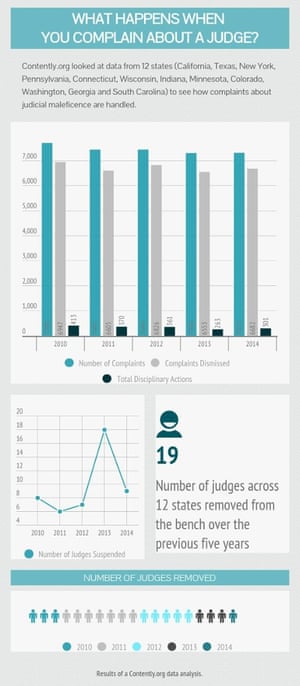
But court critics say that one reason judicial violations are common is because they frequently go unpunished. When litigants ask a judge to back away because of a conflict, they risk being told no, then face possible retaliation, so many don’t bother. If a litigant or an attorney files a complaint with an oversight body, there’s only about a 10% chance that state court authorities will properly investigate the allegation, according to a Contently.org analysis of data from 12 states.

Judges state-by-state
Photograph: Contently.org

The analysis shows that a dozen of these commissions collectively dismissed out of hand 90% of the complaints filed during the last five years, tossing 33,613 of 37,216 grievances without conducting any substantive inquiry. When they did take a look – 3,693 times between 2010 and 2014 – investigators found wrongdoing almost half the time, issuing disciplinary actions in 1,751 cases, about 47%.

The actions taken ranged from a letter of warning to censure, a formal sanction that indicates a judge is guilty of misconduct but does not merit suspension or removal.

Actually removing a judge was a rarity. Just 19 jurists in 12 states were ordered off the bench for malfeasance, which is about three per decade for each state. And even that result is becoming less common, with only one removal in 2014 and three in 2013 among all 12 states.

The states examined – California, Texas, New York, Pennsylvania, Connecticut, Wisconsin, Indiana, Minnesota, Colorado, Washington, Georgia and South Carolina – were chosen because they comprise a representative sample from different populations and areas of the country and because they had matching data for the years 2010 through 2014.

Judicial discipline at the federal level is almost non-existent. A Contently.org examination of the most recent five years of complaint data shows that 5,228 grievances were lodged against federal jurists between 2010 and 2014, including 2,561 that specifically alleged bias or conflict of interest. But only three judges were disciplined during those years and each got the mildest rebuke on the books: censure or reprimand. None was suspended or removed.

Margaret won a court order of protection barring Stuart from contact with her children for a year. But when Kent issued his final decree less than six weeks later, he awarded Stuart full custody, while Margaret was allowed only supervised visits. And he ordered Margaret to pay back half the cost of her nursing degree and to sell her diamond engagement ring and split the proceeds with Stuart. The judge also reversed the support arrangements. While Stuart would pay $1,500 a month in maintenance to Margaret, she now owed Stuart $153.90 a week for the children, even though she was earning about $13,000 a year as a part-time aide in an assisted-living facility.

Margaret began to look into her husband’s dealings and discovered, through searching public records, that he and judge Kent had possible connections. In 2010, Stuart was appointed as the Suffolk County representative on a statewide commission for vetting local judicial candidates. That same year, an organization based at Stuart Besen’s Garden City law office, the Long Island Coalition for Responsible Government, donated $7,500 to candidate Richard Ambro, who got elected and became one of Kent’s fellow Supreme Court judges in Suffolk’s 10th district. In his role as Huntington’s town lawyer, Besen argued cases before these very judges. He’d entered a circle of judicial insiders.

“I’m in the middle of a large group of people who’ve got money and influence and who are all connected,” said Margaret Besen. “I’m not being afforded an opportunity to get a fair shake.”

Margaret Besen stands in front of the former Besen family home, now unoccupied in Commack, Long Island.

Above:  Margaret Besen stands in front of the former Besen family home, now unoccupied in Commack, Long Island. Photograph: Alan Chin

Margaret had no way of knowing whether the connections she uncovered played any role in how Kent ruled in her case. But her concern deepened when she made an additional discovery about her house. Kent had ordered the Besen home, the most valuable marital asset, to be sold and the proceeds divided, putting Margaret in line to receive possibly hundreds of thousands of dollars. Then she found an online listing offering the property for sale – with the judge’s wife, Patricia Kent, as broker. The home, which was listed for $749,999 with Patricia Kent’s photo and contact information on Realty Connect USA, is currently more than $15,000 in arrears on its property taxes and no longer appears to be actively offered. Margaret was evicted from the house in 2013 and lives in a modest apartment a few miles away. She has yet to receive a penny for her interest in the property.

Scott L Cummings, a professor of legal ethics at UCLA law school, said the case raised “significant ethical red flags”, because of the judge’s wife’s alleged involvement in offering the Besen family home for sale. “Not knowing the details of how his spouse might have been assigned as broker, the idea that a judge might benefit financially from the sale of a property in dispute in a pending matter seems to raise a serious question of impartiality.”

Ronald Rotunda, a professor at Chapman University law school in Orange, California, said: “What judge Kent did here seems odd. The husband makes over a half million a year, she makes $13,000 a year, and the judge orders her to pay child support (which is tax free to him and not deductible for her).”

But a culture of judicial impunity extends far beyond Long Island’s county courts. Indeed, even the US supreme court has been tarnished on this issue.

Justice Steven Breyer owned $215,000 in health-care stocks when deciding on the legality of the Affordable Care Act in 2012. Justice Samuel Alito’s portfolio included $2,000 in stock in The Walt Disney Co. in 2008, the year the court heard Disney, FCC v. Fox Television Stations. And perhaps most famously, justice Antonin Scalia has participated in the Bush v. Gore case, even though his son Eugene’s law firm represented one of the parties. In another case, Scalia remained in the panel despite having gone on a duck hunting trip with former Vice-President Dick Cheney while he was being sued to reveal the details of secret meetings he held with oil company executives in the run-up to the 2003 invasion of Iraq.

The online vitriol directed at unscrupulous judges, which began in the mid- 2000s, has built to a howling digital crescendo. Websites including The Robe Probe, The Judiciary Report and The Robing Room, which rate judges the way Yelp rates restaurants, are rife with railing as embittered, mostly anonymous plaintiffs rip into judicial decisions they feel were biased or corrupt.

In an appeal of a case in West Virginia court, A.T. Massey Coal Co. CEO Don Blankenship spent $3m to elect Brent Benjamin, who ultimately provided the swing vote that overturned a $50m judgment against his company. Benjamin rebuffed repeated demands that the newly elected justice recuse himself because of his obvious conflict.

The US Supreme Court ruled that Benjamin’s bias was so extreme that his failure to step aside violated Caperton’s right to due process under the Constitution’s Fourteenth Amendment. The case, which spawned Grisham’s 2008 best-seller, “The Appeal,” underscored the kind of underhanded dealing that has stained the judiciary.

A further nudge for reform came last year when the Center for Public Integrity published a report on financial conflicts of interest. Among its findings: on 26 occasions in the preceding three years, federal appellate judges ruled on cases involving companies in which they owned stock or where they had a financial tie to an attorney appearing before them.

A further nudge for reform came last year when the Center for Public Integrity published a report on financial conflicts of interest. Among its findings: on 26 occasions in the preceding three years, federal appellate judges ruled on cases involving companies in which they owned stock or where they had a financial tie to an attorney appearing before them.

It also created a grading system to gauge how diligent each state was in collecting personal financial information from its judges, including stock ownership and outside sources of income, and how accessible that data was to the public. The center said that 42 states, plus the District of Columbia, failed its test. Six others earned a D grade, while two – California and Maryland – got Cs. California’s score, 77, the highest of any state, was seven points below the federal government’s grade of 84.

The report highlighted the type of conflict that can be most readily identified and that doing so requires full disclosure from the judges. Stock ownership, even if minimal, should automatically disqualify a judge from hearing a case, many experts believe. “If a judge owns a single share in a company involved in a case, he should recuse himself instantly,” says Rotunda, a leading law scholar.

It’s been more than two years since Margaret Besen has seen her children, who are now 12 and 16. There’s no money to pay the court supervisor, so they can’t visit. Nor does Besen have the funds to continue fighting. Kent retired shortly after making his decision.

“The hardest thing in my life is that I can’t be with my children and I can’t have an impact on my children’s upbringing,” Besen said over coffee at a Long Island diner. “A lot of people do not have any idea how the judicial system works or doesn’t work until you’re in it. We think we’re in a democratic society. We think we’re run by rules. But they are not being upheld by the court at all.”

This story was produced in collaboration with The Contently Foundation for Investigative Reporting.


In recent years, America’s corporations have created a private system for handling disputes that benefits them greatly while denying consumers their day in court.

Worse, according to a recent series in The Times, that system has become vast and more entrenched as companies increasingly require customers, employees, investors, patients and other consumers to agree in advance to arbitrate any disputes that arise in their dealings with a company, rather than sue in a court of law.

Such forced-arbitration clauses, found in the fine print of contracts, also typically bar aggrieved parties from pressing their claims as a group in a class action, often the only practical way for individuals to challenge corporations. In addition, corporations effectively control the arbitration process, including the selection of the arbitrator and the rules of evidence, a stacked deck if ever there was one.

As if that is not troubling enough, it is extremely difficult to avoid or get out of forced-arbitration clauses and class-action bans, particularly since they were upheld by two misguided Supreme Court decisions in 2011 and in 2013.

Photo

Richard Cordray, director of the Consumer Financial Protection Bureau, center, with colleagues at a hearing in Denver last week.CreditBrennan Linsley/Associated Press

From 2010 to 2014, corporations prevailed in four out of five cases where they asked federal judges to dismiss class-action lawsuits and compel arbitration, according to The Times’s articles. People who were blocked from going to court as a group usually dropped their claims entirely, in part because class actions are often the only affordable way to file lawsuits. If successful, they can deter future corporate wrongdoing because even small payouts, multiplied over all similarly mistreated customers, can be very large.

Indeed, faced with arbitration, it appears that most people do not pursue remedies to their grievances at all. Verizon, with more than 125 million subscribers, faced 65 consumer arbitrations between 2010 and 2014, The Times’s report found. Sprint, with more than 57 million subscribers, faced six. Time Warner Cable, with 15 million subscribers, faced seven.

Even more disturbing, the shift away from the civil justice system has gone beyond disputes about money. Nursing homes, obstetrics practices and private schools increasingly use forced-arbitration clauses to shield themselves from being taken to court over alleged discrimination, elder abuse, fraud, hate crimes, medical malpractice and wrongful death.

For the most part, Congress has looked the other way. Federal regulators, however, are starting to fight back. The Consumer Financial Protection Bureau is expected to propose a rule soon to forbid arbitration clauses that ban class actions in cases involving financial services and products. The Centers for Medicare and Medicaid Services, which is expected to issue updated nursing home regulations next year, is considering a ban on forced arbitration clauses in nursing home contracts.

Reversing the broader trend of forced arbitration, however, will require public outcry loud and long enough to stir the White House and Congress to action. Many people interviewed in The Times’s series did not realize that their right to sue had been lost until they needed it. A common refrain was the disbelief that this could happen in America. But it is happening, and it needs to stop.


North Georgia newspaper publisher jailed over open records request

North Georgia newspaper publisher jailed over open records request

July 1st, 2016 by Associated Press in Local Regional News Read Time: 4 mins.

A North Georgia newspaper publisher was indicted on a felony charge and jailed overnight last week – for filing an open-records request.

Fannin Focus publisher Mark Thomason, along with his attorney Russell Stookey, were arrested on Friday and charged with attempted identity fraud and identity fraud. Thomason was also accused of making a false statement in his records request.

Thomason’s relentless pursuit of public records relating to the local Superior Court has incensed the court’s chief judge, Brenda Weaver, who also chairs the state Judicial Qualifications Commission. Weaver took the matter to the district attorney, who obtained the indictments.

Thomason was charged June 24 with making a false statement in an open-records request in which he asked for copies of checks “cashed illegally.” Thomason and Stookey were also charged with identity fraud and attempted identity fraud because they did not get Weaver’s approval before sending subpoenas to banks where Weaver and another judge maintained accounts for office expenses. Weaver suggested that Thomason may have been trying to steal banking information on the checks.

But Thomason said he was “doing his job” when he asked for records.

“I was astounded, in disbelief that there were even any charges to be had,” said Thomason, 37, who grew up in Fannin County. “I take this as a punch at journalists across the nation that if we continue to do our jobs correctly, then we have to live in fear of being imprisoned.”

Thomason and Stookey are out on $10,000 bond and have a long list of things they cannot do or things they must do to avoid going to jail until their trials. On Thursday, for example, Thomason reported to a pretrial center and was told that he may have to submit to a random drug test – a condition of the bond on which he was released from jail last Saturday.

Alison Sosebee, district attorney in the three counties in the Appalachian Judicial Circuit, and Judge Weaver say the charges are justified. Weaver said she resented Thomason’s attacks on her character in his weekly newspaper and in conversations with her constituents.

“I don’t react well when my honesty is questioned,” Weaver said.

She said others in the community were using Thomason to get at her. “It’s clear this is a personal vendetta against me,” she said. “I don’t know how else to explain that.”

But legal experts expressed dismay at the punitive use of the Open Records Act.

“To the extent these criminal charges stem from the use of the Open Records Act undermines the entire purpose of the law,” said Hollie Manheimer, executive director of the Georgia First Amendment Foundation. “The Open Records Act is the vehicle by which citizens access governmental information Retaliation for use of the Open Records Act will inhibit every citizen from using it, and reel us back into the dark ages.”

Another expert said the charges against attorney Russell Stookey may also be unfounded. Robert Rubin, president of the Georgia Association of Criminal Defense Lawyers, said it was wrong for the grand jury to indict a lawyer who “is using the legitimate court process for a subpoena to get records relevant for his case.” The dispute grows out of a March 2015 incident involving another judge who is no longer on the bench. Judge Roger Bradley was presiding over several cases and asked the name of the next defendant. The assistant district attorney announced next up was “(Racial slur) Ray.” Bradley, who resigned earlier this year, repeated the slur and also talked about another man whose street name started with the same slur.

Thomason asked for the transcript after he was told courtroom deputies also used the slur.

But the transcript only noted that Bradley and the assistant district attorney used the word.

According to Thomason, the court reporter told him that it was “off the record” when others in the courtroom spoke the word so it would not be recorded in the transcript. He asked to listen to the audio recording, but his request was rejected.

In an article Thomason quoted the court reporter as saying the slur was not taken down each time it was used.

And then Thomason asked Stookey to file paperwork with the court to force the the stenographer, Rhonda Stubblefield, to release the recording.

Stubblefield responded with a $1.6 million counterclaim against Thomason, accusing him of defaming her in stories that said the transcript she produced may not be accurate. Two months later a visiting judge closed Thomason’s case, concluding that Thomason had not produced evidence the transcript was inaccurate.

Last April, Stubblefield dropped her counterclaim because, her lawyer wrote, it was unlikely Thomason could pay the award if she won.

The next month, however, Stubblefield filed paper work to recoup attorney’s fees even though last last year she was cut a check for almost $16,000 from then-Judge Bradley’s operating account.

“She was being accused of all this stuff. She was very distressed. She had done absolutely nothing wrong,” Weaver said of the judges’ decision to use court money to cover Stubblefield’s legal expenses. “She was tormented all these months and then had to pay attorneys’ fees. And the only reason she was sued was she was doing what the court policy was.”

Stubblefield’s lawyer, Herman Clark, said in court Stubblefield was asking for the money from Thomason or his attorney so she could replace the funds taken out of the court bank account. Clark said it was unfair to expect taxpayers to pick up the cost.

To fight Stubblefield’s claim for legal fees, Stookey filed subpoenas for copies of certain checks so he could show her attorneys had already been paid. One of those two accounts listed in a subpoena had Weaver’s name on it as well as the Appalachian Judicial Circuit.

Weaver said the identify fraud allegations came out of her concern that Thomason would use the banking information on those checks for himself.

“I have absolutely no interest in further misappropriating any government monies,” Thomason said. “My sole goal was to show that legal fees were paid from a publicly funded account.”

It Finally Dawned on Me! An Epipheny

James and I were talking the other night, about foreclosure hell.  And as we talked, we were listening to Alex Jones’ InfoWars.  It suddenly all made sense.  All of the foreclosures.  That is not what the show was talking about, at all.  It came to me suddenly, out of the blue.

Think about it.  While thinking about the foreclosures, think about all the illegal immigrants. Where the hell are they all supposed to go, where are they going to live?

Anyone that lives in a house, anywhere, every day, passes by foreclosed upon homes.  How long some of those houses been vacant.  Really now, how long?  We have houses around here that were foreclosed upon pretty early on, most of them are still vacant, and new ones being foreclosed upon every day still.

Do you get it now?  George Soros, with his shit stirring stick, funds Black Lives Matters, and who knows what else.  The banks are still gathering houses, and letting them sit.  Of course, they have lost no money, because they never funded the loans.

This has been a long time coming.  One only needs to sit back and think about it.  They now say that Detroit has been bought by Soros, for the immigrants to live there.  It all makes sense to me now.  We are being replaced by illegal immigrants.  All the people who lost their homes, and wondered why, can now know that it was a long term plan to get rid of Americans.

Just like has happened in Germany, the Germans are moving out, leaving everything for the immigrants.  The immigrants have never lived in a society like that which the Americans are used to.  They don’t want to get along with you.  They treat women like shit.  Throwing them on the ground, kicking them, kicking them in the face and stomping on their heads.  How long do you think it will be  before the same thing is happening here?

I always said the Bank with the most homes in the end wins.  Now I know what it is they have been attempting to win.  The downfall of the American people.  What better way to do it?  Reign in 100’s of thousands of illegal immigrants that hate Americans and the western way of life, brought here to destroy each and every one of us….

LEO HOHMANN: NOW WE KNOW HOW MANY ILLEGAL ALIENS REALLY IN U.S. More than 100,000 granted legal status every year

image: http://www.wnd.com/files/2016/10/immigrants-in-u.s.-1.jpg

immigrants in u.s.
A new study on immigration underscores that immigration – legal and illegal – is adding 8.3 million people to the U.S. population every four years and that some of the fastest rates of migration are coming from countries hostile to American values of freedom and democracy.

For instance, the sending country with the largest percentage increase in immigrants living in the U.S. during the four years from 2010 to 2014 was Saudi Arabia, with a 93 percent increase, followed by Bangladesh at 37 percent and Iraq at 36 percent.

image: http://www.wnd.com/files/2016/10/legals-illegals-in-pie-chart.jpg
legals illegals in pie chartAbout one-fourth of the 42.4 million foreign-born people living in the United States are illegal immigrants – this amounts to roughly 10.5 million, according to the study by Center for Immigration Studies.While many immigration hawks might dispute that number and say it’s actually much higher, the facts don’t bear it out, says Steven Camarota, director of research for CIS and co-author of the report with demographer Karen Zeigler.

“You can easily have a situation where 400,000 new people settle in the U.S. every year by overstaying their visas or sneaking across the border and that doesn’t mean you’re adding to the overall illegal immigrant population,” Camarota told WND.

Read the entire study and view all the charts at CIS.com.

Obama in November 2014 issued a series of executive orders that granted amnesty to about 5 million illegals, or nearly half of the estimated 10.5 million to 11 million now in the country. The federal courts have thus far blocked his actions as unconstitutional, and the Supreme Court, which deadlocked on the issue previously, ruled Monday that it will not re-hear the case.

Meanwhile, illegal-alien crime sprees continue to rock the country, including a series of M-13 gang-related killings on Long Island. The most recent case involved the murder of two teenage girls.

On Sept. 13, Nisa Mickens, 15, and her best friend, Kayla Cuevas, 16, were murdered, their battered bodies found near an elementary school in Brentwood on the island, the New York Times reports.

A week later and just two miles away, the remains of two more teenagers – Oscar Acosta, 19, and Miguel Garcia-Moran, 15 – were discovered in the woods near a hospital.

For nearly two decades, MS-13, an El Salvadoran gang, has been “terrorizing” the town, especially its young people, according to the Times report. Since 2009, its members have been accused of at least 14 murders.

So the problems of illegal immigration are not to be downplayed. But the problems of legal immigration are many times greater, according to the CIS study, which analyzed Census data.

“You could have half-a-million every year come illegally, and in that same year some go home, every year some will die, and some who were illegal become legal,” Camarota said.

He said there are more than 100,000 illegals given legal status every year.

“They marry an American, they find employment with a company that gives them a visa, they win the visa lottery, or they get a ‘cancellation of removal’ order from a judge that essentially gives them asylum status,” he said.

Ann Coulter’s back, and she’s never been better than in “Adios, America!: The Left’s Plan to Turn our Country into a Third World Hellhole.”

“Some get deported, and some go home voluntarily every year on their own. We can calculate death rates by age, and that’s why the overall illegal population can be stable even if 400,000 come in every year,” he added.

“You also have to remember that there are no illegal-immigrant births in the United States, because everybody born here is automatically a U.S. citizen,” Camarota added. “Now you can bemoan that and say it’s wrong, but for these purposes we can’t add them into the illegal population. We can only add those coming from abroad.”

Legal immigration has roughly four times the impact of illegal immigration, Camarota says.

“So the bottom line is, illegal immigration is dwarfed by legal immigration. The impact on our schools and on our welfare system is much bigger, and also the political impact.”

When states do apportionment and redistricting, they draw the lines for seats in Congress and state legislatures based on total population, regardless of immigration status.

“There are at least three legal immigrants for every illegal immigrant,” Camarota said. “And while the illegals do vote fraudulently, sometimes it’s the legal immigrants who vote in much larger numbers and have the big political impact on our system.”

Legal immigrants are also more dangerous in terms of their propensity to commit acts of Islamic terrorism, a lesson that should have been learned from the 9/11 attacks in which the hijackers were here largely on student and tourist visas.

Refugees connected to acts of terror

More recently, the stabbing attacks on a St. Could, Minnesota, mall that injured 10 and the pipe bombings in New York city that injured 29 were carried out by refugees, meaning they were legal immigrants. The Chattanooga shooting of five U.S. servicemen and the mass shooting in San Bernardino in 2015, as well as the attack on an Orlando gay nightclub in June 2016, were all carried out by second-generation Americans born to Muslims who legally migrated to the U.S.

The study also found some surprising facts on jobs.

“There really are no jobs Americans won’t do,” Camarota said. “Pretty much every job category is at least half American, even farms, because there are still a lot of family farms.”

In the area of entrepreneurship, Camarota found that immigrants do start businesses, but overall their rates of employment versus self-employment are about the same as native-born Americans. “So entrepreneurship is not lacking among immigrants but nor is it a distinguishing characteristic.”

Promoters of refugee resettlement use ‘stupid’ arguments not supported by data

This refutes one of the main arguments used by mayors trying to promote refugee resettlement and mass immigration in their cities.

“The way in which refugee resettlement gets sold sometimes is so stupid,” Camarota said. “We could all say that the idea that they are fleeing for their life is probably not true in most cases, but the idea is that they are in desperate circumstances and we’re taking them as a humanitarian gesture. But we know from lots of data that refugees use welfare in large amounts and for very long periods of time. We know that about this population, so it’s reasonable for them to struggle financially.

“Resettlement, if we’re going to do it, should be done as part of an honest discussion. We have the data on this, but we don’t [have an honest discussion].”

Welfare usage rates extremely high

Rates of welfare usage are not only high among refugees but also among immigrants from Latin America.

“Sixty percent of families from Mexico use at least one welfare program,” Camarota said. “Roughly half the Mexicans in the U.S. are illegal. But more importantly, what you see here if you pull out the illegals from Mexico and Latin America and you see that they sign their kids up for lots of programs. And those kids were born here, many of them. Even if they were not born here and are illegal, they can get free school, WIC and Medicaid. A pregnant woman can get Medicaid too if she is illegal.”

This is something that was not a problem during earlier waves of immigration in the 1880s, 1920s and 1950s. Immigrants were required to be self-supporting.

“Lots of immigrants come to America now and can’t support their own kids,” Camarota said. “They have to turn to the taxpayer. That’s the question to ask. Depends how you feel about that.”

image: http://www.wnd.com/files/2016/10/welfare-usage-among-various-immigrant-categories.jpg

welfare usage among various immigrant categories

Copyright 2016 WND

Read more at http://www.wnd.com/2016/10/now-we-know-how-many-illegal-aliens-really-in-u-s/#AiCxWYKTVYZVBtSz.99

CBD chaos: DEA’s refusal to reschedule marijuana molecules just the latest protectionist racket from the criminal corporate cartels running the corrupt U.S. government

CBD

(NaturalNews) Obama’s war on humanity just took another great leap toward totalitarian despotism with last week’s DEA decision to deny petitions seeking to reclassify medical marijuana as a non-schedule I drug. This decision means that any person possessing natural CBD (cannabidiol) compounds derived from hemp leaves, including CBG, CBN, CBD-A and other similar molecules from cannabis, can technically be charged with felony possession of a schedule I drug.

The CBD industry vehemently disagrees with the DEA’s current stance on both CBD and medical marijuana, and so far the DEA’s efforts have focused on CBD manufacturers, not end users who possess the natural substance. CBD is also reportedly exempt from the DEA’s criminalization scope if it is derived from hemp seeds or mature stalks rather than leaves. This is a key point to understand, as you’ll see here.

It’s also key to understand that the DEA’s assertion that CBD is a Schedule I Controlled Substance has already been successfully challenged at least once. Via New Cannabis Ventures:

[T]he DEA has taken the position that CBD is a Schedule I Controlled Substance as defined under the CSA. Without an express provision under the CSA, it is questionable whether the DEA has any sort of authority to take this position. But more importantly, in the case of Hemp Indus. Ass’n v. DEA, 333 F.3d 1082 (9th Cir. 2003), the DEA attempted to initiate rules and interpretations concerning certain cannabinoid constituents of marijuana that were not expressly set forth under the CSA or the DEA’s own regulations (at the time), and the Ninth Circuit Federal Court of Appeals struck down its efforts, stating that: “[t]he petition requesting that we declare the rule to be invalid and unenforceable is GRANTED.” Hemp Indus. Ass’n v. DEA, 333 F.3d 1082 (9th Cir. 2003). In short, an agency – such as the DEA – is not permitted to change a legislative rule retroactively through the process of disingenuous interpretation of the rule to mean something other than its original meaning.

This does not mean, however, that the DEA won’t assert imagined authority to attempt to criminalize makers of CBD products which are derived from cannabis.

Regulatory lunacy: Is the DEA smoking crack?

The DEA’s decision to maintain the Schedule I listing of medical marijuana (and its constituents) is rooted in a combination of sheer scientific lunacy and a totalitarian police state Obama regime that doesn’t want people to have access to natural medicinal substances which work better than Big Pharma’s toxic drugs.

The logic used to justify the denial of the petitions is just mind boggling. If you care to wade through the ridiculous, contorted reasoning of the criminal government cartel that’s protecting Big Pharma’s interests, click here for the federal register reply.

It states, among other absurd reasons, that medical marijuana cannot be accepted as therapeutic because:

• It has no therapeutic use whatsoever. (A ridiculous lie.)

• Its chemical constituents are never quite the same. (Because it’s from a plant, not a synthetic chemical factory.)

• All the “experts” don’t accept it as a useful drug… because all the “experts” are Big Pharma whores, of course. By definition, the FDA only considers people to be “experts” when they are owned by Big Pharma. From the federal register document: “The HHS indicated that medical practitioners who are not experts in evaluating drugs cannot be considered qualified experts…” In other words, all holistic medicine experts and naturopathic doctors are disqualified from rendering expert opinions on medical cannabis.

• All the clinical evidence of marijuana’s efficacy doesn’t count, according to HHS and the FDA, because they don’t like the way the studies were structured. From the federal register document, “FDA and HHS concluded that these studies do not ‘currently prove efficacy of marijuana’ for any therapeutic indication due to limitations in the study designs.” This dismissal of studies is how the FDA rigs everything. It simply rejects all the science it doesn’t like by claiming the studies are flawed.

• State laws that validate medical marijuana’s efficacy in treating many health conditions are all rejected by the corrupt federal government cartel which claims: “HHS pointed out that state-level ‘medical marijuana; laws do not provide evidence of such a consensus among qualified experts. ”

• Cannabis can’t even be studied for any effectiveness in treating disease, according to government. “The HHS concluded that the currently available data and information on marijuana is not sufficient to allow scientific scrutiny of the chemistry, pharmacology, toxicology, and effectiveness.”

In other words, THE GAME IS RIGGED!

It’s all a racket to protect Big Pharma’s financial interests

As is now obvious to everyone, the federal government is a criminal cartel. It’s run by criminals, enforced at gunpoint and structured to protect the interests of Big Business while crushing liberty, knowledge and freedom of the People. (As a bonus, Obama also deliberately incites race wars across America’s inner cities to spark chaos and hatred that’s exploited by opportunistic politicians.)

Marijuana poses an enormous threat to Big Pharma precisely because it is therapeutic against so many health conditions. Not only can medical marijuana help treat certain symptoms related to cancer, but its extracts such as CBD are extremely useful for treating epilepsy, seizures and various neurological disorders. The evidence is not only clear on this point, it is overwhelming!

Yet the DEA continues to ridiculously define CBD as a Schedule I Controlled Substance, even though CBD has no psychoactive components and cannot be “abused” like recreational drugs. The DEA’s refusal to reschedule CBD to a non-controlled substance is nothing short of a quack science racket to protect a criminal cartel that’s run by the government itself.

The DEA, in other words, is the gunpoint enforcement branch of Big Pharma.

What’s the solution? Congress needs to act. “The perhaps-legitimate confusion and concern expressed by these federal and state agencies about CBD can largely be cured by an act of Congress,” writes New Cannabis Ventures. “And the solution is the Industrial Hemp Farming Act of 2015, which amends the CSA to exclude industrial hemp from the definition of ‘marihuana.'” (http://www.congress.gov/bill/114th-congress/senate-bill/134)

Catch-22: It’s all rigged against natural medicine to deprive the People of affordable, safe remedies

The DEA’s current statement that “Marijuana has no currently accepted medical use in treatment in the United States” is a deliberate catch-22. The kicker here is the “currently accepted” qualifier on the claim. Accepted by whom? By the government itself, of course, which automatically disqualifies all evidence of the therapeutic benefits of medical marijuana (and its constituents) precisely because the so-called “experts” are all Big Pharma monopolists.

Under this government regime, there will never be any accepted therapeutic use of medical marijuana because the gatekeepers who decide on such matters are all on the payroll of the drug companies. Like everything else in government today, the racket to deny access to medical marijuana is nothing but a monopolistic criminal cartel that enforces its pharma monopolies at gunpoint, threatening, arresting and incarcerating anyone who attempts to bring natural medicine to the world.

CBD oil manufacturer raided at gunpoint in California

As a striking example of the kind of medical tyranny now being brought upon those who try to sell therapeutic CBD oil, the DEA conducted armed raids on a California CBD manufacturer in June. Via MedicalJane.com:

While federal agents from the Drug Enforcement Administration looked on, police officers in Santa Rosa, California coordinated raids on a half-dozen properties associated with a local cannabis oil producer on Wednesday morning, prompting an immediate outcry from the cannabis community statewide…

One of the organization’s founding patient members was arrested and charged with felony for manufacturing a controlled substance by chemical extraction (a law created for meth labs); and is being held on a $5-million-dollar bond in Sonoma County jail.

Absurd restrictions on CBDs make it clear the federal government is a criminal cartel at WAR with the American people

The obvious upshot of all this is that the DEA, FDA and HHS are all branches of a massive criminal cartel that has occupied the federal government at the highest levels. This criminal cartel protects the monopolies of corporate giants who bribe lawmakers and politicians on a routine basis. And now, one of the worst criminals in U.S. history is being heavily promoted by democrats to attain the White House: Hillary Clinton. If you believe in decriminalizing medical marijuana, don’t vote for Clinton! She’s the most treasonous criminal corporate sellout ever to seek the office of the presidency.

In order to maintain this criminal racket, every branch of government criminalizes natural medicine in order to incarcerate those who attempt to commercialize and distribute it. The bigger goal in all this is to keep people sick, financially destitute and dependent on a failed health care system that generates hundreds of billions of dollars each year for pharmaceutical interests while destroying liberty, natural medicine and public health.

Plus, the cancer industry is a multi-billion-dollar medical scam that would be economically gutted if medical marijuana were widely available for cancer patients.

Ponder that last statement for a minute and realize that in order to protect the financial interests of Big Pharma, this corrupt government regime known as the Obama administration (and the Bush regime before that) is willing to criminalize natural medicine, imprison medical marijuana manufacturers and deprive millions of Americans access to real, therapeutic relief from serious medical conditions and symptoms. This is all being deliberately done to protect the profits of the pharmaceutical drug cartels that function as medical monopolies thanks to FDA gunpoint enforcement.

All you people who are “anti-gun” should seriously rethink your position, by the way. If anybody needs to be stripped of the right to own guns, it’s government regulators. Yet gun control laws seek to concentrate all guns in the hands of the government… the very group now using guns to intimidate and terrorize natural medicine producers across America. The whole point of so-called “gun control” is to disarm the public and grant the government a firearms monopoly, after which absolute tyranny would immediately ensue.

You are living in a medical police state, dear readers. And the federal government as it operates today is absolutely no different from a Mexican drug cartel… complete with all the medical kidnappings, gunpoint enforcement, imprisoning of political enemies and all the rest. Wake up and smell the bulls–t being fed to you by Barack Obama, Hillary Clinton and CNN.

Do you really think they would criminalize marijuana if it were no threat at all to the profits of Big Pharma?

This entire war on hemp emerges from the fact that medical marijuana is so powerful and effective that is poses a very real threat to the long-term profits of the pharmaceutical industry.

If marijuana didn’t work — as HHS and DEA ridiculously claim — it would be no threat at all, and there would be no concerted effort to block its commercialization and legalization.

The very fact that the feds are pushing so hard to criminalize this substance is all the proof you need that IT REALLY WORKS.

Remember: The federal government lies about everything. Unemployment statistics are a lie. Campaign promises are a lie. The fiat currency money supply is a lie. Obama’s ransom payment to Iran is being covered up with lies. The FDA’s “approval” of pharmaceuticals is all based on medical lies and scientific quackery. The CDC’s vaccine “science” is a lie. The EPA’s climate change narrative is a massive lie. There isn’t anything the federal government says that isn’t either an outright lie or a deception of some sort.

The only way to counter all this is to end the federal government regime that now imprisons us all and denies us the freedom to access natural medicine. Our best shot at this right now is to elect Donald Trump and hope they don’t execute him before he can gut the regime. (He’s gonna need our help, however. Get ready, “Second Amendment people” as Trump jokes…) In the long run, however, the only real pathway to freedom for humanity is going to be the global collapse of criminal government cartels, to be replaced by some other system altogether.

“As it stands, the only hope for a less restrictive national marijuana policy is for the DEA and FDA to come to terms on whether cannabis is medicine or for Congressional leaders and the President of the United States to stop pussyfooting around and pass legislation that liberates the leaf once and for all,” reports High Times.

Sources for this article include:
http://hightimes.com/news/laws/dea-denies-pe…
http://www.federalregister.gov/articles/2016…
http://www.medicaljane.com/2016/06/15/breaki…
http://www.dea.gov/druginfo/ds.shtml

OPINION: The heightened pleading standard established in 2009 is based on faulty propositions. Arthur H. Bryant, The National Law Journal


National Law Journal
http://www.nationallawjournal.com/printerfriendly/id=1202758245088

‘Iqbal’ Brings Seven Years of Bad Luck for Plaintiffs

OPINION: The heightened pleading standard established in 2009 is based on faulty propositions.
Arthur H. Bryant, The National Law Journal
May 23, 2016

The seventh anniversary of the U.S. Supreme Court’s 2009 decision in Ashcroft v. Iqbal was May 18. It’s a date that should live in infamy.
A 5-4 decision, Iqbal ignored reality — and the fact that truth is stranger than fiction. It flouted the process for amending the Federal Rules of Civil Procedure. And it particularly limited access to justice for civil rights, employment discrimination and individual plaintiffs.
Seventy years before Iqbal, in 1938, the Federal Rules were adopted to get rid of “fact” pleading, which the rule-makers thought “led to wasteful disputes about distinctions that … were arbitrary or metaphysical, too often cutting off adjudication on the merits.” Under the new Rule 8, to start a lawsuit, the plaintiff had to file a complaint with “a short and plain statement of the claim showing the pleader is entitled to relief.”
As the court later explained in Conley v. Gibson, the complaint did not have to “set out the facts in detail.” It just had to give the defendant “fair notice of what the plaintiff’s claim is and the grounds upon which it rests.” A motion to dismiss would only be granted if “it appears beyond doubt that the plaintiff can prove no set of facts in support of his claim which would entitle him to relief.” Then, the plaintiff could take discovery, to find out what the defendant and other relevant people knew and when they knew it. After that, the court would determine whether there was sufficient proof to require a trial.
In Iqbal, the court rejected a complaint alleging that high-level U.S. officials had a Pakistani Muslim and thousands of other Arab men illegally arrested and detained after the 9/11 attacks because of “their race, religion, and national origin … and not because of any evidence” of their “involvement in supporting terrorist activity.”
To do so, the court changed the rules. It held that, from now on, to “survive a motion to dismiss, a complaint must contain sufficient factual matter, accepted as true, to state a claim to relief that is plausible on its face.” Dismissal no longer turned on whether the complaint provided “fair notice” to the defendant; it turned on whether the claim was “plausible on its face.” How were judges to determine that? By drawing on their “judicial experience and common sense.”
Motions to dismiss were immediately filed throughout the federal courts. Judges’ and lawyers’ workloads increased enormously. The lower courts and lawyers are still struggling to figure out how the new system is supposed to work — and, if they can, make it fair.
For three reasons, however, it’s become increasingly clear that Iqbal was a mistake.
First, whatever one thinks about the allegations in the case, the Iqbal pleading standard is based on a proposition — allegations probably aren’t true if they’re not plausible on their face — that is false. Reality keeps teaching us that. None of us, including federal judges using their “judicial experience and common sense,” would have believed that any of the following was plausible a few years ago:
• Donald Trump would be the presumptive Republican Party nominee for president of the United States of America.
• A prominent candidate for president would propose banning all Muslims from entering America or call women “fat pigs,” “dogs” and “disgusting animals.”
• Same-sex marriage would be legal nationwide.
• The U.S. government would obtain and be able to search virtually all Ameri­cans’ phone records.
• Olympic champion Bruce Jenner would become a woman, Caitlyn Jenner.
• Federal, state and local governments would battle over what kind of bathroom people such as Caitlyn Jenner could use.
Similar implausible things happen every day.
Second, Iqbal effectively rewrote the Federal Rules without following the legally established rules for amending them. Under the Rules Enabling Act, before rules are changed, detailed procedures must be followed involving the Advisory Committees to the U.S. Judicial Con­ference’s Standing Committee on Rules of Practice and Procedure; the Standing Committee itself; notice to and comment from lawyers, judges and the public; the U.S. Judicial Conference; the Supreme Court; and Congress — so the changes are fully considered and fair.
In 2002, the court unanimously rejected a company’s plea for a heightened pleading standard in employment discrimination cases, saying that result “must be obtained by the process of amending the Federal Rules, and not judicial interpretation.” It should have said that in Iqbal, too.
Third, Iqbal is especially harmful to civil rights, employment discrimination and individual plaintiffs. Last year, the most comprehensive study of Iqbal’s effects, “Measuring the Impact of Plausi­bility Pleading,” was published in the Virginia Law Review. It found that Iqbal increased dismissals of most cases by 10 percent, but employment discrimination and civil rights cases much more (16 percent and 19 percent, respectively). Cases filed by individuals were also dismissed far more often (18 percent), but not cases filed by corporations.
In theory, this could mean that only bad cases were dismissed more promptly. But, if that were true, a higher percentage of the cases remaining in court would succeed. They didn’t. These plaintiffs were just disproportionately denied a chance to prove their claims.
The high court should reverse the Iqbal decision. Whether cases proceed should turn on the facts and the law, not on whether judges think the allegations are plausible.
Arthur H. Bryant is the chairman of Public Justice, a national public interest law firm dedicated to advancing and preserving access to justice. His practice focuses on consumers’ rights, workers’ rights, civil rights, environmental protection, and corporate and government accountability.

Judicial Corruption at its Finest

Reprimanded judge says presiding over his own divorce case for several months ‘made no difference’


Reprimanded last month for presiding over his own divorce case for four months after it was randomly assigned to his own court, a Texas judge told a local newspaper that doing so did no harm.

“This was my personal divorce,” said 383rd District Judge Mike Herrera to the El Paso Times on Tuesday, explaining that there was “no rush” to transfer the case to another judge because he and his wife were trying at the time to work things out.

Hence, “the fact that it was in this court made no difference. It stayed there,” Herrera said of the divorce case. “I wasn’t actively doing anything. Me and my former spouse were working on everything. She and I were working on everything carefully.”

The Texas Commission on Judicial Conduct noted that Herrera had filed motions in the case while it was in his own court. The commission said that the judge “failed to comply with the law, demonstrated a lack of professional competence in the law, and engaged in willful and persistent conduct that was clearly inconsistent with the proper performance of his judicial duties,” the newspaper reports.

In addition to reprimanding Herrera, the commission ordered him to get six hours of training.

2016 STATE OF THE JUDICIARY ADDRESS THE HONORABLE CHIEF JUSTICE HUGH P. THOMPSON SUPREME COURT OF GEORGIA January 27, 2016, 11 a.m. House Chambers, State Capitol

016 STATE OF THE JUDICIARY ADDRESS
THE HONORABLE CHIEF JUSTICE HUGH P. THOMPSON
SUPREME COURT OF GEORGIA
January 27, 2016, 11 a.m.
House Chambers, State Capitol

Lt. Governor Cagle, Speaker Ralston, President Pro Tem Shafer, Speaker Pro Tem Jones, members of the General Assembly, my fellow judges and my fellow Georgians:
Good morning. Thank you for this annual tradition of inviting the Chief Justice to report on the State of Georgia’s Judiciary. Thanks in large part to your support and the support of our governor, as we move into 2016, I am pleased to tell you that your judicial branch of government is not only steady and secure, it is dynamic; it has momentum; and it is moving forward into the 21st century with a vitality and a commitment to meeting the inevitable changes before us.
Our mission remains the same: To protect individual rights and liberties, to uphold and interpret the rule of law, and to provide a forum for the peaceful resolution of disputes that is fair, impartial, and accessible to all.
Our judges are committed to these principles. Each day, throughout this state, they put on their black robes; they take their seat on the courtroom bench; and they work tirelessly to ensure that all citizens who come before them get justice.


Our Judicial Council is the policy-making body of the state’s judicial branch. It is made up of competent, committed leaders elected by their fellow judges and representing all classes of court. They are assisted by an Administrative Office of the Courts, which is under a new director – Cynthia Clanton – and has a renewed focus as an agency that serves judges and courts throughout Georgia.
A number of our judges have made the trip to be here today. Our judges are here today because the relationship we have with you is important. We share with you the same goal of serving the citizens of this great state. We could not do our work without your help and that of our governor.
On behalf of all of the judges, let me say we are extremely grateful to you members of the General Assembly for your judicial compensation appropriation last year.


Today I want to talk to you about Georgia’s 21st century courts – our vision for the future, the road we must travel to get there, and the accomplishments we have already achieved.
It has been said that, “Change is the law of life. And those who look only to the past or present are certain to miss the future.”
Since a new state Constitution took effect in 1983, our population has nearly doubled to a little over 10 million, making us the 8th most populous state in the country. We are among the fastest growing states in the nation, and in less than four years, our population is projected to exceed 12 million.
Because it is good for our economy, we welcome that growth. Today, Georgia ranks
among states with the highest number of Fortune 500 companies, 20 of which have their global headquarters here; we have 72 four-year colleges and universities; we have the world’s busiest airport and we have two deep-water ports. Georgia is a gateway to the South, and for a growing number of people and businesses from around the world, it is a gateway to this country.
All of this growth produces litigation – increasingly complex litigation – and just as our state must prepare for this growth by ensuring we have enough roads and modes of transportation, enough doctors and hospitals, and enough power to reach people throughout the state, our courts also must be equipped and modernized for the 21st
century.
While our population has nearly doubled since 1983, the number of Georgia judges has
grown only 16 percent. We must work together to ensure that our judicial system has enough judges, staff and resources in the 21st century to fulfill the mission and constitutional duties our forefathers assigned to us.
A healthy, vibrant judiciary is absolutely critical to the economic development of our state. Thanks to many leaders in the judiciary, as well as to our partnership with the governor and to you in the legislature, we are well on our way to building a court system for the 21st century.


This time next year, with your support, we will have put into place an historic shift in the types of cases handled by the Georgia Supreme Court – the highest court in the state – and by the Court of Appeals – our intermediate appellate court. Thanks to Governor Deal’s Georgia Appellate Jurisdiction Review Commission, this realignment will bring the Supreme Court of Georgia in line with other state Supreme Courts, which handle only the most critical cases that potentially change the law. Serving on the Commission are two of my colleagues – Justice David Nahmias and Justice Keith Blackwell – as well as two judges from the Court of Appeals – Chief
Judge Sara Doyle and Judge Stephen Dillard.
I thank you, Justices and Judges, for your leadership.
Under the Georgia Constitution, Supreme Court justices collectively decide every case that comes before us. Currently the state’s highest court hears divorce and alimony cases; we hear cases involving wills; we hear cases involving titles to land; and we hear disputes over boundary lines.
But the Governor’s Commission, and a number of reports by other commissions and
committees issued since 1983, have recommended that such cases should be heard by our intermediate appeals court, not by our highest court.
Both of our courts are among the busiest in the nation. But unlike the Supreme Court, which sits as a full court with all seven justices participating in, and deciding, every case, the Court of Appeals sits in panels of three. With your approval last year of three new Court of Appeals judges, that court will now have five panels, so it will have the capacity to consider five times as many cases as the Supreme Court.
Modernization of the Supreme Court makes sense. In a 19th century court system, when
most of the wealth was tied up in land, maybe title to land cases were the most important. Maybe they had the greatest implications for the public at large. But as we move into the 21st century, that is no longer true.
In answer to questions such as who owns a strip of land, what does a will mean, and who should prevail in a divorce settlement or an alimony dispute, most judicial systems believe that three judges are enough to provide the parties with a full and fair consideration of their appeal. It no longer makes sense to have seven – or nine – justices collectively review these types of cases.
There is no doubt these cases will be in good hands with the Court of Appeals.
Let me emphasize that all these cases the Commission recommended shifting to the Court of Appeals are critically important to the parties involved.
Let me also emphasize that the purpose of this historic change is not to lessen the burden on the Supreme Court. Rather, the intent is to free up the state’s highest court to devote more time and energy to the most complex and the most difficult cases that have the greatest implications for the law and society at large.
We will therefore retain jurisdiction of constitutional challenges to the laws you enact, questions from the federal courts seeking authoritative rulings on Georgia law, election contests, murder and death penalty cases, and cases in which the Court of Appeals judges are equally divided.
Significantly, we want to be able to accept more of what we call “certiorari” cases
which are appeals of decisions by the Court of Appeals. The number of petitions filed in this category during the first quarter of the new docket year is nearly 14 percent higher this year over last. Yet due to the amount of appeals the law now requires us to take, we have had to reject the majority of the petitions for certiorari that we receive.
These cases are often the most complex – and the most consequential. They involve
issues of great importance to the legal system and the State as a whole. Or they involve an area of law that has become inconsistent and needs clarification.
Businesses and citizens need to know what the law allows them to do and what it does
not allow them to do. It is our job at the highest court to reduce any uncertainty and bring consistency and clarity to the law.
Under the Commission’s recommendations, our 21st century Georgia Supreme Court will
be able to accept more of these important appeals.


As we move into the 21st century, plans are being discussed to build the first state Judicial Building in Georgia’s history that will be dedicated solely to the judiciary. We are grateful for the Governor’s leadership on this. The building that now houses the state’s highest court and the Court of Appeals was built in 1954 when Herman Tallmadge was governor. Back then, it made sense to combine the state judicial branch with part of the executive branch, by locating the Law Department in the same building.
But the world has changed since 1954, and the building we now occupy was not designed with visitors in mind. It was not designed with technology in mind. And it surely was not designed with security in mind. Indeed, it was designed to interconnect with neighboring buildings that housed other branches of government.
A proper Judicial Building is about more than bricks and mortar. Outside, this building will symbolize for generations to come the place where people will go to get final resolution of civil wrongs and injustices; where the government will go to safeguard its prosecution of criminals; and where defendants will go to appeal convictions and sentences to prison for life.
Inside such a building, the courtroom will reinforce the reality that what goes on here is serious and solemn; it is a place of great purpose, in the words of a federal judge. The parties and the lawyers will understand they are all on equal footing, because they are equal under the law.
There is a majesty about the law that gets played out in the courtroom. It is a hallowed place because it is where the truth must be told and where justice is born. The courtroom represents our democracy at its very best.
No, this building is not just about bricks and mortar. Rather it is a place that will house Georgia’s highest court where fairness, impartiality, and justice will reign for future generations.


We are no longer living in a 1950s Georgia. The courts of the 21st century must be
equipped to handle an increasingly diverse population. Living today in metropolitan Atlanta alone are more than 700,000 people who were born outside the United States. According to the Chamber of Commerce, today some 70 countries have a presence in Atlanta, in the form of a consulate or trade office. We must be ready to help resolve the disputes of international businesses that are increasingly locating in our state and capital. Our 21st century courts must be open, transparent and accessible to all. Our citizens’ confidence in their judicial system depends on it. We must be armed with qualified, certified interpreters, promote arbitration as an alternative to costly, courtroom-bound litigation, ensure that all those who cannot afford lawyers have an avenue toward justice, and be constantly updating technology with the aim of improving our courts’ efficiency while saving literally millions of dollars. For all of this, we need your help.


When I first became a judge, we had no email, no cell phones, no Internet. People didn’t Twitter or text, or post things on YouTube, Facebook or Instagram. The most modern equipment we had was a mimeograph machine.
This past year, by Supreme Court order, we created for the first time a governance
structure to bring our use of technology into the 21st century. Chaired by my colleague Justice Harold Melton, and co-chaired by Douglas County Superior Court Judge David Emerson, this permanent Judicial Council Standing Committee on Technology will lead the judicial branch by providing guidance and oversight of its technology initiatives.
Our courts on their own are rapidly moving away from paper documents into the digital age. At the Supreme Court, lawyers must now electronically file all cases. This past year, we successfully launched the next phase by working with trial courts to begin transmitting their entire court record to us electronically. The Court of Appeals also now requires the e-filing of applications to appeal, and this year, will join the Supreme Court in accepting electronic trial records.

Our goal is to develop a uniform statewide electronic filing and retrieval system so that lawyers and others throughout the judiciary can file and access data the easiest way possible.
Using a single portal, attorneys will be able to file documents with trial courts and appellate courts – and retrieve them from any court in the state. This is the system advocated by our partner, President Bob Kaufman of the State Bar of Georgia, and by attorneys throughout the state.
Such a system will not only make our courts more efficient at huge savings, but it will make Georgia safer. When our trial judges conduct bond hearings, for example, they often lack critical information about the person before them. They usually have reports about any former convictions, but they may not have information about cases pending against the defendant in other courts. The technology exists now to ensure that they do.
Also on the horizon is the expanded use of videoconferencing – another electronic
improvement that will save money and protect citizens’ lives. After a conviction and sentence to prison, post-trial hearings require courts to send security teams to pick up the prisoner and bring him to court. Without encroaching on the constitutional right of confrontation, we could videoconference the inmate’s testimony from his prison cell. Again, the technology already exists.
Our Committee on Technology will be at the forefront of guiding our courts into the 21st century.


As Georgia grows, it grows more diverse.
Our Georgia courts are required by the federal government to provide language services free of charge to litigants and witnesses, not only in criminal cases but in civil cases as well.
Even for fluent English speakers, the judicial system can be confusing and unwelcoming.
My vision for Georgia’s judiciary in the 21st century is that every court, in every city and every county in Georgia, will have the capacity of serving all litigants, speaking any language, regardless of national origin, from the moment they enter the courthouse until the moment they leave. That means that on court websites, signs and forms will be available in multiple languages, that all court staff will have the tools they need to assist any customers, and that court proceedings will have instant access to the interpreters of the languages they need.
Chief Magistrate Kristina Blum of the Gwinnett County Magistrate Court has been
working hard to ensure access to justice for all those who come to her court, most of whom are representing themselves.
Recently her court created brochures that provide guidance for civil trials, family
violence matters, warrant applications, garnishments, and landlord-tenant disputes. These brochures provide basic information about each proceeding – what to expect and how best to present their case in court.
Judge Blum, who is in line to be president of the Council of Magistrate Judges and is a member of our Judicial Council, has had the brochures translated into Spanish, Korean and Vietnamese. Such non-legalese forms and tutorial videos that our citizens can understand go a long way toward building trust in the judicial system, and in our entire government.
The Supreme Court Commission on Interpreters, chaired by Justice Keith Blackwell, is
making significant strides in ensuring that our courts uphold the standards of due process. With the help of Commission member Jana Edmondson-Cooper, an energetic attorney with the Georgia Legal Services Program, the Commission is working around the state to educate judges,court administrators and lawyers on the judiciary’s responsibilities in providing language assistance.
The essence of due process is the opportunity to be heard. Our justice system is the envy of other countries because it is open and fair to everyone seeking justice. By helping those who have not yet mastered English, we reinforce the message that the doors to the best justice system in the world are open to everyone.
Our law demands it. Our Constitution demands it.


The courts of the 21st century will symbolize a new era. A turning point in our history occurred when we realized there was a smarter way to handle criminals.
Six years ago, my colleague and then Chief Justice Carol Hunstein accompanied
Representative Wendell Willard to Alabama to explore how that state was reforming its criminal justice system. Back in Georgia, Governor Deal seized the reins, brought together the three branches of government, and through extraordinary leadership, has made criminal justice reform a reality. Georgia is now a model for the nation.
Today, following an explosive growth in our prison population that doubled between
1990 and 2011 and caused corrections costs to top one billion dollars a year, last year our prison population was the lowest it has been in 10 years. Our recidivism rate is the lowest it’s been in three decades. And we have turned back the tide of rising costs.
For the last five years, the Georgia Council on Criminal Justice Reform – created by the governor and your legislation – has been busy transforming our criminal justice system into one that does a better job of protecting public safety while holding non-violent offenders accountable and saving millions in taxpayer dollars. I am extremely grateful to this Council and commend the steady leadership of co-chairs Judge Michael Boggs of the Court of Appeals and Thomas Worthy of the State Bar of Georgia.
Throughout this historic reform, Georgia’s trial court judges have been in the trenches.
Our number one goal in criminal justice reform is to better protect the safety of our citizens.
Central to that goal is the development of our specialty courts – what some call accountability courts.
These courts have a proven track record of reducing recidivism rates and keeping our
citizens safe. Nationwide, 75 percent of drug court graduates remain free of arrest two years after completing the program, and the most conservative analyses show that drug courts reduce crime as much as 45 percent more than other sentencing options. Last year, these courts helped save Georgia more than $51 million in prison costs.
From the beginning, you in the legislature have steadfastly supported the growth in these courts, most recently appropriating more than $19 million for the current fiscal year.
Georgia now has 131 of these courts, which include drug courts, DUI courts, juvenile and adult mental health courts, and veterans courts. Today, only two judicial circuits in the state do not yet have a specialty court, and both are in the early stages of discussing the possibility of starting one. In addition to those already involved, last year alone, we added nearly 3500 new participants to these courts.
Behind that number are individual tales of lives changed and in some cases, lives saved.
Our judges, who see so much failure, take pride in these success stories. And so should you.

Chief Judge Richard Slaby of the Richmond County State Court, speaks with great pride of Judge David Watkins and the specialty courts that have grown under Judge Watkins’ direction. Today the recidivism rate among the Augusta participants is less than 10 percent.
The judges who run these courts are committed and deserve our thanks. We are grateful to leaders like Judge Slaby, who is President-Elect of the Council of State Court Judges and a member of our Judicial Council; to Judge Stephen Goss of the Dougherty Superior Court, whose mental health court has been recognized as one of the best mental health courts in our country; to Chief Judge Brenda Weaver, President of the Council of Superior Court Judges and a member of our Judicial Council. Judge Weaver of the Appalachian Judicial Circuit serves on the Council of
Accountability Court Judges of Georgia, which you created last year by statute. Its purpose is to improve the quality of our specialty courts through proven standards and practices, and it is chaired by Superior Court Judge Jason Deal of Hall County. Judge Deal’s dedication to the specialty court model in his community, and his guidance and encouragement to programs throughout the state, are described as invaluable by those who work with him.


We may not have a unified court system in Georgia. But we have judges unified in their commitment to our courts. Among our one thousand four hundred and fifty judges, Georgia has many fine leaders. I’ve told you about a number of them today. In closing, I want to mention two more.
When the United States Supreme Court issued its historic decision last year on same-sex marriage, our Council of Probate Court Judges led the way toward compliance. Three months before the ruling was issued, the judges met privately at the behest of the Council’s then president, Judge Chase Daughtrey of Cook County, and his successor, Judge Don Wilkes of Emanuel County. Together, they determined that regardless of what the Supreme Court decided, they would follow the law. Both Governor Deal and Attorney General Sam Olens also publicly announced they would respect the court’s decision, despite tremendous pressure to do otherwise.
These men are all great leaders who spared our state the turmoil other states endured. The bottom line is this: In Georgia, we may like the law, we may not like the law, but we follow the law.


The day-to-day business of the Georgia courts rarely makes the news. Rather judges,
their staff and clerks spend their days devoted to understanding the law, tediously pushing cases through to resolution, committed to ferreting out the truth and making the right decision. It is not easy, and they must often stand alone, knowing that when they sentence someone to prison, many lives hang in the balance between justice and mercy.
So I thank all of our leaders, and I thank all of our judges who are leading our courts into the 21st century.
May God bless them. May God bless you. And may God bless all the people of Georgia.
Thank you.

Blacklisted News: ENTIRE FLORIDA POLICE DEPT BUSTED!

ENTIRE FLORIDA POLICE DEPT BUSTED LAUNDERING TENS OF MILLIONS FOR INTERNATIONAL DRUG CARTELS
Published: January 1, 2016
Share | Print This

http://www.blacklistednews.com/Entire_Florida_Police_Dept_Busted_Laundering_Tens_of_Millions_For_International_Drug_Cartels/48092/0/38/38/Y/M.html

SOURCE: JUSTIN GARDNER

The village of Bal Harbour, population 2,513, may have a tiny footprint on the northern tip of Miami Beach, but its police department had grand aspirations of going after international drug traffickers, and making a few million dollars while they were at it.

The Bal Harbour PD and the Glades County Sheriff’s Office set up a giant money laundering scheme with the purported goal of busting drug cartels and stemming the surge of drug dealing going on in the area. But it all fell apart when federal investigators and the Miami-Herald found strange things going on.

The two-year operation, which took in more than $55 million from criminal groups, resulted in zero arrests but netted $2.4 million for the police posing as money launderers. Members of the 12-person task force traveled far and wide to carry out their deals, from Los Angeles to New York to Puerto Rico.

Along the way, the small-town cops got a taste of luxury as they used the money for first-class flights, luxury hotels, Mac computers and submachine guns. Meanwhile, the Bal Harbour PD and Glades County Sheriffs were buying all sorts of fancy new equipment.

Besides these “official” uses of the money, confidential records obtained by the Miami-Herald show that officers withdrew hundreds of thousands of dollars with no record of where the money went.

“They were like bank robbers with badges,” said Dennis Fitzgerald, an attorney and former Drug Enforcement Administration agent who taught undercover tactics for the U.S. State Department. “It had no law enforcement objective. The objective was to make money.”
The operation, which was not fully reported to federal authorities, funneled millions of dollars to overseas criminals and interfered with investigations being carried out on known money launderers.

The latest revelations show that at least 20 people in Venezuela were sent drug money from the Florida cops, including William Amaro Sanchez, the foreign minister under Hugo Chavez and now special assistant to President Nicolas Maduro.

They wired a total of $211,000 to Sanchez, even while the U.S. government was investigating Venezuelan government leaders involved in the drug trade. Instead of reporting their knowledge of Sanchez to federal agencies, the cops went on laundering money, taking their cut, and all the while aiding Sanchez in his machinations, which likely included political corruption.

Four other Venezuelan criminals and smugglers were major recipients of the millions being wired from the Bal Harbour PD and Glades County Sheriff’s Office, including a figure tied to one of the largest drug cartels in the hemisphere.

These actions violated strict federal bans on sending illegal money overseas, and the Florida cops never investigated the backgrounds of the people receiving their laundered drug money.
“I can’t think of a more podunk town than Bal Harbour — not in a bad way. But in the sense that these cops would have otherwise been stopping traffic or shooting radar,” said Ruben Oliva, who has represented alleged narco-traffickers since the 1980s. “In reality they were being launderers. The minute they started doing busts, it would have been over.

“This is like a movie. You’ve got these guys and they’re flying all over. They’re saying, ‘Hey, I’m in the big leagues.’ I’ve seen every kind of law enforcement money-laundering investigations. I’ve never seen anything like this. It’s really one for the ages.”
After the Department of Justice busted the Bal Harbour PD for misspending seized money to pay police salaries, the Miami-Herald began deeper investigations and found a much bigger pool of money that was never noticed by the feds. Soon after that, the ambitious sting operation–which was really just a money-making scheme–began to fall apart.
“The Miami Herald gained unprecedented access to the confidential records of the undercover investigation, reviewing thousands of records including cash pickup reports, emails, DEA reports, bank statements and wire transfers for millions of dollars. The inquiry found:

▪ Police routinely withdrew cash — thousands at a time — totaling $1.3 million from undercover bank accounts, but to this day there are no records to show where the money was spent. “In all my years of law enforcement, I’ve never seen anything like it,” Chief Overton said.

▪ Bal Harbour officials say they cannot find receipts for hundreds of thousands in expenses, including five-star hotel bookings, dinners that ran up to $1,000 and scores of purchases like laptops, iPads, electronic money counters, flower deliveries, and even iTunes downloads.

▪ While posing as launderers, police delivered nearly $20 million to storefront businesses in Miami-Dade to launder the money for drug groups — gathering critical evidence against the business owners — yet took no action against them. Years later, the businesses are still open, some still suspected by federal agents of laundering for the cartels.”
Cash deposits to SunTrust Bank totaling $28 million do not appear anywhere in police records. It’s no coincidence that the operation was launched “at a time law enforcement agencies across Florida were looking to boost their budgets during one of the state’s toughest economic periods.”
“We had to find a revenue stream,” said Duane Pottorff, chief of law enforcement for Glades. “It allowed us to have resources we wouldn’t normally have.”
Federal authorities and the Florida Department of Law Enforcement have launched probes into the Bal Harbour police, which will surely confirm the rampant abuses of power. However, the fact that these types of shady operations, carried out with the help of agencies such as Immigration and Customs Enforcement, can occur at all is even more troubling.

Government creates a black market of drugs and blood money through prohibition, then under the War on Drugs it grants itself the power to break the law and get involved in money laundering operations. While the professed goal is to “sting” the bad guys, government rakes in millions upon millions of dollars to further bolster its prohibition and war on drugs.

The War on Drugs is the real scheme that should be investigated.

Agendas Acc0rding to the Federal Bar Association


I ran across this tonight, looking for something else, but it caught my eye and so I read it.
Knowing what I know about this country and being “awake”, I find the following pretty fucking interesting. What are your thoughts?:

FEDERAL BAR ASSOCIATION
2015-16 ISSUES AGENDA
http://www.fedbar.org/Advocacy/Issues-Agendas.aspx

Active Issues | Monitored Issues
ACTIVE LEGISLATIVE ISSUES

Independence of the Federal Judiciary

The Federal Bar Association reaffirms the importance of the independence of the judiciary, recognizing that judicial decisions are not immune from scrutiny, but are to be made solely on the basis of the law.

Funding for the Federal Courts

The Federal Bar Association supports adequate funding for the general and continuing operations of the federal courts, including an equitable level of rent and facilities expense consistent with actual costs, budgetary constraints, staffing needs and security considerations, to permit the courts to fulfill their constitutional and statutory responsibilities

Federal Judgeships and Caseloads

The Federal Bar Association supports the authorization and establishment of additional permanent and temporary federal judgeships, including bankruptcy judgeships, along with support personnel, as proposed by the Judicial Conference of the United States, when rising caseloads in the federal courts threaten the prompt delivery of justice. The Federal Bar Association also supports efforts to educate Congress, the legal profession and the general public about how the overwhelming case loads threaten the ability of the Third Branch of the federal government to function.

Federal Judicial Vacancies

The Federal Bar Association calls upon the President and Congress to act promptly and responsibly in nominating and confirming nominees to the federal appellate and district courts. The Federal Bar Association supports the development of strategies to reduce the time required to fill federal judicial vacancies.

Courthouse Security

The Federal Bar Association supports the adoption of adequate security measures to protect the federal judiciary, their families and court personnel in and outside the courthouse, while preserving meaningful public access to judicial proceedings.

Federal Judicial Pay

The Federal Bar Association support equitable compensation and regular periodic adjustments for the federal judiciary, as well as senior officials of the Executive Branch and Members of Congress, to promote the recruitment and retention of the highest quality public servants.

Respect for the Federal Courts

Declining public confidence in our courts undermines public respect for the courts and the legitimacy of their rulings. To counter that influence, the Federal Bar Association supports programming and other efforts to educate the public about the federal courts and the role they serve in assuring a just society.

Professionalism and Stature of Federal Attorneys

The Federal Bar Association supports and promotes efforts to improve the professionalism and stature of attorneys employed by the federal government, including: enhancements to the compensation packages of federal attorneys, including pay and retirement benefits, to assist in recruitment and retention; the expansion, consistent with applicable conflict of interest laws, of policies encouraging full participation of attorneys employed by the federal government in professional organizations and pro bono legal activities, including approval for use of administrative leave; enhanced federal funding for participation in continuing legal education and training programs, including paid tuition and administrative leave; and the establishment of programs for student loan deferral and repayment assistance for all federal attorneys, including federal law clerks, federal defenders and judge advocates of the Armed Forces, in support of recruitment and retention efforts.

Social Security Disability Appeals Backlog

The Federal Bar Association supports adequate funding and resources for the Social Security Administration to remove the significant backlog of disability benefit appeals awaiting adjudication and to assure the fair and timely administration of justice for all appellants.

Authority of Bankruptcy Judges in “Core Proceedings”

The Federal Bar Association supports amendment of bankruptcy law to expressly allow bankruptcy judges to issue proposed findings of fact and conclusions of law in core proceedings in which they are otherwise barred from entering final judgments under Article III of the United States Constitution.

Commission on Nazi-Confiscated Art Claims

The Federal Bar Association supports the Congressional creation of a commission to address identification and ownership issues related to Nazi-confiscated artworks, pursuant to the Washington Conference Principles on Nazi-Confiscated Art, as signed by the United States and the international community.

Article I Immigration Court
The Federal Bar Association supports the transfer of responsibilities for the adjudication of immigration claims from the Executive Office of Immigration Review within the Department of Justice to a specialized Article I court, as established by Congress, for the adjudication of claims under the Immigration and Naturalization Act.

Federal Criminal Sentencing
The Federal Bar Association supports efforts to advance fairness and consistency in federal sentencing, while preserving judicial independence and discretion to deal with the particular circumstances of individual cases.

Military Spouse Attorney Mobility
The Federal Bar Association supports state-level legal licensing accommodations, including bar admission without additional examination, for attorneys who are spouses of service members, i.e., members of the uniformed services of the United States as defined in 10 USC §101(a)(5), when: (1) those “military spouse attorneys” are present in a particular state, commonwealth, or territory of the United States or District of Columbia due to their service members’ military assignment; (2) they are graduates of accredited law schools; and (3) they are licensed attorneys in good standing in the bar of another state, commonwealth, or territory of the United States or District of Columbia.

Patent Litigation Reform
The Federal Bar Association supports legislation that curbs abusive patent litigation practices and other responsible measures to improve the quality and clarity of patents. The FBA opposes legislation that reduces judicial discretion in adjudicating patent actions or circumvents the Rules Enabling Act by mandating changes that depart from the Federal Rules of Civil Procedure in patent cases.

MONITORED LEGISLATIVE ISSUES

Courthouse Construction

The Federal Bar Association supports the full funding of courthouse construction proposed by the Judicial Conference of the United States.

Cameras in the Courts

The Federal Bar Association encourages a discussion of the competing considerations vis-a-vis proposed legislation which would authorize federal judges, in their discretion, to permit photographing, electronic recording, broadcasting, and televising of federal court proceedings in appropriate circumstances.

Division of the Ninth Circuit Court of Appeals

The Federal Bar Association opposes the division of the Ninth Circuit Court of Appeals, consistent with its capacity to effectively and efficiently render justice.

Continuing Legal Education Funding for the Federal Judiciary

The Federal Bar Association supports the expansion of and enhancement of federal funding for continuing legal education and training programs for the federal judiciary.

Expansion of Federal Jurisdiction Over State and Local-Prosecuted Crimes

The Federal Bar Association advocates strict scrutiny of legislation proposing to grant original jurisdiction to federal authorities over crimes traditionally reserved to state and local prosecution.

Criminal Justice Act Panel Attorney Compensation

The Federal Bar Association supports Congressional funding to permit an increase in compensation rates for Criminal Justice Act panel attorneys.

National Security and Civil Liberties

The Federal Bar Association encourages the discussion of the competing considerations in the nation’s war against terror between the protection of civil liberties and the interests of national security.

Prevention of Epidemics and Civil Liberties

The Federal Bar Association encourages and contributes to a discussion of the competing considerations between governmental restrictions to guard against epidemics and pandemics and the preservation of individual rights, as well as the use of technology to ensure the continuance of participatory governance.

Safety of Administrative Judges

The Federal Bar Association supports the efforts by the Social Security Administration and the Executive Office of Immigration Review to take appropriate steps to ensure the security of their administrative law judges and immigration judges, and all others who participate in its proceedings.

Veteran Disability Claims Adjudication

The Federal Bar Association supports legislative and administrative improvements to the veterans disability claims process in the Department of Defense and Department of Veterans Affairs to assure equitable and expeditious determinations.

Attorney Fee-Based Representation of Veterans

The Federal Bar Association supports proposals to expand the availability of fee-based representation of veterans in the disability claims process and to oppose any efforts to repeal the authority of attorney representation to veterans in the furtherance of such claims.

Frivolous Litigation

The Federal Bar Association opposes legislative proposals to eliminate judicial discretion in the imposition of sanctions for frivolous litigation, including proposals to revise Rule 11 of the Federal Rules of Civil Procedure by imposing mandatory sanctions and preventing a party from withdrawing challenged pleadings on a voluntary basis within a reasonable time.

Adopted by the Board of Directors
Federal Bar Association
July 10, 2015

The compass of FBA’s government relations program is its Issues Agenda, a roster of policy priorities to which the Association devotes its advocacy resources. The policy priorities embraced by the Issues Agenda are associated with active issues that concern the health and welfare of the federal judicial system and effective federal legal practice. For example, they concern the preservation of judicial independence, adequate funding and facilities for the federal courts, sufficient numbers of federal judgeships, equitable compensation for the federal judiciary, fairness and consistency in federal sentencing and a host of other matters

Former Top IAEA Official: Actually, Fukushima “is a catastrophe for every citizen of the world… radiation doesn’t recognize borders”

Former Top IAEA Official: Actually, Fukushima “is a catastrophe for every citizen of the world… radiation doesn’t recognize borders” — Dose from Fukushima fallout in Europe many times higher than California gov’t claimed for West Coast (VIDEO)

 
Published: October 5th, 2014 at 7:42 pm ET
By
Email Article http://enenews.com/former-iaea-official-actually-fukushima-catastrophe-every-citizen-world-radiation-doesnt-recognize-borders-dose-fukushima-fallout-europe-many-times-higher-california-govt-reported-west-coast-video
 

Interview with Olli Heinonen, former IAEA deputy director general, former Finland Reactor Laboratory senior officer and senior fellow at Harvard University (emphasis added): “[We] have a potential catastrophe on our hands… I think that when this thing is over — this is certainly a national catastrophe for Japan — but actually this a catastrophe for every citizen of the world… Russians, Americans, they are also subject radiation. The radiation doesn’t recognize borders… It looks to be a very dire situation.”

United Nations (pdf), 2014: Estimated doses in the first year following the [Fukushima] accident

> Italy — External exposure, inhalation and ingestion of 131I, 134Cs, 137Cs

  • 1-year-old: 180 microsieverts/year
  • Adult: 35 microsieverts/year
  • Very conservative assumptions were applied as the highest concentration values measured for each radionuclide in rainwater were used to calculate the dose from ingested water.

> Serbia — Effective doses from 131I concentrations in food, milk, air and rainwater

  • Adult estimated effective dose: 7.2 microsieverts/month
  • [Does NOT include: Inhaled 134Cs/137Cs; Ingested 134Cs/137Cs; External doses]

Nuclear Physics Workshop (pdf), Apr. 12, 2014: Data discussed in the present work includes the observations of Fukushima related radionuclides in… Italy… [transported] from Japan, across the Pacific and to Central Europe… Estimated committed doses for population related to the contributions of Fukushima fallout due to different pathways were at least one order of magnitude [i.e. around ten times] less of the limit of 1 [millisievert a year] even if the calculations are made using high conservative assumptions… caesium and iodine were found above their detection limits in all environmental samples, but well below levels of concern.

Dr. Steve Wing, Univ. of North Carolina epidemiologist: “What we know about radiation is any amount increases risk of cancer… [At Fukushima] there’s a spectrum of types of radiation being emitted… Risks to populations exposed will play out over the rest of their lives. Even after the radiation is gone, genetic damage could lead to cancer many years later.”

Watch the interview with the former IAEA deputy director here

Judge Brian House Up For Re-Election?

It don’t get much more obvious that the corruption in Ringgold Georgia.  The judges there violate their ethics and the Cannons in blatant style.  Check the link to the news on Brian House.  He lied three times during the interview!

http://www.youtube.com/watch?v=VLZla0lf1pI