Health Ranger Article Reveals Truth on Vaccines

The 7 most dangerous vaccines injected into humans and exactly why they cause more harm than good

http://www.naturalnews.com/2016-12-14-the-7-most-dangerous-vaccines-injected-into-humans-and-exactly-why-they-cause-more-harm-than-good.html

Image: The 7 most dangerous vaccines injected into humans and exactly why they cause more harm than good

(NaturalNews) Oh, the theory of vaccines sounds great. Inject a tiny bit of the live virus into your blood so you can build antibodies and thus immunity against the “real deal” later. If that’s all there was to it, it could actually work. Then there’s the fear mongering that’s thoroughly “inflamed” and propagated by the press, pharma, and the medical doctors of quack Western medicine. This is where the real money is made. If you get measles you could die! If you get polio you’ll surely be paralyzed for life! If you get Zika, your baby’s head will be shrunken and deformed!

Yet, what if you found out today that the worst odds you or your children have of being infected with disease, disorder, and deformity exist in getting injected repeatedly with neurotoxins, genetically modified bacteria, live experimental strains of multiple viruses and pesticides? Consider this: not one single vaccine ever produced that is recommended by the CDC today has ever been proven safe or effective. Why? They don’t have to prove it. All they have to do is scare the living hell out of everyone using propaganda, and it’s worked for 75 years.

Presenting the 7 most dangerous vaccines injected into humans without any proof of safety or efficacy

#1. Gardasil HPV – Forget for a moment the fact that many girls who get the HPV vaccine beginning at age 9 for a sexually transmitted disease (diseases they don’t have) go into immediate anaphylactic shock and some into comas and die, and let’s just talk about the insane boatload of chemicals the manufacturers put in this concoction that belong nowhere in medicine, ever, especially that which is injected directly into muscle tissue and that which can penetrate the blood/brain barrier. Plus, remember to triple the amounts of these carcinogenic, dangerous, ludicrous chemical ingredients of Gardasil, because there are 3 of these toxic jabs required.

First we have sodium borate at 35mcg. Also known as “borax,” this is the main poisonous ingredient in boric acid that’s used to kill cockroaches. Is your little girl a cockroach? Is it coincidence that the side effects listed and reported with the Gardasil vaccine match those of sodium borate poisoning? No, it’s not a coincidence. Did you know that anything imported into the European Union that contains borax must carry a warning label stating, “May damage fertility” and “May damage the unborn child.” This is what America “recommends” for preteen and teenage girls who are just reaching the age of fertility. Unbelievable!

Then, Gardasil HPV contains aluminum at 225mcg, which causes nerve cell death and helps the vaccine chemicals enter the brain. Let’s not forget that Gardasil HPV contains polysorbate 80 at 50mcg. Polysorbate 80 is used as an emulsifier in foods, but when injected into animals (such as humans), causes rapid, unnatural growth of reproductive organs, causing sterility. This is population control through vaccines, just as Bill Gates once said at a TED conference would be ideal for reducing the world’s population by a few billion. Polysorbate 80 is what causes the anaphylactic shock and also causes cancer and birth defects, while we’re on that topic. Sorry, but there’s not enough time to talk about the sodium chloride at nearly 10mcg.

#2. Anthrax vaccine (biothrax) – The dreaded anthrax jab contains aluminum hydroxide, formaldehyde (yes, embalming fluid for the dead), and benzethonium chloride. In 2009, a study published in the Journal of Inorganic Biochemistry stated that aluminum hydroxide could be the primary cause of Gulf War Syndrome. Aluminum hydroxide causes apoptosis of motor neurons, leading to dementia. Go figure. Thousands of US soldiers given the mandatory anthrax jab are still sick or have died. It was never approved by the FDA, yet any soldier refusing it got dishonorably discharged, fines, and possible prison time. President Clinton’s executive order 13139 gave the DoD permission to experiment on the US military with the highly dangerous anthrax concoction.

#3. MMR II – Under Appendix B, listed on the CDC website, you can find the ingredients for the MMR (MMR-II), the combination vaccines that contain recombinant human albumin, sorbitol, hydrolized gelatin, chick (egg) embryo cell culture, human diploid lung fibroblasts, and fetal bovine serum, among other certain preservatives and chemical adjuvants. In the “ProQuad” version, or MMRV (w/vericella for chicken pox), they’ve added monosodium L-glutamate, neomycin, and MRC-5 cells. And although measles is a respiratory disease accompanied by an uncomfortable rash and fever illness that anyone with a normal immune system will likely survive, the media scares the public into getting jabbed with neurotoxins.

Sorbitol is a synthetic sweetener which metabolizes very slowly and aggravates IBS and gastrointestinal issues. Fetal bovine cow serum is extracted from cow skin and when injected causes connective tissue disorders, arthritis and lupus; also shortness of breath, low blood pressure, chest pain and skin reactions. Sodium chloride raises blood pressure and inhibits muscle contraction and growth. Human albumin is the protein portion of blood from pooled human venous plasma and when injected causes fever, chills, hives, rash, headache, nausea, breathing difficulty, and rapid heart rate. Injecting “pooled blood” can result in a loss of body cell mass and cause immunodeficiency virus infection, or contain SV40, AIDS, cancer or Hepatitis B from drug addicts. Still want that MMR vaccine? Didn’t think so.

#4. Swine Flu –  This loaded nightmare hoax vaccine contains inactivated H1N1 virus propagated in embryonated chicken eggs. The multi-dose vials contain over 24mcg of mercury per .5 ml dose! The jab also contains antibiotics polymyxin and neomycin that annihilate good gut bacteria, making the immune system highly vulnerable to infection. Add in some fluid from chicken eggs and you have one of the most experimental jabs ever created and a hoax perpetuated by WHO, GSK and the CDC to profit in the billions.

#5. Polio – This psycho-jab contains inactivated monkey kidney cells, newborn calf serum, embalming fluid, antibiotics, and bovine albumin. Salk didn’t invent the cure for polio–he invented new strains of it by haphazardly combining several. Get the facts!

#6. Influenza vaccine (a.k.a. the flu shot)Specifically, the “FluLaval” flu shot contains 25 mcg of mercury in one jab. The EPA safety limit for drinking water? Just 5 mcg. Do the math, then consider that shots bypass digestion, breathing, and skin filters. Common flu jabs also contain formaldehyde and polysorbate 80.

#7. RotaTeq for Rotavirus – Three oral doses of this Merck-made horror story cost about $200 and are mandated for about four million infants every year. Rotavirus vaccine contains 5 live strains, plus some fetal bovine serum and porcine circovirus–a volatile and dangerous virus that infects pigs. Side effects of RotaTeq? Difficulty breathing, vomiting and ear infection, followed by bloody stool. Then the intestines get blocked and twisted (known as intussusception) which can be deadly and requires surgery on infant’s intestines. Be sure and call your doctor right away if your child dies from RotaTeq.

Sources:

OffTheRadar.co.nz

TruthWiki.org

TruthWiki.org

TruthWiki.org

Vaccines.ProCon.org

Every day it seems, I read something about Judges in this Country, or someone contacts me about them, or I experience them first hand, or perhaps, one of the attorneys that I have worked with feels their wrath.

The judges hate pro se litigants.  The judges hate foreclosure defense lawsuits.  The judges hate almost everything and/or everyone, except their fellow judges, or people they knew while they were attorneys, or maybe their own families.  It has come to the point, that I told someone the other day, we need to get rid of all govt., and all judges, and start anew.

I’m serious.  Most people don’t encounter the crimes that the judges are committing.  Or so I thought.  I have read some things lately, where more and more people are noticing that unless you are a bank, an attorney on the judge’s good side, or a multi-billion dollar corporation, there is no justice for you in the US.

Read on, and see some of what I am talking about.  I have added in parts of articles supporting what I am claiming.  There will be links to the articles, so that you can see for yourself, where the information came from:

From:

Margaret Besen, 51, says that she was unfairly ruled against on multiple occasions by the judge in her divorce case.

Corrupt justice: what happens when judges’ bias taints a case?

Divorced mother Margaret Besen tells her five-year struggle to get justice, just one story in the hundreds of judicial transgressions across the US revealed in a Guardian and Contently Foundation for Investigative Reporting collaboration

https://www.theguardian.com/us-news/2015/oct/18/judge-bias-corrupts-court-cases

Judge William Kent’s preliminary ruling seemed like a first step toward compromise. Margaret and Stuart Besen, who agreed their marriage was beyond repair, would remain in their suburban Suffolk County house, living in separate rooms – and keeping away from each other – while sharing custody until a resolution could be reached.

But within weeks, the situation deteriorated. Stuart Besen, a politically connected attorney for the town of Huntington, had an anger problem, Margaret told authorities. The couple’s screaming matches left Margaret feeling intimidated and their children – a daughter, 11, and son, 7 – terrified, she said. So in August of that year she obtained an order of protection prohibiting Stuart from harassing her. Three weeks later, Stuart entered Margaret’s bedroom and hovered over her as she slept, she told police. They arrested him for violating the order, reporting that Stuart had stared down at Margaret with his arms folded on three consecutive nights. She got temporary possession of the family home.

In the years that followed, Besen’s hopes for an equitable settlement dwindled as she battled a series of harsh and hard-to-explain decisions against her. Though she could never prove anything, she suspected that the scales had tipped for reasons unrelated to the evidence in her case. If true, Besen faced what experts say is one of the most troubling threats to our nation’s system of justice: judges, who, through incompetence, bias or outright corruption, prevent the wronged from getting a fair hearing in our courts.

“The decorum and bias and the perfectly unethical behavior of the judges is really rampant,” said Amanda Lundergan, a defense attorney in Royal Palm Beach, Florida, who confronted a nest of judicial conflicts in her state’s rapid-fire foreclosure rulings – dubbed the “rocket-docket” – following the housing market collapse. “It’s judicial bullying.”

Judges in local, state and federal courts across the country routinely hide their connections to litigants and their lawyers. These links can be social – they may have been law school classmates or share common friends – political, financial or ideological. In some instances the two may have mutual investment interests. They might be in-laws. Occasionally they are literally in bed together. While it’s unavoidable that such relationships will occur, when they do create a perception of bias, a judge is duty-bound to at the very least disclose that information, and if it is creates an actual bias, allow a different judge to take over.

All too often, however, the conflicted jurist says nothing and proceeds to rule in favor of the connected party, while the loser goes off without realizing an undisclosed bias doomed her case.

Hundreds of judicial transgressions have been uncovered during the last decade, with results that cost the defeated litigants their home, business, custody, health or freedom.

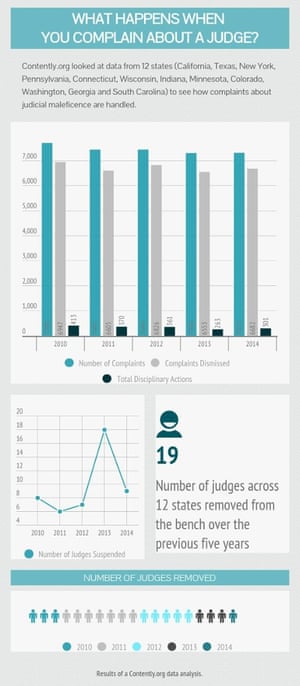
But court critics say that one reason judicial violations are common is because they frequently go unpunished. When litigants ask a judge to back away because of a conflict, they risk being told no, then face possible retaliation, so many don’t bother. If a litigant or an attorney files a complaint with an oversight body, there’s only about a 10% chance that state court authorities will properly investigate the allegation, according to a Contently.org analysis of data from 12 states.

Judges state-by-state
Photograph: Contently.org

The analysis shows that a dozen of these commissions collectively dismissed out of hand 90% of the complaints filed during the last five years, tossing 33,613 of 37,216 grievances without conducting any substantive inquiry. When they did take a look – 3,693 times between 2010 and 2014 – investigators found wrongdoing almost half the time, issuing disciplinary actions in 1,751 cases, about 47%.

The actions taken ranged from a letter of warning to censure, a formal sanction that indicates a judge is guilty of misconduct but does not merit suspension or removal.

Actually removing a judge was a rarity. Just 19 jurists in 12 states were ordered off the bench for malfeasance, which is about three per decade for each state. And even that result is becoming less common, with only one removal in 2014 and three in 2013 among all 12 states.

The states examined – California, Texas, New York, Pennsylvania, Connecticut, Wisconsin, Indiana, Minnesota, Colorado, Washington, Georgia and South Carolina – were chosen because they comprise a representative sample from different populations and areas of the country and because they had matching data for the years 2010 through 2014.

Judicial discipline at the federal level is almost non-existent. A Contently.org examination of the most recent five years of complaint data shows that 5,228 grievances were lodged against federal jurists between 2010 and 2014, including 2,561 that specifically alleged bias or conflict of interest. But only three judges were disciplined during those years and each got the mildest rebuke on the books: censure or reprimand. None was suspended or removed.

Margaret won a court order of protection barring Stuart from contact with her children for a year. But when Kent issued his final decree less than six weeks later, he awarded Stuart full custody, while Margaret was allowed only supervised visits. And he ordered Margaret to pay back half the cost of her nursing degree and to sell her diamond engagement ring and split the proceeds with Stuart. The judge also reversed the support arrangements. While Stuart would pay $1,500 a month in maintenance to Margaret, she now owed Stuart $153.90 a week for the children, even though she was earning about $13,000 a year as a part-time aide in an assisted-living facility.

Margaret began to look into her husband’s dealings and discovered, through searching public records, that he and judge Kent had possible connections. In 2010, Stuart was appointed as the Suffolk County representative on a statewide commission for vetting local judicial candidates. That same year, an organization based at Stuart Besen’s Garden City law office, the Long Island Coalition for Responsible Government, donated $7,500 to candidate Richard Ambro, who got elected and became one of Kent’s fellow Supreme Court judges in Suffolk’s 10th district. In his role as Huntington’s town lawyer, Besen argued cases before these very judges. He’d entered a circle of judicial insiders.

“I’m in the middle of a large group of people who’ve got money and influence and who are all connected,” said Margaret Besen. “I’m not being afforded an opportunity to get a fair shake.”

Margaret Besen stands in front of the former Besen family home, now unoccupied in Commack, Long Island.

Above:  Margaret Besen stands in front of the former Besen family home, now unoccupied in Commack, Long Island. Photograph: Alan Chin

Margaret had no way of knowing whether the connections she uncovered played any role in how Kent ruled in her case. But her concern deepened when she made an additional discovery about her house. Kent had ordered the Besen home, the most valuable marital asset, to be sold and the proceeds divided, putting Margaret in line to receive possibly hundreds of thousands of dollars. Then she found an online listing offering the property for sale – with the judge’s wife, Patricia Kent, as broker. The home, which was listed for $749,999 with Patricia Kent’s photo and contact information on Realty Connect USA, is currently more than $15,000 in arrears on its property taxes and no longer appears to be actively offered. Margaret was evicted from the house in 2013 and lives in a modest apartment a few miles away. She has yet to receive a penny for her interest in the property.

Scott L Cummings, a professor of legal ethics at UCLA law school, said the case raised “significant ethical red flags”, because of the judge’s wife’s alleged involvement in offering the Besen family home for sale. “Not knowing the details of how his spouse might have been assigned as broker, the idea that a judge might benefit financially from the sale of a property in dispute in a pending matter seems to raise a serious question of impartiality.”

Ronald Rotunda, a professor at Chapman University law school in Orange, California, said: “What judge Kent did here seems odd. The husband makes over a half million a year, she makes $13,000 a year, and the judge orders her to pay child support (which is tax free to him and not deductible for her).”

But a culture of judicial impunity extends far beyond Long Island’s county courts. Indeed, even the US supreme court has been tarnished on this issue.

Justice Steven Breyer owned $215,000 in health-care stocks when deciding on the legality of the Affordable Care Act in 2012. Justice Samuel Alito’s portfolio included $2,000 in stock in The Walt Disney Co. in 2008, the year the court heard Disney, FCC v. Fox Television Stations. And perhaps most famously, justice Antonin Scalia has participated in the Bush v. Gore case, even though his son Eugene’s law firm represented one of the parties. In another case, Scalia remained in the panel despite having gone on a duck hunting trip with former Vice-President Dick Cheney while he was being sued to reveal the details of secret meetings he held with oil company executives in the run-up to the 2003 invasion of Iraq.

The online vitriol directed at unscrupulous judges, which began in the mid- 2000s, has built to a howling digital crescendo. Websites including The Robe Probe, The Judiciary Report and The Robing Room, which rate judges the way Yelp rates restaurants, are rife with railing as embittered, mostly anonymous plaintiffs rip into judicial decisions they feel were biased or corrupt.

In an appeal of a case in West Virginia court, A.T. Massey Coal Co. CEO Don Blankenship spent $3m to elect Brent Benjamin, who ultimately provided the swing vote that overturned a $50m judgment against his company. Benjamin rebuffed repeated demands that the newly elected justice recuse himself because of his obvious conflict.

The US Supreme Court ruled that Benjamin’s bias was so extreme that his failure to step aside violated Caperton’s right to due process under the Constitution’s Fourteenth Amendment. The case, which spawned Grisham’s 2008 best-seller, “The Appeal,” underscored the kind of underhanded dealing that has stained the judiciary.

A further nudge for reform came last year when the Center for Public Integrity published a report on financial conflicts of interest. Among its findings: on 26 occasions in the preceding three years, federal appellate judges ruled on cases involving companies in which they owned stock or where they had a financial tie to an attorney appearing before them.

A further nudge for reform came last year when the Center for Public Integrity published a report on financial conflicts of interest. Among its findings: on 26 occasions in the preceding three years, federal appellate judges ruled on cases involving companies in which they owned stock or where they had a financial tie to an attorney appearing before them.

It also created a grading system to gauge how diligent each state was in collecting personal financial information from its judges, including stock ownership and outside sources of income, and how accessible that data was to the public. The center said that 42 states, plus the District of Columbia, failed its test. Six others earned a D grade, while two – California and Maryland – got Cs. California’s score, 77, the highest of any state, was seven points below the federal government’s grade of 84.

The report highlighted the type of conflict that can be most readily identified and that doing so requires full disclosure from the judges. Stock ownership, even if minimal, should automatically disqualify a judge from hearing a case, many experts believe. “If a judge owns a single share in a company involved in a case, he should recuse himself instantly,” says Rotunda, a leading law scholar.

It’s been more than two years since Margaret Besen has seen her children, who are now 12 and 16. There’s no money to pay the court supervisor, so they can’t visit. Nor does Besen have the funds to continue fighting. Kent retired shortly after making his decision.

“The hardest thing in my life is that I can’t be with my children and I can’t have an impact on my children’s upbringing,” Besen said over coffee at a Long Island diner. “A lot of people do not have any idea how the judicial system works or doesn’t work until you’re in it. We think we’re in a democratic society. We think we’re run by rules. But they are not being upheld by the court at all.”

This story was produced in collaboration with The Contently Foundation for Investigative Reporting.


In recent years, America’s corporations have created a private system for handling disputes that benefits them greatly while denying consumers their day in court.

Worse, according to a recent series in The Times, that system has become vast and more entrenched as companies increasingly require customers, employees, investors, patients and other consumers to agree in advance to arbitrate any disputes that arise in their dealings with a company, rather than sue in a court of law.

Such forced-arbitration clauses, found in the fine print of contracts, also typically bar aggrieved parties from pressing their claims as a group in a class action, often the only practical way for individuals to challenge corporations. In addition, corporations effectively control the arbitration process, including the selection of the arbitrator and the rules of evidence, a stacked deck if ever there was one.

As if that is not troubling enough, it is extremely difficult to avoid or get out of forced-arbitration clauses and class-action bans, particularly since they were upheld by two misguided Supreme Court decisions in 2011 and in 2013.

Photo

Richard Cordray, director of the Consumer Financial Protection Bureau, center, with colleagues at a hearing in Denver last week.CreditBrennan Linsley/Associated Press

From 2010 to 2014, corporations prevailed in four out of five cases where they asked federal judges to dismiss class-action lawsuits and compel arbitration, according to The Times’s articles. People who were blocked from going to court as a group usually dropped their claims entirely, in part because class actions are often the only affordable way to file lawsuits. If successful, they can deter future corporate wrongdoing because even small payouts, multiplied over all similarly mistreated customers, can be very large.

Indeed, faced with arbitration, it appears that most people do not pursue remedies to their grievances at all. Verizon, with more than 125 million subscribers, faced 65 consumer arbitrations between 2010 and 2014, The Times’s report found. Sprint, with more than 57 million subscribers, faced six. Time Warner Cable, with 15 million subscribers, faced seven.

Even more disturbing, the shift away from the civil justice system has gone beyond disputes about money. Nursing homes, obstetrics practices and private schools increasingly use forced-arbitration clauses to shield themselves from being taken to court over alleged discrimination, elder abuse, fraud, hate crimes, medical malpractice and wrongful death.

For the most part, Congress has looked the other way. Federal regulators, however, are starting to fight back. The Consumer Financial Protection Bureau is expected to propose a rule soon to forbid arbitration clauses that ban class actions in cases involving financial services and products. The Centers for Medicare and Medicaid Services, which is expected to issue updated nursing home regulations next year, is considering a ban on forced arbitration clauses in nursing home contracts.

Reversing the broader trend of forced arbitration, however, will require public outcry loud and long enough to stir the White House and Congress to action. Many people interviewed in The Times’s series did not realize that their right to sue had been lost until they needed it. A common refrain was the disbelief that this could happen in America. But it is happening, and it needs to stop.


From the Health Ranger Clinton Will Win!

Electoral victory for Hillary already LOCKED IN via massive bribery… George Soros admits on video… democracy be damned… THEFT of the presidency already complete
Tuesday, October 25, 2016
by Mike Adams, the Health Ranger
http://www.naturalnews.com/055769_electoral_college_bribery_theft_of_power.html

Electoral college
(NaturalNews) The democrats have bribed electoral college representatives to “fix” the election outcome in favor of Hillary Clinton, admits George Soros in a recently unearthed video. Soros, the same globalist terrorist who funded Black Lives Matter executions of police officers in Dallas — and who also funds hundreds of liberal websites and violent activist organizations who staged violence at Trump rallies to blame Republicans — says in the video that Trump will win the popular vote in a “landslide” but that he will lose the electoral vote because it’s already a “done deal” for Hillary Clinton.

Soros-Interview-Clinton-Popular-Vote
image hosting without registration

From the video on TopRightNews.com:

SOROS: It’s going to lead to a landslide for Donald Trump in the popular vote, not in the electoral vote, because there, paid political announcements will have a big role… the popular vote will be a landslide because we are a small minority of extremists… I don’t think that Donald Trump has any chance of being elected.

REPORTER: But you think that Hillary Clinton is a done deal?

SOROS: Yes.

This astonishing revelation confirms what Dave Hodges recently told me in an interview: That electoral college representatives (“Electors”) are being approached with bribes to buy their final votes.

Watch the Soros video here:

George Soros literally says Trump will win popular vote but it’s already been decided that Clinton will be the POTUS pic.twitter.com/fz2Tjt70nt

— South Lone Star (@SouthLoneStar) August 31, 2016

image
print screen windows 7

Yes, Electors can be bought off to vote for anyone they want… democracy be damned!
Via Archives.gov:

There is no Constitutional provision or Federal law that requires Electors to vote according to the results of the popular vote in their states. Some states, however, require Electors to cast their votes according to the popular vote.

The U.S. Supreme Court has held that the Constitution does not require that Electors be completely free to act as they choose and therefore, political parties may extract pledges from electors to vote for the parties’ nominees… The Supreme Court has not specifically ruled on the question of whether pledges and penalties for failure to vote as pledged may be enforced under the Constitution. No Elector has ever been prosecuted for failing to vote as pledged.

You might be shocked to learn that only 29 states require Electors to case their electoral votes in accordance with the popular vote of their state. Those 29 states, listed here are:

Alabama (Code of Ala. SS17-19-2)
Alaska (Alaska Stat. SS15.30.090)
California (Election Code SS6906)
Colorado (CRS SS1-4-304)
Connecticut (Conn. Gen. Stat. SS9-176)
Delaware (15 Del C SS4303)
District of Columbia (SS1-1312(g))
Florida (Fla. Stat. SS103.021(1))
Hawaii (HRS SS14-28)
Maine (21-A MRS SS805)
Maryland (Md Ann Code art 33, SS8-505)
Massachusetts (MGL, ch. 53, SS8)
Michigan (MCL SS168.47)
Mississippi (Miss Code Ann SS23-15-785)
Montana (MCA SS13-25-104)
Nebraska (SS32-714)
Nevada (NRS SS298.050)
New Mexico (NM Stat Ann SS1-15-9)
North Carolina (NC Gen Stat SS163-212)
Ohio (ORC Ann SS3505.40)
Oklahoma (26 Okl St SS10-102)
Oregon (ORS SS248.355)
South Carolina (SC Code Ann SS7-19-80)
Tennessee (Tenn Code Ann SS2-15-104(c))
Utah (Utah Code Ann SS20A-13-304)
Vermont (17 VSA SS2732)
Virginia (SS24.2-203)
Washington (RCW SS29.71.020)
Wisconsin (Wis Stat SS7.75)
Wyoming (Wyo Stat SS22-19-108)

As that same page writes:

Over the years, however, despite legal oversight, a number of electors have violated their state’s law binding them to their pledged vote. However, these violators often only face being charged with a misdemeanor or a small fine, usually $1,000. Many constitutional scholars agree that electors remain free agents despite state laws and that, if challenged, such laws would be ruled unconstitutional. Therefore, electors can decline to cast their vote for a specific candidate (the one that wins the popular vote of their state), either voting for an alternative candidate, or abstaining completely.

The same corrupt democrats that have rigged the debates, rigged the polls, rigged the news media and rigged the justice system are now about to STEAL the election through bribery of Electors
Now it’s all becoming clear. Having failed to destroy Donald Trump despite the world’s most vicious barrage of lies and defamatory news slander, George Soros and the corrupt democrats have bribed enough Electors to “lock in” a victory for Hillary Clinton no matter what happens on election day.

What you’re going to see the night of Nov. 8th, in other words, is a landslide popular vote victory for Donald Trump, immediately followed by electoral votes handing the official election victory to Hillary Clinton.

The theft of the presidency will be achieved thusly. And as you might expect, the American people are going to REVOLT en masse.
french_nuke_test
image upload no ads

We the People will not accept the theft of power and the nullification of democracy
We the People will not accept the theft of power by a corrupt, criminal regime run by deceptive leftists who lie, cheat and steal their way to power at every election. The bribery of Electors is, of course, the nullification of democracy in America, since it means wealthy globalists can simply buy off the electoral votes and put anyone they want into the White House… the voters be damned.

When the American people realize their votes have just been nullified through massive bribery and corruption, they are going to revolt like we’ve never seen before. They will take to the streets in protest, and the greater the margin of victory in the popular vote by Donald Trump, the more angry the voters are going to be.

We have quite simply reached the point in American history where the people will no longer tolerate the theft of power and massive election fraud that’s now routinely pursued by democrats (and especially Clinton operatives). If this election is stolen by George Soros via the bribery of Electors, I anticipate a full-on revolt where the military, the police and the citizens storm Washington and depose the corrupt Obama / Clinton regime and install the proper election winner as President. That would be Donald J. Trump, of course.

Frankly, We the People have every right to demand that democracy be restored. It is time to take America back from the thieving, lying commie bastards running the democrat party today.

Artificial Intelligence – The Judge, Jury, Lawyer, Journalist, and Executioner

Sent to me by futuret as a comment to “According to Russia, if Clinton Elected, Will Be Last US President” on my Manifest Injustice blog:

https://freedomfightertimes.com/end-times/science/beast-tech/4th/artificial-intelligence-the-judge-jury-lawyer-journalist-and-executioner/

Artificial Intelligence – The Judge, Jury, Lawyer, Journalist, and Executioner

By Nate – 10/24/2016

Support independent, investigative journalism for $3 a month Subscribe

If you go to their site, you can view a video on it.  I could not copy the video section across.

In the days ahead imagine a world in which your crimes were judged not by your fellow peers, but rather by an artificial intelligence. A team of scientists in the UK have developed an AI which can successfully predict the verdicts of Human Rights cases with an accuracy of 79 percent.

The ‘computer judge’ was developed by The University College London and the University of Sheffield. The scientists developed an algorithm which can not only weigh up evidence but can also make moral considerations.
Are you ready for the Terminator Judge?

Artificial Intelligence, no matter how smart, has no morals. What all began in the 1960’s as a prediction that computers could one day be able to predict the outcomes of judicial decisions, has just come about.

AI is increasingly being used in fields such as journalism, law, and accountancy.

However, according to the team of scientists;

“We don’t see AI replacing judges or lawyers, but we think they’d find it useful for rapidly identifying patterns in cases that lead to certain outcomes,” said Dr Nikolaos Aletras, who led the study at UCL Computer Science.

“It could also be a valuable tool for highlighting which cases are most likely to be violations of the European Convention on Human Rights.”

Interestingly enough, this is how it starts. First, the AI weighs in, then the AI becomes a member of the Judicial process, and finally the AI replaces the AI process.

Realistically this is step one.

In the not-so-distant future, artificial intelligence will replace lawyers, journalists, judges, policemen, law and order, and so many more common jobs. The most critical positions that will determine mankind’s fate are that of the legal sector, and as of this report – it begins.

Scientists claim that the Artificial Intelligence was taught morals. However, morals cannot be found in brain tissue but rather in the spirit. The conviction that comes from wrongdoing is not found in mankind, but it is located in the conviction that comes from the Holy Spirit, lest we forget the days and stories of the Israelites departure from Egypt.

Artificial Intelligence is coming about through the rise in evolutionist ideology, and the belief that man is just another animal. In the not so distant future; a central intelligence, no not the CIA, but rather the Central Artificial Intelligence will be the judge jury and executioner. The artificial intelligence will make assumptions and calculations based on thought crimes, and based on tendencies.
How so?

By the year 2023, according to the World Economic Forum, the first ever implantable mobile device will be sold to consumers. At this point an individual will be able to control a device by thought, and at this moment an individual’s thought will ping a server rather than an action inputted into a smartphone. The implantable mobile device can and will give rise to the analyzation of an individual’s thoughts.

To develop the algorithm, the team allowed the algorithm to scan the published judgments from 584 cases relating to torture and degrading treatment, fair trials and privacy. The computer learned that certain phrases, facts, or circumstances occurred more frequently when there was a violation of the human rights act. After analyzing hundreds of cases, the computer was able to predict a verdict with 79 percent accuracy.

Creating an algorithm which judges upon particular facts, phrases and circumstances will give rise to the Artificial Judge, Jury, and Executioner. Thus, creating an artificial judge which bases its decision upon thoughts rather than actual crimes.

“Previous studies have predicted outcomes based on the nature of the crime, or the policy position of each judge, so this is the first time judgments have been predicted using analysis of text prepared by the court,” said co-author, Dr. Vasileios Lampos, UCL Computer Science.

“We expect this sort of tool would improve efficiencies of high level, in demand courts, but to become a reality, we need to test it against more articles and the case data submitted to the tribunal.

“Ideally, we’d test and refine our algorithm using the applications made to the court rather than the published judgments, but without access to that data, we rely on the court-published summaries of these submissions.

To conclude, the allowance of such a judge in real-time, in an actual court would require the doing away of the entirety, and legitimacy of the legal system. Thus giving rise to the beast system which could deem Christianity as dangerous, certain phrases and thoughts as conviction, and certain circumstances as grounds for execution.

Works Cited

Jane Wakefield. “AI predicts outcome of human rights cases.” BBC. . (2016): . . http://bbc.in/2eBuned

Sarah Knapton. “Artifically intelligent ‘judge’ developed which can predict court verdicts with 79 per cent accuracy.” The Telegraph . . (2016): . . http://bit.ly/2dCPyco

From Hennessy’s View: Killing Scalia: The Clinton Crime Family

Antonin_Scalia_2010

Killing Scalia: The Clinton Crime Family

Reading Time: 4 minutesDo you think the Clinton Crime Family whacked Antonin Scalia? You will soon if you let yourself read this and all the links. But first, a strange call I had last week.

Something Unrelated

At the end of our talk, the reporter said, “do you mind if I ask you about something else? It has nothing to do with my article, and I won’t write about it.”

“Uh, sure,” I said. I was a little apprehensive.

“Do you believe the Clinton’s killed Ron Brown?” the reporter asked.

Here we go, I thought. I’m going to  get called a conspiracy whack job.

“I have no idea,” I said. “I do know reporters who have looked into the case and no longer call the idea crazy. Even some skeptics trying to debunk the assassination story have come away uncertain. And I’m sort of a libertarian. I really don’t trust the government.”

“I don’t trust the Clintons,” the reporter said. “I covered them back in the early nineties in Arkansas. During the campaign in ninety-two. And in Washington some.”

We talked a little more. The reporter knew Ron Brown and liked him. “He told you the truth.” And she knows the Clintons. They are not like Ron Brown. The Clintons are mean people. And they lie to reporters. They lie to everybody.

(“Your life is in danger. At this moment, a Chinese nuclear warhead sits in a missile silo. Its guidance, if launched, instructs the warhead to detonate a mile or two above your home. And this was all made possible by extortion, murder, and illegal campaign contributions to Bill and Hillary Clinton”

Remember Ron Brown? Brown was Clinton’s Secretary of Commerce.

Ron Brown ran the Clintons’ extortion racket in the 1990s.

[Killing of Ron Brown. here]

Conspiracy Theory

I expected to be called a conspiracy theorist when I posted the Ron Brown story. Instead, I’ve received only worried acknowledgments that the Clintons are capable of anything, including assassination.

The reporter is a veteran, serious, established journalist. You’d know her name if I told you. Like all good reporters, she’s skeptical and meticulous. She checks things out.

And like everyone who’s checked into the Ron Brown assassination, she’s not sure. She doesn’t believe it was an accident, but she can’t prove it wasn’t.

Scalia Wet Work

Then today we learned that Hillary associates John Podesta and Steve Elmendorf exchanged emails that appeared to reference an assassination the day before Supreme Court Justice Antonin Scalia was found dead with a pillow over his head at a remote lodge.

screenshot-2016-10-13-20-16-39

“Wet works” is spy-talk for “assassination.”

Scalia died in a lodge owned by a well-connected Democrat. Alex Newman wrote in The New American, February 16, 2016:

“Suspicions and unanswered questions surrounding the surprise weekend death of pro-Constitution U.S. Supreme Court Justice Antonin Scalia are swirling around the Internet and beyond. Many of the concerns center on the fact that the man who found Scalia’s body, businessman and Democrat donor John Poindexter, said the late justice was discovered with “a pillow over his head.” Also sparking alarm among some commentators and suspicious citizens are reports and official statements indicating that no autopsy will be conducted, despite contradictory claims surrounding the cause of death. Even the establishment press, apparently unfamiliar with the definition of the term “conspiracy theory,” has started reporting on the concerns and questions, albeit generally with a dismissive tone. Cries for an autopsy and congressional probe are growing louder, too, even as the White House, Democrats, and leftists waste no time in plotting to name a successor and tip the balance of power. The atmosphere is getting very tense.”

Suspicious Death

You probably remember that a lot of suspicions surrounded Scalia’s death.

  • He showed no signs of health problems at dinner the night before
  • He went to be at 9:00 p.m.
  • According to Democrat John Poindexter, owner of the lodge where Scalia died, Scalia “refused” a security detail for the night
  • John Poindexter discovered Scalia’s body the next morning
  • Scalia was dressed with a pillow over his head
  • Scalia’s bed looked unused, as if he took a nap on top of the blankets
  • But he had a pillow over his head
  • And there was no autopsy

The government refused to allow an autopsy on Ron Brown’s body, too, after a US Marshall determined cause of death over the phone, via The New American:

“Another top media personality asking questions was Michael Savage, among the top five most influential and most widely listened to talk-radio hosts in America. “Was [Scalia] murdered?” Savage asked during his program. “We need a Warren Commission-like federal investigation…. This is serious business.” He also called for an immediate autopsy, according to media reports. In a follow-up post on his website, Savage also wondered how the left would react if anti-U.S. Constitution zealot Ruth Bader Ginsburg died under similar circumstances with a pillow on her face in the final year of a Republican administration at a property owned by a mega-donor for the GOP. And in an interview with Savage on Tuesday, leading GOP presidential contender Donald Trump, when asked whether the candidate would support a Warren Commission-style probe, noted that “they found a pillow on his face, which is a pretty unusual place to find a pillow.” Trump did not say whether he would support a commission.

“There was no medical examiner present. There was no one who declared the death who was there. It was done by telephone from a U.S. Marshal appointed by Obama himself,” Savage said, outlining some of the many reasons why suspicion, whether warranted or not, is spreading like wildfire across America. “The question is, is it a conspiracy theory to ask questions that are so obviously in need of answer, or is it just common sense. And where is the common sense both in the press and the Republican Party. The answer is nowhere.” Of course, questions, by definition, cannot be a “conspiracy theory, despite the establishment media’s misuse of the term”.

It looked in February like Scalia was assassinated, and it looks now like Team Hillary conducted the murder. Why else would “wet work” make Hillary Dems “buckle up and double down?”

The Clinton Body Count

The more you read about the Clinton body count, the more you believe it’s possible that the Clintons have ordered the assassinations of many, many people. Not just enemies, but people with information. People in the way.

Scalia was in the way. Now he’s not.

Call me crazy, but that conversation with a veteran reporter tells me the Clintons are capable of anything, including assassinations. And I think they could have killed Scalia.

P.S. If you’re wondering what Vineyard they’re referring to, see The Gateway Pundit.


2 million phony accounts Wells Fargo!

Together we'll go far Wells Fargo Home Page

5,300 Wells Fargo employees fired over 2 million phony accounts

Everyone hates paying bank fees. But imagine paying fees on a ghost account you didn’t even sign up for.

That’s exactly what happened to Wells Fargo customers nationwide.

On Thursday, federal regulators said Wells Fargo (WFC) employees secretly created millions of unauthorized bank and credit card accounts — without their customers knowing it — since 2011.

The phony accounts earned the bank unwarranted fees and allowed Wells Fargo employees to boost their sales figures and make more money.

“Wells Fargo employees secretly opened unauthorized accounts to hit sales targets and receive bonuses,” Richard Cordray, director of the Consumer Financial Protection Bureau, said in a statement.

Wells Fargo confirmed to CNNMoney that it had fired 5,300 employees over the last few years related to the shady behavior. Employees went so far as to create phony PIN numbers and fake email addresses to enroll customers in online banking services, the CFPB said.

Related: Who owns Wells Fargo? You, me and Warren Buffett

The scope of the scandal is shocking. An analysis conducted by a consulting firm hired by Wells Fargo concluded that bank employees opened over 1.5 million deposit accounts that may not have been authorized.

The way it worked was that employees moved funds from customers’ existing accounts into newly-created ones without their knowledge or consent, regulators say. The CFPB described this practice as “widespread.” Customers were being charged for insufficient funds or overdraft fees — because there wasn’t enough money in their original accounts.

Additionally, Wells Fargo employees also submitted applications for 565,443 credit card accounts without their customers’ knowledge or consent. Roughly 14,000 of those accounts incurred over $400,000 in fees, including annual fees, interest charges and overdraft-protection fees.

The CFPB said Wells Fargo will pay “full restitutions to all victims.”

Related: ATM and overdraft fees top $6 billion at the big 3 banks

Wells Fargo is being slapped with the largest penalty since the CFPB was founded in 2011. The bank agreed to pay $185 million in fines, along with $5 million to refund customers.

“We regret and take responsibility for any instances where customers may have received a product that they did not request,” Wells Fargo said in a statement.

Wells Fargo has the highest market valuation among any bank in America, worth just north of $250 billion. Berkshire Hathaway (BRKA), the investment firm run legendary investor Warren Buffett, is the company’s biggest shareholder.

Of the total fines, $100 million will go toward the CFPB’s Civil Penalty Fund, $35 million will go to the Office of the Comptroller of the Currency, and another $50 million will be paid to the City and County of Los Angeles.

“One wonders whether (the CFPB) penalty of $100 million is enough,” said David Vladeck, a Georgetown University law professor and former director of the Federal Trade Commission’s Bureau of Consumer Protection. “It sounds like a big number, but for a bank the size of Wells Fargo, it isn’t really.”

Wells Fargo confirmed to CNNMoney that the 5,300 firings took place over several years. The bank listed 265,000 employees as of the end of 2015.

Related: Barclays fined $109 million for trying to hide a deal with rich clients

“At Wells Fargo, when we make mistakes, we are open about it, we take responsibility, and we take action,” the bank said in a memo to employees on Thursday.

The CFPB declined to comment on when the investigation began and what sparked it, citing agency policy. “We don’t comment on how we uncover these matters,” a spokesman said.

As part of the settlement, Wells Fargo needs to make changes to its sales practices and internal oversight.

Customers are fuming. Brian Kennedy, a Maryland retiree, told CNNMoney he detected an unauthorized Wells Fargo account had been created in his name about a year ago. He asked Wells Fargo about it and the bank closed it, he said.

“I didn’t sign up for any bloody checking account,” Kennedy, who is 57 years old, told CNNMoney. “They lost me as a banking customer and I have warned family and friends.”

“Consumers must be able to trust their banks,” said Mike Feuer, the Los Angeles City Attorney who joined the settlement.

Feuer’s office sued Wells Fargo in May 2015 over allegations of unauthorized accounts. After filing the suit, his office received more than 1,000 calls and emails from customers as well as current and former Wells Fargo employees about the allegations.

Wells Fargo declined to say when it hired a consulting firm to investigate the allegations. However, a person familiar with the matter told CNNMoney the bank launched the review after the L.A. lawsuit was filed.

Even though the Wells Fargo scandal took place nationally, the settlement with L.A. requires the bank to specifically alert all its California customers to review their accounts and shut down ones they don’t recognize or want.

“How does a bank that is supposed to have robust internal controls permit the creation of over a half-million dummy accounts?” asked Vladeck. “If I were a Wells Fargo customer, and fortunately I am not, I’d think seriously about finding a new bank.”

–To reach the author of this article email Matt.Egan@cnn.com

Massachusetts churches sue over transgender bathroom bill

The U.S. Supreme Court, file. REUTERS Gary Cameron
10/12/16 REUTERS 00:22:49
REUTERS
Copyright (c) 2016 Thomson Reuters
October 12, 2016

Massachusetts churches sue over transgender bathroom bill

Curtis Skinner
(Reuters) – Four Massachusetts churches on Tuesday filed a lawsuit asking to be exempted from a state law that requires public places to allow transgender people to use bathrooms in line with their gender identity.
Access to public bathrooms has become a flashpoint in the battle over transgender rights in the United States, after North Carolina earlier this year enacted a measure mandating that bathrooms and locker rooms be restricted according to a person’s biological gender.
The Horizon Christian Fellowship, the Swansea Abundant Life Assembly of God, the House of Destiny Ministries and the Faith Christian Fellowship of Haverhill filed the federal civil rights lawsuit in Massachusetts, arguing the law violates their constitutional rights to freedom of religious expression and free speech.
“The Churches’ policies and practices regarding access to their changing rooms and restrooms flow logically and directly from their religious beliefs concerning God’s design for biological sex,” the lawsuit said.
The law did not provide exemptions for religious organizations, with the Massachusetts Attorney General’s Office saying on its website that “houses of worship” are public places.
The lawsuit is seeking an injunction from the law for religious organizations and attorneys fees.
Massachusetts Attorney General Maura Healey and the Massachusetts Commission Against Discrimination were named as defendants in the case. Neither could be reached for comment on Tuesday night.
Jillian Fennimore, a spokeswoman for Healey’s office, told the MassLive news website the office would not comment on the lawsuit as they are still reviewing it.
Fennimore added however, “We are pleased that we finally have a law in place that protects transgender people from discrimination in public places. This law is about civil rights and is critical for people who were without full protection and equality under the law for too long.”
The lawsuit makes Massachusetts the latest battleground for transgender rights.
A U.S. judge in August blocked an Obama administration policy that public schools should allow transgender students to use the bathrooms of their choice, granting a nationwide injunction sought by 13 dissenting states.
Meanwhile, lawmakers elsewhere have moved to expand protections for transgender people. Late last month California Governor Jerry Brown signed a bill opening single-stall public restrooms to anyone, regardless of gender. The state already bars discrimination against transgender people, including in public bathrooms.
—- Index References —-
Company: CITY OF HAVERHILL MASSACHUSETTS
News Subject: (Civil Rights Law (1CI34); Gay & Lesbian Issues (1GA65); Intellectual Freedoms & Civil Liberties (1IN08); Legal (1LE33); Social Issues (1SO05))
Region: (Americas (1AM92); Massachusetts (1MA15); North America (1NO39); U.S. New England Region (1NE37); USA (1US73))
Language: EN
Other Indexing: (Destiny Ministries; Jillian Fennimore; Lucy NicholsonA; Jerry Brown; Lucy Nicholson; Maura Healey)
Keywords: (MCC:a); (N2:US); (N2:AMERS); (N2:NAMER); (N2:USA); (MCCL:OVR)
Word Count: 433
Massachusetts churches sue over transgender bathroom bill

North Georgia newspaper publisher jailed over open records request

North Georgia newspaper publisher jailed over open records request

July 1st, 2016 by Associated Press in Local Regional News Read Time: 4 mins.

A North Georgia newspaper publisher was indicted on a felony charge and jailed overnight last week – for filing an open-records request.

Fannin Focus publisher Mark Thomason, along with his attorney Russell Stookey, were arrested on Friday and charged with attempted identity fraud and identity fraud. Thomason was also accused of making a false statement in his records request.

Thomason’s relentless pursuit of public records relating to the local Superior Court has incensed the court’s chief judge, Brenda Weaver, who also chairs the state Judicial Qualifications Commission. Weaver took the matter to the district attorney, who obtained the indictments.

Thomason was charged June 24 with making a false statement in an open-records request in which he asked for copies of checks “cashed illegally.” Thomason and Stookey were also charged with identity fraud and attempted identity fraud because they did not get Weaver’s approval before sending subpoenas to banks where Weaver and another judge maintained accounts for office expenses. Weaver suggested that Thomason may have been trying to steal banking information on the checks.

But Thomason said he was “doing his job” when he asked for records.

“I was astounded, in disbelief that there were even any charges to be had,” said Thomason, 37, who grew up in Fannin County. “I take this as a punch at journalists across the nation that if we continue to do our jobs correctly, then we have to live in fear of being imprisoned.”

Thomason and Stookey are out on $10,000 bond and have a long list of things they cannot do or things they must do to avoid going to jail until their trials. On Thursday, for example, Thomason reported to a pretrial center and was told that he may have to submit to a random drug test – a condition of the bond on which he was released from jail last Saturday.

Alison Sosebee, district attorney in the three counties in the Appalachian Judicial Circuit, and Judge Weaver say the charges are justified. Weaver said she resented Thomason’s attacks on her character in his weekly newspaper and in conversations with her constituents.

“I don’t react well when my honesty is questioned,” Weaver said.

She said others in the community were using Thomason to get at her. “It’s clear this is a personal vendetta against me,” she said. “I don’t know how else to explain that.”

But legal experts expressed dismay at the punitive use of the Open Records Act.

“To the extent these criminal charges stem from the use of the Open Records Act undermines the entire purpose of the law,” said Hollie Manheimer, executive director of the Georgia First Amendment Foundation. “The Open Records Act is the vehicle by which citizens access governmental information Retaliation for use of the Open Records Act will inhibit every citizen from using it, and reel us back into the dark ages.”

Another expert said the charges against attorney Russell Stookey may also be unfounded. Robert Rubin, president of the Georgia Association of Criminal Defense Lawyers, said it was wrong for the grand jury to indict a lawyer who “is using the legitimate court process for a subpoena to get records relevant for his case.” The dispute grows out of a March 2015 incident involving another judge who is no longer on the bench. Judge Roger Bradley was presiding over several cases and asked the name of the next defendant. The assistant district attorney announced next up was “(Racial slur) Ray.” Bradley, who resigned earlier this year, repeated the slur and also talked about another man whose street name started with the same slur.

Thomason asked for the transcript after he was told courtroom deputies also used the slur.

But the transcript only noted that Bradley and the assistant district attorney used the word.

According to Thomason, the court reporter told him that it was “off the record” when others in the courtroom spoke the word so it would not be recorded in the transcript. He asked to listen to the audio recording, but his request was rejected.

In an article Thomason quoted the court reporter as saying the slur was not taken down each time it was used.

And then Thomason asked Stookey to file paperwork with the court to force the the stenographer, Rhonda Stubblefield, to release the recording.

Stubblefield responded with a $1.6 million counterclaim against Thomason, accusing him of defaming her in stories that said the transcript she produced may not be accurate. Two months later a visiting judge closed Thomason’s case, concluding that Thomason had not produced evidence the transcript was inaccurate.

Last April, Stubblefield dropped her counterclaim because, her lawyer wrote, it was unlikely Thomason could pay the award if she won.

The next month, however, Stubblefield filed paper work to recoup attorney’s fees even though last last year she was cut a check for almost $16,000 from then-Judge Bradley’s operating account.

“She was being accused of all this stuff. She was very distressed. She had done absolutely nothing wrong,” Weaver said of the judges’ decision to use court money to cover Stubblefield’s legal expenses. “She was tormented all these months and then had to pay attorneys’ fees. And the only reason she was sued was she was doing what the court policy was.”

Stubblefield’s lawyer, Herman Clark, said in court Stubblefield was asking for the money from Thomason or his attorney so she could replace the funds taken out of the court bank account. Clark said it was unfair to expect taxpayers to pick up the cost.

To fight Stubblefield’s claim for legal fees, Stookey filed subpoenas for copies of certain checks so he could show her attorneys had already been paid. One of those two accounts listed in a subpoena had Weaver’s name on it as well as the Appalachian Judicial Circuit.

Weaver said the identify fraud allegations came out of her concern that Thomason would use the banking information on those checks for himself.

“I have absolutely no interest in further misappropriating any government monies,” Thomason said. “My sole goal was to show that legal fees were paid from a publicly funded account.”

(NaturalSociety) The United States has been paying farmers for over two decades to NOT produce food, yet biotech would have us believe that genetically modified organisms are necessary to feed the world.

The Ongoing Propaganda War Behind GMOs Exposed

Christina Sarich
by Christina Sarich
Posted on October 9, 2014

(NaturalSociety) The United States has been paying farmers for over two decades to NOT produce food, yet biotech would have us believe that genetically modified organisms are necessary to feed the world. This is but one of the many lies they have perpetrated, all the while hiding the real truth behind GM crops. Genetically modified organisms and the chemicals which support their growth are just an outcropping of the military industrial complex and the war industry.

The truth is that there is more than enough food in the world to feed every single person, even if organic crops didn’t produce a greater yield. (Arguably, they do.) We already throw away more than 133 billion pounds of food every year. Food losses and waste amounts to roughly $680 billion in industrialized countries and $310 billion in developing countries

The problem isn’t food production, it is food distribution. So this is an argument that should be put to rest once and for all. This remains the truth, even though Monsanto and Dow, et al., will tell you that biotech is needed so the world won’t starve as populations increase. Many parts of the world are already starving, and it has nothing to do with crop yields. It has to do with corporate greed.

Monsanto will also tell you that, “The GM traits we develop typically help farmers increase yields on their farmland, while conserving resources such as soil and water.” Getting lost in arguments over whether or not GMOs are ‘safe’ or organic food is healthier is important, but these debates lose sight of the most appalling truth that many should know as we move forward to fight companies like Monsanto, Dow, Bayer, Syngenta, and the food manufacturers who support them (Coca-Cola, Pepsi, Kraft, General Mills, etc.)

Biotech’s Toxic History

The genetically modified model of agribusiness came straight out of the development of nerve gas used in World War II. The first modern synthetic chemical pesticides were derived from Nazi intelligence. By simply changing the molecules slightly, the greatest toxicity could be harnessed to kill ‘pests’ instead of humans.

After World War, II there were numerous chemical factories that sat idle, and the military industrial complex had to figure out a way to use them in a hurry, or lose the government funding which they had grown fat on during war times. This is when Agribusiness as we know it today really started to flourish.

Chemical fertilizers, pesticides, and herbicides were touted as a ‘miraculous’ way to improve people’s lives and make farming easier. Most of our chemical-based genetic engineering today came from secrets unraveled from Nazi Germany during and just after the war.

It is no mistake that DDT and Agent Orange, chemicals heavily funded and used by our own government, were used on people both on American soil and abroad. The Nazi regime, if you recall, was founded on the idea of creating a world utopia by invoking the ‘scientific legitimacy‘ of eugenics.

Ironically, though, it was American scientists in California who first exported this idea to Germany. Sir Francis Galton believed that ‘good breeding’ could rid the population of undesirables. British mathematician, Karl Pearson supported this idea as well.

“. . . Elements of the philosophy were enshrined as national policy by forced sterilization and segregation laws, as well as marriage restrictions, enacted in twenty-seven states. In 1909, California became the third state to adopt such laws. Ultimately, eugenics practitioners coercively sterilized some 60,000 Americans, barred the marriage of thousands, forcibly segregated thousands in “colonies,” and persecuted untold numbers in ways we are just learning. Before World War II, nearly half of coercive sterilizations were done in California, and even after the war, the state accounted for a third of all such surgeries.”

Today in the US, we have a scientific dictatorship which is very similar to that which Hitler installed during his days of rule. Monsanto suing farmers en masse, and bribing federal courts is no different than the actions of Hitler’s Brown Shirts who terrorized to support his regime:

“Their main assignments were providing protection for Nazi rallies and assemblies, disrupting the meetings of the opposing parties, fighting against the paramilitary units of the opposing parties (especially the Rotfrontkämpferbund) and intimidating Slavic and Romani citizens, unionists and Jews (e.g. the Nazi boycott of Jewish businesses).”

When you consider that the same reproductive ‘experiments’ were conducted by Hitler’s scientific henchmen are analogous to the results we are finding with many GM foods, it can be eerily familiar, but the truth must come out for us to do anything about it. Hiding in fear will only allow history to repeat itself.

In fact, air force physician Dr. Horst Schumann ran experiments at Auschwitz two to three times a week on groups of 30 prisoners–male and female–who were brought in to have their testicles or ovaries irradiated with X-rays, thus sterilizing them.

We now have numerous scientists who have proven that:

These are just a few studies of hundreds that have come out over the last few decades, not discounting others, which prove cancer, gastrointestinal failure, and chronic kidney disease. Make no mistake – this is not an agribusiness game to produce more or ‘better’ food, it is a war. It is the continuance of the eugenics ideology that was started in America, exported to Germany, and brought right back to our own shores.

Whether that is to lower population numbers or to serve some other purpose is up for debate, but the results of GMO are clear, now. Biotech, their corporate monopolies, and scientific oligarchies must be stopped.

Ruth-Bader-Ginsburg
screen capture

Ruth Bader Ginsburg
The Trumpster is right: Ruth Bader Ginsburg’s ‘mind is shot’ because she was brain damaged by chemotherapy in 2009… (and hasn’t been able to think straight since)
http://www.naturalnews.com/054650_Ruth_Bader_Ginsburg_chemo_brain_Donald_Trump.html
Wednesday, July 13, 2016
by Mike Adams, the Health Ranger

(NaturalNews) Three days ago, U.S. Supreme Court Justice Ruth Bader Ginsburg went on a discombobulated verbal rampage against Donald Trump, calling him a “faker” and claiming that if he were elected president, “then everything is up for grabs.”

She then went on to declare that everybody should “move to New Zealand” where, apparently, they can all wear their liberal tin foil hats together while America finally builds a wall to keep them all out.

But what almost nobody seems to remember about all this is that U.S. Supreme Court Justice Ruth Bader Ginsburg was brain damaged by chemotherapy in 2009. As this NY Daily News story explains, she underwent chemotherapy for pancreatic cancer that year.

Chemotherapy is a systemic poison that damages the brains, kidneys and hearts of those who undergo the procedure. As oncologists well know, chemotherapy causes “chemo brain” — a form of chemically induced brain damage that severely impairs cognitive ability by damaging brain cells. It’s far worse than the brain damage you’d suffer from sniffing glue or consuming meth, by the way.

Chemo brain is a medically recognized side effect of chemotherapy, and even the Mayo Clinic describes chemo brain side effects as including:

  • Confusion
  • Difficulty concentrating
  • Difficulty finding the right word
  • Feeling of mental fogginess
  • Short-term memory problems
  • Taking longer than usual to complete routine tasks
  • Trouble with verbal memory, such as remembering a conversation

Does this sound exactly like Ruth Bader Ginsburg? You bet it does!

America’s highest court populated by a brain-damaged liberal
All this explains why Ginsberg’s Supreme Court decisions have been so cognitively impaired for the last seven years. It’s also why she recently committed a huge error by uttering all those insanely stupid words against Donald Trump, earning her a retort from Trump who correctly says her “mind is shot.”

The Trumpster is now calling for Ginsberg to resign in shame, and even the New York Times now agrees that Trump is right: Ginsberg has totally lost her mind. Why hasn’t she resigned yet? Because she’s too cognitively impaired to realize she needs to resign.

It’s frightening to think that the very future of America hinges in part on the decisions of a brain-damaged U.S. Supreme Court Justice who has lost the ability to think or speak with clarity. Yet in another way, it’s also not so surprising: She’s the perfect poster girl for the total insanity that now exists in Washington D.C. … a dangerous departure from sanity that’s now endemic across the entire federal government. In fact, if you think about it, why shouldn’t an insanely stupid, incompetent and corrupt federal government be incessantly granted unconstitutional powers by a brain-damaged Supreme Court justice who can’t control her own mouth?

This is all the more reason to elect Donald Trump, by the way. If we are to have any real hope of saving America, we have to replace all the insane, incompetent and brain damaged government officials with intelligent, capable, patriotic Americans who can get things done while protecting individual liberty. Read more at Trump.news.

JPMorgan Chase Bank Fines Do Nothing to Them

I was working on something today, and saw that I needed to add some references (footnotes) to support what I was saying. It had to do with JPMorgan Chase Bank, and the fines for violations concerning robo-signing, lying, cheating, stealing homes, and the like. All related to foreclosures of course.

When I began adding the references for my allegations, I almost fell off my chair. I could not believe the fines and the violations, and yet, they continue on, to this very day. The only thing that Chase has learned from all the fines for violations, is that they make enough money, that the fines don’t matter. If anything else had come of it, as in, it hurt them financially, they would have quit with all the violations.
As it turns out, attorneys for these banks have gotten worse. It is ruining the legal profession. If the courts would stand up and make those that should be held accountable, accountable, the foreclosures would have ended. So, it has also ruined the court system for their failure to the citizens of the states and country.
http://s25.postimg.org/ze1twuhu7/is_CDBx_Oy_Hkyno_GSsgx_Oz_TCmykgo7_D_Dsbu_N6nx_ELu_AK48_h.jpgForeclosure hell has only taught the people that have lost their homes. And what pray tell did those people learn other than they will never be able to purchase another home? That you cannot trust attorneys, you cannot trust the courts, and by God you had better never trust the lender. In other words, the world around you is corrupt as hell, and no one, except you, the borrower is accountable for anything.

Just a sampling of fines levied against JPMorgan Chase Bank:
2008: Unpacking the JPMorgan Chase scandals; $30 billion in fines and counting — and this monster bank still got off lightly!: http://www.socialism.com/drupal-6.8/articles/unpacking-jpmorgan-chase-scandals
June 2011: Misleading CDO Investments: http://www.dividend.com/dividend-education/a-brief-history-of-jp-morgans-massive-fines-jpm/;
July 7, 2011: Conduct in Municipal Bonds $228 Million: http://www.dividend.com/dividend-education/a-brief-history-of-jp-morgans-massive-fines-jpm/;
February 9, 2012: Foreclosure Abuses and “Robo-Signing” $5.29 Billion: http://www.dividend.com/dividend-education/a-brief-history-of-jp-morgans-massive-fines-jpm/;
November 16, 2012: $269.9 Million: More Mortgage Misrepresentations: http://www.dividend.com/dividend-education/a-brief-history-of-jp-morgans-massive-fines-jpm/;
January 2013: $1.8 Billion: Improper Foreclosures: http://www.dividend.com/dividend-education/a-brief-history-of-jp-morgans-massive-fines-jpm/;
October 25, 2013: $5.1 Billion: Fannie and Freddie Fines: http://www.dividend.com/dividend-education/a-brief-history-of-jp-morgans-massive-fines-jpm/;
Nov. 2013: JPMorgan agrees $13 billion settlement with U.S. over bad mortgages; http://www.reuters.com/article/us-jpmorgan-settlement-idUSBRE9AI0OA20131120;
November 15, 2013: $4.5 Billion: Mortgage Securities: http://www.dividend.com/dividend-education/a-brief-history-of-jp-morgans-massive-fines-jpm/;
January 2014: JPMorgan Chase Fines Exceed $2 Billion: http://www.bankinfosecurity.com/chase-a-6356;
January 06, 2014: Madoff Scandal: $1.7 Billion: http://www.dividend.com/dividend-education/a-brief-history-of-jp-morgans-massive-fines-jpm/;
November 11, 2014: Currency Manipulation (stock price): $1.34 Billion: http://www.dividend.com/dividend-education/a-brief-history-of-jp-morgans-massive-fines-jpm/;
March 2015: Chase has paid $38 Billion in 22 settlements from 2009 through March of 2015: http://www.dispatch.com/content/stories/business/2015/07/16/fine-despite-fines.html;
July 2015: JPMorgan Chase fined $136M over how it collects debts: http://www.npr.org/sections/thetwo-way/2015/07/08/421277881/jpmorgan-chase-fined-136m-over-how-it-collects-debt;
July 8, 2015: Chase fined $216M over debt collection: http://www.bankrate.com/financing/credit-cards/chase-fined-216m-over-debt-collection/;
December 2015: JPMorgan Admits It Didn’t Tell Clients About Conflicts $300M: http://www.bloomberg.com/news/articles/2015-12-18/jpmorgan-pays-267-million-to-settle-conflict-of-interest-claims;
January 2016: JPMorgan Chase Fined $48Million for Failing to Comply With Robosigning Settlement: https://consumerist.com/2016/01/05/jpmorgan-chase-fined-48-million-for-failing-to-comply-with-robosigning-settlement/;

And it goes on. There are many that I missed, in my hurry to get this done.
And in the end, the buck stops with the Courts, U.S. Attorneys and District Attorneys for not throwing the lot of their asses in the clink!

Judge Says FBI’s Hacking Tool Deployed In Child Porn Investigation Is An Illegal Search

Judge Says FBI’s Hacking Tool Deployed In Child Porn Investigation Is An Illegal Search

http://abovethelaw.com/2016/04/judge-says-fbis-hacking-tool-deployed-in-child-porn-investigation-is-an-illegal-search/

The judicial system doesn’t seem to have a problem with the FBI acting as admins for child porn sites while conducting investigations. After all, judges have seen worse. They’ve OK’ed the FBI’s hiring of a “heroin-addicted prostitute” to seduce an investigation target into selling drugs to undercover agents. Judges have, for the most part, allowed the ATF to bust people for robbing fake drug houses containing zero drugs — even when the actual robbery has never taken place. Judges have also found nothing wrong with law enforcement creating its own “pedophilic organization,” recruiting members and encouraging them to create child pornography.
So, when the FBI ran a child porn site for two weeks last year, its position as a child porn middleman was never considered to be a problem. The “network investigative technique” (NIT) it used to obtain identifying information about anonymous site visitors and their computer hardware, however, has resulted in a few problems for the agency.
While the FBI has been able to fend off one defendant’s attempt to suppress evidence out in Washington, it has just seen its evidence disappear in another case related to its NIT and the “PlayPen” child porn site it seized (and ran) last year.
What troubles the court isn’t the FBI acting as a child porn conduit in exchange for unmasking Tor users. What bothers the court is the reach of its NIT, which extends far outside the jurisdiction of the magistrate judge who granted the FBI’s search warrants. This decision benefits defendant Alex Levin of Massachusetts directly. But it could also pay off for Jay Michaud in Washington.
The warrants were issued in Virginia, which is where the seized server resided during the FBI’s spyware-based investigation. Levin, like Michaud, does not reside in the district where the warrant was issued (Virginia – Eastern District) and where the search was supposed to be undertaken. As Judge William Young explains, the FBI’s failure to restrict itself to the location where the NIT warrants were issued makes them worthless pieces of paper outside of that district. (via Chris Soghoian)

The government argues for a liberal construction of Rule 41(b) that would authorize the type of search that occurred here pursuant to the NIT Warrant. See Gov’t’s Resp. 18-20. Specifically, it argues that subsections (1), (2), and (4) of Rule 41(b) are each sufficient to support the magistrate judge’s issuance of the NIT Warrant. Id. This Court is unpersuaded by the government’s arguments. Because the NIT Warrant purported to authorize a search of property located outside the Eastern District of Virginia, and because none of the exceptions to the general territorial limitation of Rule 41(b)(1) applies, the Court holds that the magistrate judge lacked authority under Rule 41(b) to issue the NIT Warrant.

The government deployed some spectacular theories in its effort to salvage these warrants, but the court is having none of it.

The government advances two distinct lines of argument as to why Rule 41(b)(1) authorizes the NIT Warrant. One is that all of the property that was searched pursuant to the NIT Warrant was actually located within the Eastern District of Virginia, where the magistrate judge sat: since Levin — as a user of Website A — “retrieved the NIT from a server in the Eastern District of Virginia, and the NIT sent [Levin’s] network information back to a server in that district,” the government argues the search it conducted pursuant to the NIT Warrant properly can be understood as occurring within the Eastern District of Virginia. Gov’t’s Resp. 20. This is nothing but a strained, after-the-fact rationalization.

As the government attempts to portray it, the search was wholly contained in Virginia because the NIT was distributed by the seized server in the FBI’s control. But, as the judge notes, the searchitself — via the NIT — did not occur in Virginia. The NIT may have originated there, but without grabbing info and data from Levin’s computer in Massachusetts, the FBI would have nothing to use against the defendant.

That the Website A server is located in the Eastern District of Virginia is, for purposes of Rule 41(b)(1), immaterial, since it is not the server itself from which the relevant information was sought.

And, according to Judge Young, that’s exactly what the FBI has now: nothing.

The Court concludes that the violation at issue here is distinct from the technical Rule 41 violations that have been deemed insufficient to warrant suppression in past cases, and, in any event, Levin was prejudiced by the violation. Moreover, the Court holds that the good-faith exception is inapplicable because the warrant at issue here was void ab initio.

The judge has more to say about the FBI’s last ditch attempt to have the “good faith exception” salvage its invalid searches.

Even were the Court to hold that the good-faith exception could apply to circumstances involving a search pursuant to a warrant issued without jurisdiction, it would decline to rule such exception applicable here. For one, it was not objectively reasonable for law enforcement — particularly “a veteran FBI agent with 19 years of federal law enforcement experience[,]” Gov’t’s Resp. 7-8 — to believe that the NIT Warrant was properly issued considering the plain mandate of Rule 41(b).

The court doesn’t have a problem with NITs or the FBI’s decision to spend two weeks operating a seized child porn server. But it does have a problem with the government getting warrants signed in one jurisdiction and using them everywhere but.
The decision here could call into question other such warrants used extraterritorially, like the DEA’s dozens of wiretap warrants obtained in California but used to eavesdrop on targets located on the other side of the country. And it may help Jay Michaud in his case, seeing as he resides a few thousand miles away from where the search was supposedly performed.

2016 STATE OF THE JUDICIARY ADDRESS THE HONORABLE CHIEF JUSTICE HUGH P. THOMPSON SUPREME COURT OF GEORGIA January 27, 2016, 11 a.m. House Chambers, State Capitol

016 STATE OF THE JUDICIARY ADDRESS
THE HONORABLE CHIEF JUSTICE HUGH P. THOMPSON
SUPREME COURT OF GEORGIA
January 27, 2016, 11 a.m.
House Chambers, State Capitol

Lt. Governor Cagle, Speaker Ralston, President Pro Tem Shafer, Speaker Pro Tem Jones, members of the General Assembly, my fellow judges and my fellow Georgians:
Good morning. Thank you for this annual tradition of inviting the Chief Justice to report on the State of Georgia’s Judiciary. Thanks in large part to your support and the support of our governor, as we move into 2016, I am pleased to tell you that your judicial branch of government is not only steady and secure, it is dynamic; it has momentum; and it is moving forward into the 21st century with a vitality and a commitment to meeting the inevitable changes before us.
Our mission remains the same: To protect individual rights and liberties, to uphold and interpret the rule of law, and to provide a forum for the peaceful resolution of disputes that is fair, impartial, and accessible to all.
Our judges are committed to these principles. Each day, throughout this state, they put on their black robes; they take their seat on the courtroom bench; and they work tirelessly to ensure that all citizens who come before them get justice.


Our Judicial Council is the policy-making body of the state’s judicial branch. It is made up of competent, committed leaders elected by their fellow judges and representing all classes of court. They are assisted by an Administrative Office of the Courts, which is under a new director – Cynthia Clanton – and has a renewed focus as an agency that serves judges and courts throughout Georgia.
A number of our judges have made the trip to be here today. Our judges are here today because the relationship we have with you is important. We share with you the same goal of serving the citizens of this great state. We could not do our work without your help and that of our governor.
On behalf of all of the judges, let me say we are extremely grateful to you members of the General Assembly for your judicial compensation appropriation last year.


Today I want to talk to you about Georgia’s 21st century courts – our vision for the future, the road we must travel to get there, and the accomplishments we have already achieved.
It has been said that, “Change is the law of life. And those who look only to the past or present are certain to miss the future.”
Since a new state Constitution took effect in 1983, our population has nearly doubled to a little over 10 million, making us the 8th most populous state in the country. We are among the fastest growing states in the nation, and in less than four years, our population is projected to exceed 12 million.
Because it is good for our economy, we welcome that growth. Today, Georgia ranks
among states with the highest number of Fortune 500 companies, 20 of which have their global headquarters here; we have 72 four-year colleges and universities; we have the world’s busiest airport and we have two deep-water ports. Georgia is a gateway to the South, and for a growing number of people and businesses from around the world, it is a gateway to this country.
All of this growth produces litigation – increasingly complex litigation – and just as our state must prepare for this growth by ensuring we have enough roads and modes of transportation, enough doctors and hospitals, and enough power to reach people throughout the state, our courts also must be equipped and modernized for the 21st
century.
While our population has nearly doubled since 1983, the number of Georgia judges has
grown only 16 percent. We must work together to ensure that our judicial system has enough judges, staff and resources in the 21st century to fulfill the mission and constitutional duties our forefathers assigned to us.
A healthy, vibrant judiciary is absolutely critical to the economic development of our state. Thanks to many leaders in the judiciary, as well as to our partnership with the governor and to you in the legislature, we are well on our way to building a court system for the 21st century.


This time next year, with your support, we will have put into place an historic shift in the types of cases handled by the Georgia Supreme Court – the highest court in the state – and by the Court of Appeals – our intermediate appellate court. Thanks to Governor Deal’s Georgia Appellate Jurisdiction Review Commission, this realignment will bring the Supreme Court of Georgia in line with other state Supreme Courts, which handle only the most critical cases that potentially change the law. Serving on the Commission are two of my colleagues – Justice David Nahmias and Justice Keith Blackwell – as well as two judges from the Court of Appeals – Chief
Judge Sara Doyle and Judge Stephen Dillard.
I thank you, Justices and Judges, for your leadership.
Under the Georgia Constitution, Supreme Court justices collectively decide every case that comes before us. Currently the state’s highest court hears divorce and alimony cases; we hear cases involving wills; we hear cases involving titles to land; and we hear disputes over boundary lines.
But the Governor’s Commission, and a number of reports by other commissions and
committees issued since 1983, have recommended that such cases should be heard by our intermediate appeals court, not by our highest court.
Both of our courts are among the busiest in the nation. But unlike the Supreme Court, which sits as a full court with all seven justices participating in, and deciding, every case, the Court of Appeals sits in panels of three. With your approval last year of three new Court of Appeals judges, that court will now have five panels, so it will have the capacity to consider five times as many cases as the Supreme Court.
Modernization of the Supreme Court makes sense. In a 19th century court system, when
most of the wealth was tied up in land, maybe title to land cases were the most important. Maybe they had the greatest implications for the public at large. But as we move into the 21st century, that is no longer true.
In answer to questions such as who owns a strip of land, what does a will mean, and who should prevail in a divorce settlement or an alimony dispute, most judicial systems believe that three judges are enough to provide the parties with a full and fair consideration of their appeal. It no longer makes sense to have seven – or nine – justices collectively review these types of cases.
There is no doubt these cases will be in good hands with the Court of Appeals.
Let me emphasize that all these cases the Commission recommended shifting to the Court of Appeals are critically important to the parties involved.
Let me also emphasize that the purpose of this historic change is not to lessen the burden on the Supreme Court. Rather, the intent is to free up the state’s highest court to devote more time and energy to the most complex and the most difficult cases that have the greatest implications for the law and society at large.
We will therefore retain jurisdiction of constitutional challenges to the laws you enact, questions from the federal courts seeking authoritative rulings on Georgia law, election contests, murder and death penalty cases, and cases in which the Court of Appeals judges are equally divided.
Significantly, we want to be able to accept more of what we call “certiorari” cases
which are appeals of decisions by the Court of Appeals. The number of petitions filed in this category during the first quarter of the new docket year is nearly 14 percent higher this year over last. Yet due to the amount of appeals the law now requires us to take, we have had to reject the majority of the petitions for certiorari that we receive.
These cases are often the most complex – and the most consequential. They involve
issues of great importance to the legal system and the State as a whole. Or they involve an area of law that has become inconsistent and needs clarification.
Businesses and citizens need to know what the law allows them to do and what it does
not allow them to do. It is our job at the highest court to reduce any uncertainty and bring consistency and clarity to the law.
Under the Commission’s recommendations, our 21st century Georgia Supreme Court will
be able to accept more of these important appeals.


As we move into the 21st century, plans are being discussed to build the first state Judicial Building in Georgia’s history that will be dedicated solely to the judiciary. We are grateful for the Governor’s leadership on this. The building that now houses the state’s highest court and the Court of Appeals was built in 1954 when Herman Tallmadge was governor. Back then, it made sense to combine the state judicial branch with part of the executive branch, by locating the Law Department in the same building.
But the world has changed since 1954, and the building we now occupy was not designed with visitors in mind. It was not designed with technology in mind. And it surely was not designed with security in mind. Indeed, it was designed to interconnect with neighboring buildings that housed other branches of government.
A proper Judicial Building is about more than bricks and mortar. Outside, this building will symbolize for generations to come the place where people will go to get final resolution of civil wrongs and injustices; where the government will go to safeguard its prosecution of criminals; and where defendants will go to appeal convictions and sentences to prison for life.
Inside such a building, the courtroom will reinforce the reality that what goes on here is serious and solemn; it is a place of great purpose, in the words of a federal judge. The parties and the lawyers will understand they are all on equal footing, because they are equal under the law.
There is a majesty about the law that gets played out in the courtroom. It is a hallowed place because it is where the truth must be told and where justice is born. The courtroom represents our democracy at its very best.
No, this building is not just about bricks and mortar. Rather it is a place that will house Georgia’s highest court where fairness, impartiality, and justice will reign for future generations.


We are no longer living in a 1950s Georgia. The courts of the 21st century must be
equipped to handle an increasingly diverse population. Living today in metropolitan Atlanta alone are more than 700,000 people who were born outside the United States. According to the Chamber of Commerce, today some 70 countries have a presence in Atlanta, in the form of a consulate or trade office. We must be ready to help resolve the disputes of international businesses that are increasingly locating in our state and capital. Our 21st century courts must be open, transparent and accessible to all. Our citizens’ confidence in their judicial system depends on it. We must be armed with qualified, certified interpreters, promote arbitration as an alternative to costly, courtroom-bound litigation, ensure that all those who cannot afford lawyers have an avenue toward justice, and be constantly updating technology with the aim of improving our courts’ efficiency while saving literally millions of dollars. For all of this, we need your help.


When I first became a judge, we had no email, no cell phones, no Internet. People didn’t Twitter or text, or post things on YouTube, Facebook or Instagram. The most modern equipment we had was a mimeograph machine.
This past year, by Supreme Court order, we created for the first time a governance
structure to bring our use of technology into the 21st century. Chaired by my colleague Justice Harold Melton, and co-chaired by Douglas County Superior Court Judge David Emerson, this permanent Judicial Council Standing Committee on Technology will lead the judicial branch by providing guidance and oversight of its technology initiatives.
Our courts on their own are rapidly moving away from paper documents into the digital age. At the Supreme Court, lawyers must now electronically file all cases. This past year, we successfully launched the next phase by working with trial courts to begin transmitting their entire court record to us electronically. The Court of Appeals also now requires the e-filing of applications to appeal, and this year, will join the Supreme Court in accepting electronic trial records.

Our goal is to develop a uniform statewide electronic filing and retrieval system so that lawyers and others throughout the judiciary can file and access data the easiest way possible.
Using a single portal, attorneys will be able to file documents with trial courts and appellate courts – and retrieve them from any court in the state. This is the system advocated by our partner, President Bob Kaufman of the State Bar of Georgia, and by attorneys throughout the state.
Such a system will not only make our courts more efficient at huge savings, but it will make Georgia safer. When our trial judges conduct bond hearings, for example, they often lack critical information about the person before them. They usually have reports about any former convictions, but they may not have information about cases pending against the defendant in other courts. The technology exists now to ensure that they do.
Also on the horizon is the expanded use of videoconferencing – another electronic
improvement that will save money and protect citizens’ lives. After a conviction and sentence to prison, post-trial hearings require courts to send security teams to pick up the prisoner and bring him to court. Without encroaching on the constitutional right of confrontation, we could videoconference the inmate’s testimony from his prison cell. Again, the technology already exists.
Our Committee on Technology will be at the forefront of guiding our courts into the 21st century.


As Georgia grows, it grows more diverse.
Our Georgia courts are required by the federal government to provide language services free of charge to litigants and witnesses, not only in criminal cases but in civil cases as well.
Even for fluent English speakers, the judicial system can be confusing and unwelcoming.
My vision for Georgia’s judiciary in the 21st century is that every court, in every city and every county in Georgia, will have the capacity of serving all litigants, speaking any language, regardless of national origin, from the moment they enter the courthouse until the moment they leave. That means that on court websites, signs and forms will be available in multiple languages, that all court staff will have the tools they need to assist any customers, and that court proceedings will have instant access to the interpreters of the languages they need.
Chief Magistrate Kristina Blum of the Gwinnett County Magistrate Court has been
working hard to ensure access to justice for all those who come to her court, most of whom are representing themselves.
Recently her court created brochures that provide guidance for civil trials, family
violence matters, warrant applications, garnishments, and landlord-tenant disputes. These brochures provide basic information about each proceeding – what to expect and how best to present their case in court.
Judge Blum, who is in line to be president of the Council of Magistrate Judges and is a member of our Judicial Council, has had the brochures translated into Spanish, Korean and Vietnamese. Such non-legalese forms and tutorial videos that our citizens can understand go a long way toward building trust in the judicial system, and in our entire government.
The Supreme Court Commission on Interpreters, chaired by Justice Keith Blackwell, is
making significant strides in ensuring that our courts uphold the standards of due process. With the help of Commission member Jana Edmondson-Cooper, an energetic attorney with the Georgia Legal Services Program, the Commission is working around the state to educate judges,court administrators and lawyers on the judiciary’s responsibilities in providing language assistance.
The essence of due process is the opportunity to be heard. Our justice system is the envy of other countries because it is open and fair to everyone seeking justice. By helping those who have not yet mastered English, we reinforce the message that the doors to the best justice system in the world are open to everyone.
Our law demands it. Our Constitution demands it.


The courts of the 21st century will symbolize a new era. A turning point in our history occurred when we realized there was a smarter way to handle criminals.
Six years ago, my colleague and then Chief Justice Carol Hunstein accompanied
Representative Wendell Willard to Alabama to explore how that state was reforming its criminal justice system. Back in Georgia, Governor Deal seized the reins, brought together the three branches of government, and through extraordinary leadership, has made criminal justice reform a reality. Georgia is now a model for the nation.
Today, following an explosive growth in our prison population that doubled between
1990 and 2011 and caused corrections costs to top one billion dollars a year, last year our prison population was the lowest it has been in 10 years. Our recidivism rate is the lowest it’s been in three decades. And we have turned back the tide of rising costs.
For the last five years, the Georgia Council on Criminal Justice Reform – created by the governor and your legislation – has been busy transforming our criminal justice system into one that does a better job of protecting public safety while holding non-violent offenders accountable and saving millions in taxpayer dollars. I am extremely grateful to this Council and commend the steady leadership of co-chairs Judge Michael Boggs of the Court of Appeals and Thomas Worthy of the State Bar of Georgia.
Throughout this historic reform, Georgia’s trial court judges have been in the trenches.
Our number one goal in criminal justice reform is to better protect the safety of our citizens.
Central to that goal is the development of our specialty courts – what some call accountability courts.
These courts have a proven track record of reducing recidivism rates and keeping our
citizens safe. Nationwide, 75 percent of drug court graduates remain free of arrest two years after completing the program, and the most conservative analyses show that drug courts reduce crime as much as 45 percent more than other sentencing options. Last year, these courts helped save Georgia more than $51 million in prison costs.
From the beginning, you in the legislature have steadfastly supported the growth in these courts, most recently appropriating more than $19 million for the current fiscal year.
Georgia now has 131 of these courts, which include drug courts, DUI courts, juvenile and adult mental health courts, and veterans courts. Today, only two judicial circuits in the state do not yet have a specialty court, and both are in the early stages of discussing the possibility of starting one. In addition to those already involved, last year alone, we added nearly 3500 new participants to these courts.
Behind that number are individual tales of lives changed and in some cases, lives saved.
Our judges, who see so much failure, take pride in these success stories. And so should you.

Chief Judge Richard Slaby of the Richmond County State Court, speaks with great pride of Judge David Watkins and the specialty courts that have grown under Judge Watkins’ direction. Today the recidivism rate among the Augusta participants is less than 10 percent.
The judges who run these courts are committed and deserve our thanks. We are grateful to leaders like Judge Slaby, who is President-Elect of the Council of State Court Judges and a member of our Judicial Council; to Judge Stephen Goss of the Dougherty Superior Court, whose mental health court has been recognized as one of the best mental health courts in our country; to Chief Judge Brenda Weaver, President of the Council of Superior Court Judges and a member of our Judicial Council. Judge Weaver of the Appalachian Judicial Circuit serves on the Council of
Accountability Court Judges of Georgia, which you created last year by statute. Its purpose is to improve the quality of our specialty courts through proven standards and practices, and it is chaired by Superior Court Judge Jason Deal of Hall County. Judge Deal’s dedication to the specialty court model in his community, and his guidance and encouragement to programs throughout the state, are described as invaluable by those who work with him.


We may not have a unified court system in Georgia. But we have judges unified in their commitment to our courts. Among our one thousand four hundred and fifty judges, Georgia has many fine leaders. I’ve told you about a number of them today. In closing, I want to mention two more.
When the United States Supreme Court issued its historic decision last year on same-sex marriage, our Council of Probate Court Judges led the way toward compliance. Three months before the ruling was issued, the judges met privately at the behest of the Council’s then president, Judge Chase Daughtrey of Cook County, and his successor, Judge Don Wilkes of Emanuel County. Together, they determined that regardless of what the Supreme Court decided, they would follow the law. Both Governor Deal and Attorney General Sam Olens also publicly announced they would respect the court’s decision, despite tremendous pressure to do otherwise.
These men are all great leaders who spared our state the turmoil other states endured. The bottom line is this: In Georgia, we may like the law, we may not like the law, but we follow the law.


The day-to-day business of the Georgia courts rarely makes the news. Rather judges,
their staff and clerks spend their days devoted to understanding the law, tediously pushing cases through to resolution, committed to ferreting out the truth and making the right decision. It is not easy, and they must often stand alone, knowing that when they sentence someone to prison, many lives hang in the balance between justice and mercy.
So I thank all of our leaders, and I thank all of our judges who are leading our courts into the 21st century.
May God bless them. May God bless you. And may God bless all the people of Georgia.
Thank you.

Bar Groups See Threat from Nonlawyers

The American Lawyer
http://www.americanlawyer.com/printerfriendly/id=1202748892813
from: The American Lawyer

At ABA Meeting, Bar Groups See Threat from Nonlawyers

Susan Beck, The Am Law Daily

February 4, 2016


(Stanford Law School Professor Deborah Rhode criticized the opposition to Resolution 105, which some fear could lead to more non-lawyers providing legal services.
Photo: Jason Doiy/The Recorder)

A modest proposal that hints at opening the door to nonlawyers providing simple legal services faces a tough fight at the American Bar Association’s midyear meetings, which are currently underway in San Diego.

The ABA’s Litigation Section, as well as the bar associations of Illinois, Nevada, New York, New Jersey and Texas, are all on record opposing Resolution 105, which was submitted by the Commission on the Future of Legal Services and five other ABA divisions. The commission was formed in August 2014 by then-incoming ABA president William Hubbard, who has been vocal about the need to improve access to justice. Under the leadership of former Northrop Grumman Corporation lawyer Judy Perry Martinez, the commission has explored new ways to improve the delivery of civil legal services to the public, especially to those who can’t afford a lawyer or are confused by the legal system.

While the 30-member commission has considered many possible solutions—from technological innovations to allowing nonlawyers to provide limited legal services—Resolution 105 doesn’t propose any specific changes to the status quo. Instead, it asks the ABA to adopt “Model Regulatory Objectives for the Provision of Legal Services” that are guided by such benign principles as protection of the public and meaningful access to justice. It also urges each state’s highest court to be guided by these objectives if it is considering new rules to allow activity by “nontraditional legal service providers.”

While the resolution doesn’t advocate for such changes, the mere mention of “nontraditional legal service providers” raises hackles for some in the ABA. The Texas state bar board, for example, has asked Texas delegates to withhold their support for Resolution 105. State bar president-elect Frank Stevenson II of Locke Lord said the board opposes the proposal because it seems to presume there’s a place for nonlawyers to provide legal services. He added that Texas’ chief justice has already set up a commission to study how lawyers can reach more of the public, and his group wants to wait for that group to finish its work.

“Our position shouldn’t be interpreted as rigidly opposed to innovation in the provision of legal services,” Stevenson said. But he added, “We feel lawyers are not fungible with nonlawyers.”

The New Jersey State Bar Association’s board of trustees voted unanimously to oppose the resolution, also because it envisions new categories of legal service providers. The ABA’s Litigation Section voted 17-8 against it.

Philadelphia lawyer Lawrence Fox of Drinker Biddle & Reath, who has long crusaded against allowing nonlawyers to provide legal services, sent a Jan. 29 email to all delegates with the subject line “Save Our Profession.” He implored them to reject Resolution 105: “If we are going to show leadership, it ought to be in opposing the unauthorized practice of law, wherever it rears its ugly head,” he wrote.

The resolution does have some organized support, including from the South Carolina Bar Association, the ABA’s Business Law Section, the Bar Association of San Francisco and the Washington State Bar Association. (In Washington state, licensed nonlawyers already provide some legal services.)

ABA President Paulette Brown declined to comment on the resolution or the work of the commission.

The commission will hold a roundtable discussion in San Diego on Saturday and will meet again on Sunday. The ABA’s House of Delegates will consider the resolution on Monday.

A simple majority vote is needed to adopt a resolution. The ABA has 560 delegates, but it’s not clear how many will be present Monday.

Over the past year and a half, the Commission on the Future of Legal Services has sought new ideas to improve the public’s access to legal solutions. In May of last year it held a National Summit on Innovation in Legal Services at Stanford Law School that drew 200 participants, including 12 state court chief justices, the CEO of LegalZoom, a Microsoft Corp. in-house lawyer and numerous academics.

The following month, in a podcast on the Legal Talk Network, commission chairman Martinez sounded optimistic that the profession might change. “There’s room in this space to think differently about how we provide legal services,” she said. “This has the potential for sea change.”

Some of the profession’s rules, she said, serve as barriers that don’t protect the public. “We’re making sure that lawyers understand what services aren’t needed to be delivered by a lawyer and can in fact be delivered by somebody else.”

Martinez also noted that some lawyers might have trouble adjusting to a new model: “[There] will be some pain for those not alert and ready for change.”

Martinez could not be reached for comment.

The United Kingdom has already allowed some of the changes that are being fought over in the United States. In 2007 it passed the Legal Services Act, which permits so-called alternative business structures in the practice of law. The U.K. law breaks down many of the barriers that prevented nonlawyers from providing legal services or supplying capital to legal service providers.

Stanford Law School professor Deborah Rhode, who co-chaired last year’s summit and who directs the Center on the Legal Profession at Stanford University, called the May gathering an “extraordinary show of support for innovation” by ABA leadership. Four past, current and future ABA presidents attended, she noted.

“The major challenge for the ABA is how to get the rank and file behind some of these innovative initiatives,” she said. “A lot of lawyers feel very threatened.”

Rhode criticized the organized opposition against Resolution 105. “It’s such a mindless reflexive response,” she said. “This [change] is coming whether the bar likes it or not. Sticking their heads in the sand and trying to block even such an unobjectionable compromise position [in Resolution 105] seems a step in the wrong direction.”

She added, “This is why I titled my book ‘The Trouble with Lawyers,’” referring to her 2015 book critiquing the profession.

“I don’t think it’s fair to say that everyone who has concerns is sticking their heads in the sand,” said Locke Lord’s Stevenson, the Texas bar president. “A lot of criticism has been very nuanced and raises some issues that need to be addressed.”

“Four judicial appointments are being denied Gov. Nathan Deal”. “over a period of decades, it has become customary throughout Georgia for a judge to resign mid-way through the final elected term, which allows the governor to install an incumbent of his choice in time for the next nonpartisan election. Which usually discourages all challengers. Bestowing these prizes has become one of the great perks of the governor’s office.”


(Judge Irma Glover speaks to the audience during a criminal arraignment at Cobb County State Court in Marietta in 2013. Her retirement was announced on Tuesday. Hyosub Shin, hshin@ajc.com)
Greg Bluestein
@bluestein
Daniel Malloy
@ajconwashington
Jim Galloway
@politicalinsidr
http://politics.blog.ajc.com/2016/01/06/cobb-county-judges-deny-gov-nathan-deal-four-bench-appointments/

Cobb County judges deny Gov. Nathan Deal four bench appointments
January 6, 2016 | Filed in: Cobb County, Elections – President, Georgia Legislature, Jimmy Carter, John Lewis, Nathan Deal.

Judge Irma Glover speaks to the audience during a criminal arraignment at Cobb County State Court in Marietta in 2013. Her retirement was announced on Tuesday. Hyosub Shin, hshin@ajc.com

Judge Irma Glover speaks to the audience during a criminal arraignment at Cobb County State Court in Marietta in 2013. Her retirement was announced on Tuesday. Hyosub Shin, hshin@ajc.com

We told you earlier this morning that Allison Barnes Salter, daughter of former Gov. Roy Barnes and a managing partner in the Barnes Law Group, will run for an open seat on the Cobb County State Court bench.

But that is only part of the story.

(Allison Salter Barnes, who announced her candidacy for a state court judgeship on Tuesday).

Allison Salter Barnes, who announced her candidacy for a state court judgeship on Tuesday.

A total of four judges in Cobb County – all women, one on the superior court bench and three on the state court bench – have announced that they will not be running for re-election when their terms expire this year.

Which means that four judicial appointments are being denied Gov. Nathan Deal.

This is actually how the system is supposed to work. But over a period of decades, it has become customary throughout Georgia for a judge to resign mid-way through the final elected term, which allows the governor to install an incumbent of his choice in time for the next nonpartisan election. Which usually discourages all challengers. Bestowing these prizes has become one of the great perks of the governor’s office.

One can’t rule out the possibility that these departing judges hold a fervent belief in the power of voters. Superior Court Judge Adele Grubbs, who is retiring at age 72, won her seat on the bench in a 2000 election. State Court Judge Melanie Clayton first won her seat in an open-field election in 1992.

But we also may be seeing something of a Democratic hangover here. Kathryn Tanksley, another departing state court judge, was appointed as one of the last acts of Governor Barnes before he left office in 2002. And State Court Judge Irma Glover, whose retirement was announced Tuesday in the Daily Report, was a 1995 appointee of Gov. Zell Miller.

Agendas Acc0rding to the Federal Bar Association


I ran across this tonight, looking for something else, but it caught my eye and so I read it.
Knowing what I know about this country and being “awake”, I find the following pretty fucking interesting. What are your thoughts?:

FEDERAL BAR ASSOCIATION
2015-16 ISSUES AGENDA
http://www.fedbar.org/Advocacy/Issues-Agendas.aspx

Active Issues | Monitored Issues
ACTIVE LEGISLATIVE ISSUES

Independence of the Federal Judiciary

The Federal Bar Association reaffirms the importance of the independence of the judiciary, recognizing that judicial decisions are not immune from scrutiny, but are to be made solely on the basis of the law.

Funding for the Federal Courts

The Federal Bar Association supports adequate funding for the general and continuing operations of the federal courts, including an equitable level of rent and facilities expense consistent with actual costs, budgetary constraints, staffing needs and security considerations, to permit the courts to fulfill their constitutional and statutory responsibilities

Federal Judgeships and Caseloads

The Federal Bar Association supports the authorization and establishment of additional permanent and temporary federal judgeships, including bankruptcy judgeships, along with support personnel, as proposed by the Judicial Conference of the United States, when rising caseloads in the federal courts threaten the prompt delivery of justice. The Federal Bar Association also supports efforts to educate Congress, the legal profession and the general public about how the overwhelming case loads threaten the ability of the Third Branch of the federal government to function.

Federal Judicial Vacancies

The Federal Bar Association calls upon the President and Congress to act promptly and responsibly in nominating and confirming nominees to the federal appellate and district courts. The Federal Bar Association supports the development of strategies to reduce the time required to fill federal judicial vacancies.

Courthouse Security

The Federal Bar Association supports the adoption of adequate security measures to protect the federal judiciary, their families and court personnel in and outside the courthouse, while preserving meaningful public access to judicial proceedings.

Federal Judicial Pay

The Federal Bar Association support equitable compensation and regular periodic adjustments for the federal judiciary, as well as senior officials of the Executive Branch and Members of Congress, to promote the recruitment and retention of the highest quality public servants.

Respect for the Federal Courts

Declining public confidence in our courts undermines public respect for the courts and the legitimacy of their rulings. To counter that influence, the Federal Bar Association supports programming and other efforts to educate the public about the federal courts and the role they serve in assuring a just society.

Professionalism and Stature of Federal Attorneys

The Federal Bar Association supports and promotes efforts to improve the professionalism and stature of attorneys employed by the federal government, including: enhancements to the compensation packages of federal attorneys, including pay and retirement benefits, to assist in recruitment and retention; the expansion, consistent with applicable conflict of interest laws, of policies encouraging full participation of attorneys employed by the federal government in professional organizations and pro bono legal activities, including approval for use of administrative leave; enhanced federal funding for participation in continuing legal education and training programs, including paid tuition and administrative leave; and the establishment of programs for student loan deferral and repayment assistance for all federal attorneys, including federal law clerks, federal defenders and judge advocates of the Armed Forces, in support of recruitment and retention efforts.

Social Security Disability Appeals Backlog

The Federal Bar Association supports adequate funding and resources for the Social Security Administration to remove the significant backlog of disability benefit appeals awaiting adjudication and to assure the fair and timely administration of justice for all appellants.

Authority of Bankruptcy Judges in “Core Proceedings”

The Federal Bar Association supports amendment of bankruptcy law to expressly allow bankruptcy judges to issue proposed findings of fact and conclusions of law in core proceedings in which they are otherwise barred from entering final judgments under Article III of the United States Constitution.

Commission on Nazi-Confiscated Art Claims

The Federal Bar Association supports the Congressional creation of a commission to address identification and ownership issues related to Nazi-confiscated artworks, pursuant to the Washington Conference Principles on Nazi-Confiscated Art, as signed by the United States and the international community.

Article I Immigration Court
The Federal Bar Association supports the transfer of responsibilities for the adjudication of immigration claims from the Executive Office of Immigration Review within the Department of Justice to a specialized Article I court, as established by Congress, for the adjudication of claims under the Immigration and Naturalization Act.

Federal Criminal Sentencing
The Federal Bar Association supports efforts to advance fairness and consistency in federal sentencing, while preserving judicial independence and discretion to deal with the particular circumstances of individual cases.

Military Spouse Attorney Mobility
The Federal Bar Association supports state-level legal licensing accommodations, including bar admission without additional examination, for attorneys who are spouses of service members, i.e., members of the uniformed services of the United States as defined in 10 USC §101(a)(5), when: (1) those “military spouse attorneys” are present in a particular state, commonwealth, or territory of the United States or District of Columbia due to their service members’ military assignment; (2) they are graduates of accredited law schools; and (3) they are licensed attorneys in good standing in the bar of another state, commonwealth, or territory of the United States or District of Columbia.

Patent Litigation Reform
The Federal Bar Association supports legislation that curbs abusive patent litigation practices and other responsible measures to improve the quality and clarity of patents. The FBA opposes legislation that reduces judicial discretion in adjudicating patent actions or circumvents the Rules Enabling Act by mandating changes that depart from the Federal Rules of Civil Procedure in patent cases.

MONITORED LEGISLATIVE ISSUES

Courthouse Construction

The Federal Bar Association supports the full funding of courthouse construction proposed by the Judicial Conference of the United States.

Cameras in the Courts

The Federal Bar Association encourages a discussion of the competing considerations vis-a-vis proposed legislation which would authorize federal judges, in their discretion, to permit photographing, electronic recording, broadcasting, and televising of federal court proceedings in appropriate circumstances.

Division of the Ninth Circuit Court of Appeals

The Federal Bar Association opposes the division of the Ninth Circuit Court of Appeals, consistent with its capacity to effectively and efficiently render justice.

Continuing Legal Education Funding for the Federal Judiciary

The Federal Bar Association supports the expansion of and enhancement of federal funding for continuing legal education and training programs for the federal judiciary.

Expansion of Federal Jurisdiction Over State and Local-Prosecuted Crimes

The Federal Bar Association advocates strict scrutiny of legislation proposing to grant original jurisdiction to federal authorities over crimes traditionally reserved to state and local prosecution.

Criminal Justice Act Panel Attorney Compensation

The Federal Bar Association supports Congressional funding to permit an increase in compensation rates for Criminal Justice Act panel attorneys.

National Security and Civil Liberties

The Federal Bar Association encourages the discussion of the competing considerations in the nation’s war against terror between the protection of civil liberties and the interests of national security.

Prevention of Epidemics and Civil Liberties

The Federal Bar Association encourages and contributes to a discussion of the competing considerations between governmental restrictions to guard against epidemics and pandemics and the preservation of individual rights, as well as the use of technology to ensure the continuance of participatory governance.

Safety of Administrative Judges

The Federal Bar Association supports the efforts by the Social Security Administration and the Executive Office of Immigration Review to take appropriate steps to ensure the security of their administrative law judges and immigration judges, and all others who participate in its proceedings.

Veteran Disability Claims Adjudication

The Federal Bar Association supports legislative and administrative improvements to the veterans disability claims process in the Department of Defense and Department of Veterans Affairs to assure equitable and expeditious determinations.

Attorney Fee-Based Representation of Veterans

The Federal Bar Association supports proposals to expand the availability of fee-based representation of veterans in the disability claims process and to oppose any efforts to repeal the authority of attorney representation to veterans in the furtherance of such claims.

Frivolous Litigation

The Federal Bar Association opposes legislative proposals to eliminate judicial discretion in the imposition of sanctions for frivolous litigation, including proposals to revise Rule 11 of the Federal Rules of Civil Procedure by imposing mandatory sanctions and preventing a party from withdrawing challenged pleadings on a voluntary basis within a reasonable time.

Adopted by the Board of Directors
Federal Bar Association
July 10, 2015

The compass of FBA’s government relations program is its Issues Agenda, a roster of policy priorities to which the Association devotes its advocacy resources. The policy priorities embraced by the Issues Agenda are associated with active issues that concern the health and welfare of the federal judicial system and effective federal legal practice. For example, they concern the preservation of judicial independence, adequate funding and facilities for the federal courts, sufficient numbers of federal judgeships, equitable compensation for the federal judiciary, fairness and consistency in federal sentencing and a host of other matters

Radioactive Cobalt 60 Properties, Dangers, FROM AGreenRoad Project – Teaching A Science Of Sustainable Health/Success What works for 7 f

Radioactive Cobalt 60 Properties, Dangers, Half Life, Weapons Application

AGreenRoad Project – Teaching A Science Of Sustainable Health/Success

What works for 7 f

http://agreenroad.blogspot.com/2012/12/radioactive-cobalt-60-properties.html

I
n the video above, viewers can watch as a Geiger Counter measures radiation from a Cobalt 60 source. Putting glass, aluminum and even lead sheets in between the Cobalt 60 and the detector makes no difference, as the Gamma radiation passes through all of them. This is what makes Gamma radiation so dangerous. It takes a very dense, very thick layer of lead (many feet thick) to stop Gamma radiation. Imagine what a particle of Gamma radiation will do INSIDE the human body, if this is the power it has OUTSIDE the human body.
According to Wikipedia; “Cobalt-60, 60Co, is a synthetic radioactive isotope of cobaltwith a half-life of 5.27 years. It is produced artificially by neutron activation of the isotope59Co.[3] 60Co decays by beta decay to the stable isotope nickel-60 (60Ni). The activated nickel nucleus emits two gamma rays with energies of 1.17 and 1.33 MeV, hence the overall nuclear equation of the reaction is
59
27Co + n → 60
27Co → 60
28Ni + e− + gamma rays.
Corresponding to its half-life the radioactive activity of one gram of 60Co is 44 TBq(about 1100curies). The absorbed dose constant is related to the decay energy and time. For 60Co it is equal to 0.35 mSv/(GBq h) at one meter from the source. This allows calculation of the equivalent dose, which depends on distance and activity.
Activity
Example: a 60Co source with an activity of 2.8 GBq, which is equivalent to 60 µg of pure 60Co, generates a dose of 1 mSv in one meter distance within one hour. The swallowing of 60Co reduces the distance to a few millimeters, and the same dose is achieved within seconds. (Inhaling or ingesting ANY radioactive materials makes them MUCH MORE DANGEROUS and increases the speed of a LETHAL or cancer causing dose, with even small particles that would not be lethal if exterior to the body.)
The high γ-energies result in a significant mass difference between 60Ni and 60Co of 0.003 u. The short lifetime contributes further to the high decay energy. This amounts to nearly 20 watts per gram, nearly 30 times larger than that of 238Pu.
Decay
decay scheme of 60Co and 60mCo.
The diagram shows a (simplified) decay scheme of 60Co and 60mCo. The main β-decay transitions are shown. The probability for population of the middle energy level of 2.1 MeV by β-decay is 0.0022%, with a maximum energy of 665.26 keV. Energy transfers between the three levels generate six different gamma-ray frequencies.[4] In the diagram the two important ones are marked.
Weapons Application
Car scanning using Co-60 gamma-ray device.
Cobalt has been discussed as a “salting” element to add to nuclear weapons, to produce a cobalt bomb, an extremely “dirty” weapon which would contaminate large areas with 60Co nuclear fallout, rendering them uninhabitable. In one hypothetical design, thetamper of the weapon would be made of 59Co. When the bomb exploded, the excess neutrons from the nuclear fission would irradiate the cobalt and transmute it into 60Co. No nation is known to have done any serious development of this type of weapon.
(For more information about the dangers of Cobalt 60 in ‘dirty’ bombs, and the horrors of having a substance like this out in the world, easily available to ANYONE who really wants it, via food irradiation plants, and testing devices such as the one shown above, click on the following link)… http://youtu.be/pkoEwZtemnc?t=1m39s
Occurrence
There is no natural 60Co in existence; thus, synthetic 60Co is created by bombarding a 59Co target with a slow neutron source, usually californium-252 moderated through water to slow the neutrons down, or in a nuclear reactor such as a CANDU reactor, where the control rods usually made of steel are instead made of 59Co [10]59Co + n → 60Co
Safety
After entering a living human ( in food, air or water), some of the 60Co is excreted infeces. The remainder is taken up by tissues, mainly the liver, kidneys, and bones, where the prolonged exposure to gamma radiation can cause bone, liver, kidney or other cancers. Over time, some of the absorbed radioactive cobalt is eliminated in urine.[7]
Cobalt is an element of steel alloys. Uncontrolled disposal of 60Co in scrap metal is responsible for the radioactivity found in several iron-based products.[11][12] (This happens more often than you think)
In the above video an incident involving radioactive cobalt is discussed in India.
In 2000, a disused radiotherapy head containing a 60Co source was stored at an unsecured location in Bangkok, Thailand and then accidentally was sold to scrap collectors. Unaware of the dangers, a junkyard employee dismantled the head and extracted the source, which remained unprotected for a period of days at the junkyard. Ten people, including the scrap collectors and workers at the junkyard, were exposed to high levels of radiation and became ill. Three of the junkyard workers subsequently died as a result of their exposure, which was estimated to be over 6 Gy. The source was safely recovered by the Thai authorities.[13]
This does not happen just in foreign countries. It also happens in the USA. In August, 2012, Petco recalled several models of steel pet food bowls after US Customs and Border Protection determined that they were emitting low levels of radiation. The source of the radiation was determined to be 60Co that had contaminated the steel.[14] Many other incidents like this have happened in the USA, but there is no one tracking these, or monitoring where radioactive substances go that are sold for scrap.
Source; Wikipedia
Food and other items are often irradiated with Cobalt 60. These food items are often NOT LABELED.
Food Irradiation; Consequences and Negative Health Effects; via A Green Road
Here is how the radiation of foods and other items works… The item is sent into a chamber where Cobalt 60 is then exposed to it, killing all bacteria on or in the food item. But there is much more to this story. Click on link above to find out more…
End
Radioactive Cobalt 60 Properties, Dangers, Half Life, Weapons Application; via A Green Road

Fukushima Cs-137 Found in Beef, Milk, Vegetation, Beginning in 2011 Through now

Fukushima nuclear material reported in West Coast groundwater; It’s discharging into Pacific Ocean — Fallout also found in meat and fish from same area — “Routinely detected’ in plant life long after March 2011

 
Published: September 4th, 2014 at 11:02 am ET
By
Email Article Email Article
124 comments

http://enenews.com/fukushima-nuclear-material-reported-west-coast-groundwater-being-discharged-pacific-ocean-fallout-detected-meat-fish?utm_source=feedburner&utm_medium=feed&utm_campaign=Feed%3A+ENENews+%28Energy+News%29


Diablo Canyon Power Plant (DCPP) Units 1 and 2 Annual Radiological Environmental Operating Report, published April 30, 2014: Isotopic releases occurred in Japan and were carried by the jet stream to the west coast of the United States… [DCPP] periodically detected cesium (Cs-137) within market fish and cow meat due to deposition of Cs-137 from [Fukushima]… Fukushima Cs-137 was detected within one sample of monitoring well… Cs-137 was detected in three samples of market fish most likely due to rainwater washout of Fukushima Cs-137… Cs-137 was detected in [a] 2013 meat samples due to the Fukushima Japan nuclear accidents. This detection occurred… in October… [DCPP] detected cesium within milk, vegetation, and meat throughout 2011 [and] continued to detect cesium within groundwater, fish, vegetation, and meat throughout 2012.

Diablo Canyon Power Plant Units 1 and 2 Annual Radiological Environmental Operating Report, Apr. 30, 2013: Throughout 2012 [we] continued to detect cesium (Cs-137) within milk, vegetation, monitoring wells, fish, and meat due to deposition of Cs-137 from that event… Concentrations of cesium (Cs-137) were also detected in two shallow monitoring wells… This cesium was evaluated and attributed to rain-washout of Fukushima fallout… Due to topography and site characteristics, this groundwater gradient flow discharged into the Pacific Ocean… Cs-137 was detected in three samples of fish most likely due to rainwater washout of Fukushima Cs-137… Cs-137 was detected in 2012 vegetation samples… due to rainwater washout of Fukushima Cs-137 [that] was absorbed by plant life and the soil. DCPP… has routinely detected Cs-137 in plant life since March of 2011 due to this Fukushima event… Cs-137 was detected in… [cow] meat samples due to the Fukushima Japan nuclear accidents… Vegetation uptake and subsequent digestion by the animals were the source of these Cs-137 isotopes into the meat.

See also: California Nuclear Plant Engineer: We were hit by explosion at Fukushima Unit 3 (MAP) — “The public started to freak out” — Tell colleagues what radioactive material is coming their way… don’t notify public — Don’t release initial data to officials until they’re ‘on board’

City of Springfield Banned all Foreclosures! How Will The Supreme Court Rule On That?


BOSTON – A group of Western Massachusetts banks argued before the state’s highest court on Thursday that the city of Springfield’s anti-foreclosure ordinances should be overturned.

The banks say the local ordinances contradict state laws, and a bond levied on lenders constitutes an illegal tax. “It’s not that banks are opposed to mortgage laws and reform, but to how it’s being done,” said Craig Kaylor, general counsel for Hampden Bank, one of the banks that brought the lawsuit. “These are for the state to decide, not city by city.”

But the city disagrees and says the laws are necessary to avoid blight and protect neighborhoods that have high rates of foreclosure.

“This is the city’s response to the foreclosure crisis,” said Springfield Assistant City Solicitor Thomas Moore, who argued the case before the Supreme Judicial Court. “It’s a response from the city council and mayor based on what they see every day in the city. They’ve taken the strongest stance to protect homeowners and the city itself.”

The city of Springfield passed two anti-foreclosure ordinances in 2011 as the city was being hit hard by the mortgage foreclosure crisis. One ordinance requires a bank that forecloses on a home to pay for a $10,000 bond, which can be used by the city to maintain the foreclosed properties, if the bank fails to do so.

The other ordinance requires the establishment of a mandatory mediation program to help homeowners facing foreclosure. The bank would be responsible for paying most of the cost of the mediation.

Springfield is among the top cities in the state in the number of distressed properties it has. The city says high rates of foreclosures lead to health and education problems for children in families that lose their homes, and high rates of blighted or vacant properties lead to crime and violence in those neighborhoods.

Six western Massachusetts banks, with Easthampton Savings Bank as the lead plaintiff, challenged the ordinances. A U.S. District court judge upheld the ordinances. However, on appeal, the U.S. Court of Appeals issued a stay preventing Springfield from enforcing them. The federal court then asked the Supreme Judicial Court, the state’s highest court, to answer two questions related to state law before the federal court makes its ruling. The case is Easthampton Savings Bank and others vs. City of Springfield.

The SJC must decide whether the local foreclosure ordinances are preempted by existing state foreclosure laws. The court must also decide whether the $10,000 bond is a legal fee or an illegal tax. Cities and towns cannot create taxes without legislative approval.

The banks also argue that the ordinances violate the contract clause of the U.S. Constitution by impairing the contract between the homeowner and the mortgage-holder, a question that remains before the federal court.

During Thursday’s arguments, Tani Sapirstein, an attorney representing the banks, argued that the bond is a tax because banks do not get any particular benefit from paying it – which is the criteria for calling something a fee. The way the bond works is when a foreclosed property is sold, if the city did not have to use the bond money to maintain it, $9,500 would be returned to the bank and $500 is kept by the city as an administrative fee, used to maintain blighted properties and implement the foreclosure laws.

Chief Justice Ralph Gants questioned Sapirstein on whether the bank does not actually receive benefits. “You have an interest in preserving the value of your property,” Gants said. “If there are foreclosed properties going to hell all around your property, it diminishes the value of your property and diminishes the value of what you receive on the foreclosure. Why is this concern about avoiding blight not something that would benefit the bank as well as the city?”

Sapirstein replied that eliminating blight would benefit the bank “as well as the city and other property owners in the neighborhood.” “How is that a particularized benefit?” she said.

Moore argued that the bond is a fee, which the city needs to hire code inspectors and create a database of who controls foreclosed properties.

But Justice Geraldine Hines said if she pays for a copy of her birth certificate, she gets a document in return for the fee. “Here I don’t see that,” she said. “The property owners, the mortgagees, don’t have something tangible.”

Moore said the banks get a “well-regulated industry” and preservation of their property values. In addition, when a bank registers ownership in the database, the city knows who is responsible and problems can be resolved more easily.

Sapirstein also argued that local law cannot require more than state law in an area that is regulated by the state or the result would be “a patchwork of ordinances.”

Gants indicated that the court may move to narrow the ordinances – for example, applying them only to a bank that has taken possession of a house, not a bank that is in the process of foreclosure when the homeowner is still living there. Gants said the ordinance as written could fine a bank for not maintaining a property where the homeowner still lives. As a homeowner, Gants said, “I’d say I’m still living here. This is my home. How can they be punished for not invading what’s still my home just because they happen to be foreclosing on it?” Gants said.

Moore acknowledged that the ordinance may be overbroad and said the city does not anticipate pursuing a violation in a case like that. Moore said the lenders’ lawsuit is premature because there is no information yet about how the city will enforce the laws. “We have the lenders essentially saying the sky will be falling, we are worried about x, y, z happening. None of that has happened and none of that may happen,” Moore said.

Moore said the city is still writing the regulations for the ordinances and if they are upheld, “The city is ready to go forward with implementation within a period of weeks.”

Similar foreclosure ordinances were established in Lynn and Worcester, and local banks challenged those as well. That lawsuit is pending in U.S. District Court in Worcester. The case involving Lynn and Worcester could be affected by the SJC’s ruling in the Springfield case.

Several activists supporting homeowners came in from Lynn and Springfield to hear the arguments. Candejah Pink, a Springfield homeowner and community organizer battled foreclosure for four years before reaching an agreement to keep her home. She helped write the Springfield ordinances. Pink said the bond is there to ensure that homes are maintained, which keeps crime and violence down. The mediation program, she said, is important to help homeowners come to an agreement with lenders. “We’re not asking to live in our homes for free. We’re asking for some mediation,” she said.

Hell, We Know We Are Killing the Pacific, As Well As the Rest of the World, Duuhh, What You Want Us To Do About It? We Have Done Nothing So Far, and It Has Worked, No One Will Make Us Do Anything!

When I was a kid, there was a cartoon.  Two vultures in a tree, looking around, really bored.  One says to the other:  “What ya wanna do?”  The other replies, “I dunno, whatya wanna do?”  That is what has gone on at Fukushima.  Hell, I dunno, maybe if we do nothing, nobody will know it happened.  I won’t tell, if you won’t tell.  What the hell?!?

The rest of the world, stands around with their fingers in their butts, and let’s them get away with it.  Can you imagine the long term impact that, we as Americans are going to endure?  Your great grandchildren may not even resemble a human.  And yall stand around like nothing has happened?  Are you sure that you were qualified to reproduce?

Think about it.

Japan Nuclear Prof.: Fukushima plant now a ‘swamp of radioactive material’ — Can’t stop pumping in more water because they don’t know where melted fuel went — Build roof over entire site? — Asahi: Continued presence of water threatens construction of ice wall around reactors

 
http://enenews.com/japan-nuclear-prof-fukushima-plant-is-now-a-swamp-of-radioactive-material-cant-stop-pumping-in-more-water-because-tepco-doesnt-know-where-melted-fuel-went-build-roof-over-entire-site-
Published: July 13th, 2014 at 9:15 pm ET 
By  
Email Article Email Article 
135 comments

Interview with Professor Hiroaki Koide, Kyoto University Reactor Research Institute, translated by Fukushima Diary, July 13, 2014: Fukushima plant is now like a swamp of radioactive material due to the contaminated water […] Tepco should quit cooling with water since one year ago. However from Tepco’s assumption, it is impossible to shift to air cooling because they can’t identify the exact locations of molten fuel.

More from interview with Professor Koide
, translated by Google: I think of that accident of Fukushima […] the human race has been encountered for the first time […] Rather than the cooling in the water, should switch as soon as possible to the cooling method of another I think. […] I thought the most part rain is falling on the site […] so, I cut off the rain. In other words, it is such as paving the entire site. I think I think in some cases, that I would build a roof on the entire site […] in the premises of the Fukushima Daiichi nuclear power plant, but is in a state such as the swamp of radioactivity […]

Asahi Shimbun, July 9, 2014: 11,000 tons of contaminated water [are in] underground trenches connected to the No. 2 and No. 3 reactor turbine buildings. […] contaminated water began seeping into them after the onset of the March 2011 nuclear crisis. If the contaminated water is not removed from the trenches, it could eventually leak out. The Nuclear Regulation Authority instructed TEPCO to promptly remove the water, calling it the “most serious source of concern.” […] But TEPCO officials said the ice walls failed to form because of the constant flow of a maximum 2 milliliters of water per minute around the connecting points. Toyoshi Fuketa, an NRA commissioner, has instructed TEPCO to come up with steps to resolve the matter by the end of July, arguing that the frozen walls should be able to withstand certain levels of water flow under normal circumstances. The continued presence of water threatens to prevent the creation of outer frozen soil walls encircling the No. 1 through No. 4 reactors, which are a central part of TEPCO’s plans to reduce the amount of contaminated water at the plant.

Full interview with Prof. Koide available here (Japanese only)

Published: July 13th, 2014 at 9:15 pm ET
By 
Email Article Email Article
135 comments

Related Posts

  1. Japan TV ‘News Flash’: Officials fear melted reactor fuel is now exposed at Fukushima — Tepco: We don’t know at this point if fuel is uncovered — Large drop in water level — Experts ‘struggling’ to find condition of nuclear cores, nothing is known for all 3 reactors (VIDEO) June 10, 2014
  2. Japan Nuclear Expert: “Containment vessel continued to break at various spots, one after another” from Fukushima melted fuel — “It lost the protective wall which seals in radiation” (VIDEO) March 13, 2013
  3. TV: Trouble reported with inner ‘ice wall’ at Fukushima; Highly radioactive water underground won’t freeze — Tepco: “We can’t make temperature low enough” after trying for months; Fluctuating water levels beneath Unit 2 blamed — Expert: Ground can liquify around reactors, form sinkholes (VIDEO) June 17, 2014
  4. PBS: Engineers believe Fukushima’s nuclear fuel melted right through the containment vessels, where it’s contacting ground water — Expert: The fuel “melted down into ground” (VIDEO) March 1, 2014
  5. TV: Hundreds of tons of water in contact with melted nuclear fuel have now flooded basements at Fukushima plant — Nearly 10 Trillion Bq of Cesium — Concentration of strontium-90 and other radioactive materials not reported (VIDEO) April 14, 2014

SHEEPLE AWAKEN!!!

Once Upon a Time…. I Thought the Worst We Had To Face Was Foreclosure Hell, I WAS WRONG!

Posted on  

Ya know, I used to think that Foreclosure Hell was the worst thing we in this Country had to face.  Wow, Was I Wrong!

I didn’t realize that just like in Japan, they will cook us to death with radiation, and not even bother to tell us.  I have condemned the Japanese for nuking the world and not telling us the truth about it, but fuck me, this country is doing the same thing.

While most people go about their daily business, they never think about the fact, that a pleasure of getting rained on is killing them.  We are the walking dead, and being asleep to the fact is just fucking us up more.

I would apologize for my slang, no, crude language, but something needs to wake these sleeping zombies up!

So, they are not only going to take every house they can get their grimy paws on, but they are going to continue the slow kill of humankind from the planet.  

It is not the kids growing up now that will suffer so much, it is like the butterfly test in Fukushima.  It is the children’s children that will be riddled with deformities. 

No matter what they try to tell us, we cannot be stupid, and believe that radiation is ok.  The thought of believing that, well, it is, stupid.  The sheeple that make up this country now, is amazing.  If the government says the radiation is not hurting us, we’ll just believe them.  Because the government says so?  Yall need to get out from under the rock, and out of the sun, cause damn!  You been drinking too much water with fluoride in it, for too long, and it has made you dumb!  I take that back, it has made you dumber than dirt!

For years, they have been doing things with the weather, with our food, with our prescriptions, our health!  They have taken healthy human beings and turned them into out of shape, fat slugs that have lives that are meant for cattle.  Chemtrails is no lie either.  What about HARP?  I guess that you also believe that 911 was not an inside job.

No, I am not a conspiracy theorist, I believe in taking what is put before me, studying it, seeing it for what it is, listening to scientists, listening to experts, and deducing my own opinion.  You see, we woke up.  We quit drinking the tap water.  We quit watching the regular news.  The news media is brainwashing you sheeple, which is not hard for them to do.

Terrorists are here, they are going to get you, so we have to militarize the Police forces.  These false flag shootings, are to outrage you sheeple, so that you will agree that guns are bad, and they can confiscate our guns.  We are told that our rights have to be taken, so that we can be protected from the terrorists, etc.,

If you are so blind you cannot see your nose on your face, you will not notice that Fannie Mae, and the banks are throwing our elderly out on the street.  Right now, in Goodyear, Arizona, an 83 year old woman and her 86 year old husband are being thrown out of their home.  No one cares.  In Colorado Springs, CO, an 82 year old woman is being thrown out of her home.  No one cares.

What the hell is wrong with you sheeple?  It’s not you, so it is Ok?  The Bank With the Most Homes in the End Wins, Get Used to It!!!

Sheeple Awaken!

Neil Garfield Telling It As It Is…”Bullying As An Acceptable Way of Life – Covered By A Corporate Shell Game!

By Paul Craig Roberts – Police Are More Dangerous To The Public Than Are Criminals, (Explained to Where Even Sheeple Can Understand!)

A MUST READ FOR EVERY AMERICAN!

From:  http://www.paulcraigroberts.org/2013/09/16/police-are-more-dangerous-to-the-public-than-are-criminals-paul-craig-roberts/

Latest Book

 PCR’s new book, HOW AMERICA WAS LOST, is now available:In Print by Clarity Press and In Ebook Format by Atwell Publishing


Police Are More Dangerous To The Public Than Are Criminals — Paul Craig Roberts

The goon thug psychopaths no longer only brutalize minorities–it is open season on all of us –the latest victim is a petite young white mother of two small children

http://www.informationclearinghouse.info/article36211.htm

Police Are More Dangerous To The Public Than Are Criminals

Paul Craig Roberts

The worse threat every American faces comes from his/her own government.

At the federal level the threat is a seventh war (Syria) in 12 years, leading on to the eighth and ninth (Iran and Lebanon) and then on to nuclear war with Russia and China.

The criminal psychopaths in Washington have squandered trillions of dollars on their wars, killing and dispossessing millions of Muslims while millions of American citizens have been dispossessed of their homes and careers. Now the entire social safety net is on the chopping bloc so that Washington can finance more wars.

At the state and local level every American faces brutal, armed psychopaths known as the police. The “law and order” conservatives and the “compassionate” liberals stand silent while police psychopaths brutalize children and grandmothers, murder double amputees in wheel chairs, break into the wrong homes, murder the family dogs, and terrify the occupants, pointing their automatic assault weapons in the faces of small children.

The American police perform no positive function. They pose a much larger threat to citizens than do the criminals who operate without a police badge. Americans would be safer if the police forces were abolished.

The police have been militarized and largely federalized by the Pentagon and the gestapo Homeland Security. The role of the federal government in equipping state and local police with military weapons, including tanks, and training in their use has essentially removed the police from state and local control. No matter how brutal any police officer, it is rare that any suffer more than a few months suspension, usually with full pay, while a report is concocted that clears them of any wrong doing.

In America today, police murder with impunity. All the psychopaths have to say is, “I thought his wallet was a gun,” or “we had to taser the unconscious guy we found lying on the ground, because he wouldn’t obey our commands to get up.”

There are innumerable cases of 240 pound cop psychopaths beating a 115 pound woman black and blue. Or handcuffing and carting off to jail 6 and 7 year old boys for having a dispute on the school playground.

Many Americans take solace in their erroneous belief that this only happens to minorities who they believe deserve it, but psychopaths use their unaccountable power against everyone. The American police are a brutal criminal gang free of civilian control.

Unaccountable power, which the police have, always attracts psychopaths. You are lucky if you only get bullies, but mainly police forces attract people who enjoy hurting people and tyrannizing them. To inflict harm on the public is why psychopaths join police forces.

Calling the police is a risky thing to do. Often it is the person who calls for help or some innocent person who ends up brutalized or murdered by the police. For example, on September 15 CNN reported a case of a young man who wrecked his car and went to a nearby house for help. The woman, made paranoid by the “war on crime,” imagined that she was in danger and called police. When the police arrived, the young man ran up to them, and the police shot him dead. http://www.cnn.com/2013/09/15/justice/north-carolina-police-shooting/

People who say the solution is better police training are unaware of how the police are trained. Police are trained to perceive the public as the enemy and to use maximum force. I have watched local police forces train. Two or three dozen officers will simultaneously empty their high-capacity magazines at the same target, a minimum of 300 bullets fired at one target. The purpose is to completely destroy whatever is on the receiving end of police fire.

US prosecutors seem to be the equal to police in terms of the psychopaths in their ranks. The United States, “the light unto the world,” not only has the highest percentage of its population in prison of every other country in the world, but also has the largest absolute number of people in prison. The US prison population is much larger in absolute numbers that the prison populations of China and India, countries with four times the US population.

Just try to find a prosecutor who gives a hoot about the innocence or guilt of the accused who is in his clutches. All the prosecutor cares about is his conviction rate. The higher his conviction rate, the greater his success even if every person convicted is innocent. The higher his conviction rate, the more likely he can run for public office.

Many prosecutors, such as Rudy Giuliani, target well known people so that they can gain name recognition via the names of their victims.

The American justice (sic) system serves the political ambitions of prosecutors and the murderous lusts of police psychopaths. It serves the profit motives of the privatized prisons who need high occupancy rates for their balance sheets.

But you can bet your life that the American justice (sic) system does not serve justice.

While writing this article, I googled “police brutality,” and google delivered 4,100,000 results. If a person googles “police brutality videos,” he will discover that there are more videos than could be watched in a lifetime. And these are only those acts of police brutality that are witnessed and caught on camera.

It would take thousands of pages just to compile the information available.

The facts seem to support the case that police in the US commit more crimes and acts of violence against the public than do the criminals who do not wear badges. According to the FBI crime Statisticshttp://www.fbi.gov/about-us/cjis/ucr/crime-in-the-u.s/2010/crime-in-the-u.s.-2010/summary in 2010 there were 1,246,248 violent crimes committed by people without police badges. Keep in mind that the definition of violent crime can be an expansive definition. For example, simply to push someone is considered assault. If two people come to blows in an argument, both have committed assault. However, even with this expansive definition of violent crimes, police assaults are both more numerous and more dangerous, as it is usually a half dozen overweight goon thugs beating and tasering one person.

Reports of police brutality are commonplace, but hardly anything is ever done about them. For example, on September 10, AlterNet reported that Houston, Texas, police routinely beat and murder local citizens.http://www.alternet.org/investigations/cops-are-beating-unarmed-suspect-nearly-every-day-houston?akid=10911.81835.yRJa7d&rd=1&src=newsletter894783&t=9&paging=off

The threat posed to the public by police psychopaths is growing rapidly. Last July 19 the Wall Street Journal reported: “Driven by martial rhetoric and the availability of military-style equipment–from bayonets and M-16 rifles to armored personnel carriers–American police forces have often adopted a mind-set previously reserved for the battlefield. The war on drugs and, more recently, post-9/11 antiterrorism efforts have created a new figure on the US scene: the warrior cop–armed to the teeth, ready to deal harshly with targeted wrongdoers, and a growing threat to familiar American liberties.”

The Wall Street Journal, being an establishment newspaper, has to put it as nicely as possible. The bald fact is that today’s cop in body armor with assault weapons, grenades, and tanks is not there to make arrests of suspected criminals. He is there in anticipation of protests to beat down the public for exercising constitutional rights.

To suppress public protests is also the purpose of the Department of Homeland Security Police, a federal para-military police force that is a new development for the United States. No one in their right mind could possibly think that the vast militarized police have been created because of “the terrorist threat.” Terrorists are so rare that the FBI has to round up demented people and talk them into a plot so that the “terrorist threat” can be kept alive in the public’s mind.

The American public is too brainwashed to be able to defend itself. Consider the factthat cops seldom face any consequence when they murder citizens. We never hear cops called “citizen killer.” But if a citizen kills some overbearing cop bully, the media go ballistic: “Cop killer, cop killer.” The screaming doesn’t stop until the cop killer is executed.

As long as a brainwashed public continues to accept that cop lives are more precious than their own, citizens will continue to be brutalized and murdered by police psychopaths.

I can remember when the police were different. If there was a fight, the police broke it up. If it was a case of people coming to blows over a dispute, charges were not filed. If it was a clear case of assault, unless it was brutal or done with use of a weapon, the police usually left it up to the victim to file charges.

When I lived in England, the police walked their beats armed only with their billysticks.

When and why did it all go wrong? Among the collection of probable causes are the growth or urban populations, the onslaught of heavy immigration on formerly stable and predictable neighborhoods, the war on drugs, and management consultants called in to improve efficiency who focused police on quantitative results, such as the number of arrests, and away from such traditional goals as keeping the peace and investigating reported crimes.

Each step of the way accountability was removed in order to more easily apprehend criminals and drug dealers. The “war on terror” was another step, resulting in the militarization of the police.

The replacement of jury trials with plea bargains meant that police investigations ceased to be tested in court or even to support the plea, usually a fictitious crime reached by negotiation in order to obtain a guilty plea. Police learned that all prosecutors needed was a charge and that little depended on police investigations. Police work became sloppy. It was easier simply to pick up a suspect who had a record of having committed a similar crime.

As justice receded as the goal, the quality of people drawn into police work changed. Idealistic people found that their motivations were not compatible with the process, while bullies and psychopaths were attracted by largely unaccountable power.

Much of the blame can be attributed to “law and order” conservatives. Years ago when New York liberals began to observe the growing high-handed behavior of police, they called for civilian police review boards. Conservatives, such as National Review’s William F. Buckley, went berserk, claiming that any oversight over the police would hamstring the police and cause crime to explode.

The conservatives could see no threat in the police, only in an effort to hold police accountable. As far as I can tell, this is still the mindset.

What we observed in the police response to the Boston Marathon bombing suggests that the situation is irretrievable. One of the country’s largest cities and its suburbs–100 square miles–was tightly locked down with no one permitted to leave their homes, while 10,000 heavily armed police, essentially combat soldiers armed with tanks, forced their way into people’s homes, ordering them out at gunpoint. The excuse given for this unprecedented gestapo police action was a search for one wounded 19-year old kid.

That such a completely unnecessary and unconstitutional event could occur in Boston without the responsible officials being removed from office indicates that “the land of the free” no longer exists. The American population of the past, suspicious of government and jealous of its liberty, has been replaced by a brainwashed and fearful people, who are increasingly referred to as “the sheeple.”

<div “=””>

About Dr. Paul Craig Roberts

Paul Craig Roberts was Assistant Secretary of the Treasury for Economic Policy and associate editor of the Wall Street Journal. He was columnist for Business Week, Scripps Howard News Service, and Creators Syndicate. He has had many university appointments. His internet columns have attracted a worldwide following. Roberts’ latest books are The Failure of Laissez Faire Capitalism and The Failure of Laissez Faire Capitalism and Economic Dissolution of the West and How America Was Lost.

Cops Killing Dogs, and Loving It!

Stay Away From Oklahoma With Your Pets!

Oklahoma Police Officer Shoots Family’s Dog Then Brags It was ‘Awesome’

 
10001317_610368532379697_1727829192_n

An Oklahoma family is devastated after a police officer shot their family pet for simply jumping the fence and getting loose.

Cali, a 2-year-old pit bull had escaped from the yard and had been reported by neighbors to be running loose in the neighborhood. When police and animal officers arrived, Cali evaded the officers, who then decided that the only way to handle the situation was the kill the dog.

Officer Brice Woolly shot one round into the neck of Cali, who was still breathing after the first shot. The police officer then instructed the animal control officer to finish the job.

A neighbor present when the shooting occurred claims Woolly seemed to take delight in downing the dog and overheard him saying to the animal control officer, ”Did you see the way its collar flew up into the air when I blew it’s head off? It was awesome!”

The neighbor also heard Woolly coach the animal control officer on how to fill out the report to avoid trouble.  ”We are just going to write this up in the report as the dog tried to attack me and you and others in the neighborhood,” Woolly told the other shooter, according to the neighbor’s account.

Cali’s death is also not the first time, or even the first time this month, that Officer Woolly used deadly force on an animal because it was ‘aggressive’ and the owner could not be located. On March 14, Woolly shot a dog twice. The owner of that dog was never found.

Despite the questions in the case, the Ardmore Police Department claims the matter has been closed and that Officer Woolly acted within the line of duty in shooting the dog.

Local residents and animal lovers, however, disagree. A petition that has already garnered over 17,000 signatures on Change.org  is calling for Woolly’s firing for his cruel action. A peaceful rally is also planned for March 29 to protest Cali’s killing by Officer Woolly.

Photo Credit: Facebook/Justice for Cali

Corrupt Attorneys Being Held Accountable, Finally!

Courts

Judges Slam More and More Plaintiffs’ Attorneys for Corruption

March 13, 2014

Peasants in Leon, Nicaragua, march in 2007 to denounce the use of harmful pesticides at banana plantations

Photograph by Miguel Alvarez/AFP via Getty Images

http://www.businessweek.com/articles/2014-03-13/judges-slam-more-and-more-plaintiffs-attorneys-for-corruption#p1

Peasants in Leon, Nicaragua, march in 2007 to denounce the use of harmful pesticides at banana plantations

On March 7 a California appellate court upheld a trial judge’s finding that what had been billed as a watershed liability verdict against Dole Food over pesticide use in Nicaragua was actually the product of a conspiracy by corrupt plaintiffs’ lawyers. That decision came only three days after a federal judge in New York ruled that a multibillion-dollar pollution judgment against Chevron (CVX) in 2011 was so tainted by bribery and coercion that it wasn’t worth the paper it was written on.

Meanwhile, in Texas, a prominent class-action injury lawyer faces mounting woes because of allegations that he faked thousands of damage claims against BP (BP)related to the 2010 Gulf of Mexico oil spill. When you combine these cases with the criminal convictions several years ago of plaintiffs-bar titans Mel Weiss, Bill Lerach, and Dickie Scruggs—all of whom served time for corrupting the civil justice system—it’s hard to deny that there’s deep dysfunction within a powerful portion of the legal profession that claims to fight corporate abuse on behalf of the little guy.

A look at the Dole ruling illustrates the point. The California Court of Appeal in Los Angeles affirmed dismissal of one of a series of suits filed against Dole, alleging the company’s use of pesticides in Nicaragua left banana workers sterile in the late 1970s. In all, these suits resulted in billions of dollars in judgments against Dole.

The case at issue in the March 7 ruling, known as Tellez, went to trial in 2008 and produced a multimillion-dollar verdict for workers. That verdict was thrown out when Dole’s attorneys proved that many of the plaintiffs never worked for the company and weren’t, in fact, sterile. Witnesses and investigators were intimidated in Nicaragua, and plaintiffs were coached to concoct false stories. One supposed victim testified that he was instructed to memorize and repeat phony evidence “like a parrot.”


Plaintiffs’ lawyers and law firms are major political contributors, particularly to Democrats

The California appellate court said the trial judge correctly sent the Tellez plaintiffs packing. The ruling was a win for the Los Angeles firm Gibson, Dunn & Crutcher, which has engineered the negation of multiple pesticide verdicts against Dole. That accomplishment prompted Chevron to hire Gibson Dunn to fight back against a $19 billion oil-contamination judgment imposed by an Ecuadorean court in 2011. In the Chevron case, U.S. District Judge Lewis Kaplan of New York ruled on March 4 that plaintiffs’ attorney Steven Donziger turned his Ecuadorean lawsuit against the oil company into a racketeering scheme, complete with extortion, bribery of judges, and fabrication of evidence. Donziger has denied wrongdoing and vowed to appeal.

Mass-tort and class-action securities-fraud suits reached their apogee in the 1990s, fueled in part by the energy and ingenuity of an elite fraternity of plaintiffs’ firms and individual lawyers, some of whom became phenomenally wealthy as a result of their success. There’s nothing necessarily wrong, of course, with plaintiffs’ attorneys doing well along the path to doing good, just as there’s nothing necessarily improper with corporate-defense lawyers getting richly paid.

But as the plaintiffs’ bar achieved lucrative triumphs in asbestos litigation and the tobacco cases, some of its leaders lost their bearings. Scruggs, who earned a fortune in both of those arenas, pleaded guilty in 2008 to crimes related to a judicial bribery scheme. Weiss and Lerach, impresarios of securities-fraud class actions, went to prison for paying kickbacks to shareholder plaintiffs-for-hire. Last year the Kentucky Supreme Court upheld the disbarment of Stanley Chesley, a scourge of the pharmaceuticals and chemicals industries, among others. Chesley allegedly sought “unreasonable” fees in the settlement of a diet drug class action against Wyeth, now part of Pfizer (PFE).

Mikal Watts of San Antonio ranks among the nation’s most feared mass-injury lawyers. In the wake of the BP oil spill four years ago, his firm filed some 40,000 claims on behalf of deckhands and others alleging economic harm from the disaster that killed 11 rig workers and sullied the Gulf Coast. Last December, BP hit back, accusing Watts of seeking to shake down the company by filing claims for thousands of “phantom” clients who didn’t fit his description of them or didn’t exist at all. Then, in January, another well-known mass-tort attorney, Danny Becnel of Louisiana, filed a separate suit against Watts on behalf of Vietnamese American fishermen and business owners who say Watts used their names without authorization. Watts last year resigned from the plaintiffs’ steering committee helping to direct the litigation against BP after media reports that federal agents had searched his offices in connection with the phantom-claims scandal. The federal criminal probe is continuing. Watts, a major fundraiser for the presidential campaigns of Barack Obama, has denied any wrongdoing—civil or criminal. His lawyers have said all his filings against BP were made in good faith.

Despite the egregiousness of the plaintiffs’ bar abuses, there’s little chance that Congress will enact tort reform anytime soon, says Victor Schwartz, a lobbyist for business on the issue and a partner in Washington with law firm Shook, Hardy & Bacon. Plaintiffs’ lawyers and law firms are major political contributors, particularly to Democrats, who have fought attempts to cap settlements in big corporate liability cases and class actions. Lawyers spent about $135 million in 2012 helping to elect Democrats, compared with $56 million for Republican candidates, according to the Center for Responsive Politics, which tracks political money. “There have been no major business civil justice victories [in Congress] for almost a decade,” Schwartz says. Likewise, President Obama has shown little interest in taking on attorneys who invested $28 million in his reelection effort in 2012, more than twice what they gave Mitt Romney, according to the center. And bar associations and state attorneys general rarely seek to prosecute litigation fraud, which is expensive to pursue and politically fraught. As a result, says Sherman Joyce, president of the corporate-funded American Tort Reform Association, “too many plaintiffs’ lawyers believe there’s not much risk in filing fraudulent suits.”

The bottom line: Dole and Chevron have won major court victories after federal judges ruled that plaintiffs’ lawyers engaged in fraud.

Barrett_190
Barrett is an assistant managing editor and senior writer at Bloomberg Businessweek. His new book, Law of the Jungle, which tells the story of the Chevron oil pollution case in Ecuador, will be published by Crown in September 2014. His most recent book is GLOCK: The Rise of America’s Gun.

Never Ending Foreclosures

      Foreclosure filings were reported on 124,419 U.S. properties in January 2014, an 8 percent increase from December but still down 18 percent from January 2013.  Foreclosure filings were reported on 1,361,795 U.S. properties in 2013, down 26 percent from 2012 and down 53 percent from the peak of 2.9 million properties with foreclosure filings in 2010.  But still, 9.3 million U.S. residential properties were deeply underwater representing 19 percent of all properties with a mortgage in December 2013, down from 10.7 million homes underwater in September 2013.[1] 

            In 2006 there were 1,215,304 foreclosures, 545,000 foreclosure filings and 268,532 Home Repossessions.  By 2007 foreclosures had almost doubled – up to 2,203,295 with 1,260,000 foreclosure filings and 489,000 Home Repossessions.  2008 saw an even further increase to 3,019,482 foreclosures, 2,350,000 Foreclosure filings and 679,000 Home Repossessions.  In 20093,457,643 foreclosures, 2,920,000 foreclosure filings, and 945,000 Home Repossessions.  2010:  3,843,548 foreclosures, 3,500,000 foreclosure filings, and 1,125,000 Home Repossessions.  2011:  3,920,418 foreclosures, 3,580,000 foreclosure filings, and 1,147,000 Home Repossessions.  Then January to September 20121,616,427 foreclosures 1,382,000 foreclosure filings and 572,844 Repossessions.  The remainder of 2012 – September through December saw an additional 2,300,000 foreclosures, 2,100,000 foreclosure filings and 700,000 Repossessions.  In other words, from 2006 through 2012, there were a total of  21,576,117 foreclosures; 17,637,000 foreclosure filings; 5,926,376 Home Repossessions.  The foreclosures added to the repossessions is equal to:  27,502,493[2].  The numbers are staggering.

            Many of the homes have been wrongfully foreclosed upon, where either the party had not been in default, or the foreclosing party lacked standing to foreclose.  It has become almost as lawless as the wildwest, or comparable to a shark feeding frenzy.


[1] All of the foreclosure figures came from RealtyTrac:  http://www.realtytrac.com/content/foreclosure-market-report

[2] http://www.statisticbrain.com/home-foreclosure-statistics/Statistic Verification  Source: RealtyTrac, Federal Reserve, Equifax

New Legal Issues – Jeff Barnes Esq., Foreclosure Defense Nationwide

NEW LEGAL ISSUES COMING UP IN TRIAL AND APPELLATE COURTS

DECEMBER 16, 2013

December 16, 2013

With the release of the US Bank admissions per our post of November 6, 2013; the issuance of the opinions from the Supreme Courts of Oregon and Montana holding that MERS is not the “beneficiary”; and recent opinions from various jurisdictions which are now, finally, holding that securitization-related issues are relevant in a foreclosure, a host of new legal issues are about to be litigated in the trial and appellate courts throughout the country. It has taken six (6) years and coast-to-coast work to get courts to realize that securitization of a mortgage loan raises issues as to standing, real party in interest, and the alleged authority to foreclose, and that the simplistic mantra of the “banks” and servicers of “we have the note, thus we win” is no longer to be blindly accepted.

One issue which we and others are litigating relates to mortgage loans originated by Option One, which changed its name to Sand Canyon Corporation and thereafter ceased all mortgage loan operations. Pursuant to the sworn testimony of the former President of Sand Canyon, it stopped owning mortgage loans as of 2008. However, even after this cessation of any involvement with servicing or ownership of mortgage loans, we see “Assignments” from Option One or Sand Canyon to a securitization trustee bank or other third party long after 2008.

The United States District Court for the District of New Hampshire concluded, with the admission of the President of Sand Canyon, that the homeowner’s challenge to the foreclosure based on a 2011 alleged transfer from Sand Canyon to Wells Fargo was not an “attack on the assignment” which certain jurisdictions have precluded on the alleged basis that the borrower is not a party to the assignment, but is a situation where no assignment occurred because it could not have as a matter of admitted fact, as Sand Canyon could not assign something it did not have. The case is Drouin v. American Home Mortgage Servicing, Inc. and Wells Fargo, etc., No. 11-cv-596-JL.

The Option One/Sand Canyon situation is not unique: there are many originating “lenders” which allegedly “assigned” mortgages or Deeds of Trust long after they went out of business or filed for Bankruptcy, with no evidence of post-closing assignment authority or that the Bankruptcy court having jurisdiction over a bankrupt lender ever granted permission for the alleged transfer of the loan (which is an asset of the Bankruptcy estate) out of the estate. Such a transfer without proof of authority to do so implicates bankruptcy fraud (which is a serious crime punishable under United States criminal statutes), and fraud on the court in a foreclosure case where such an alleged assignment is relied upon by the foreclosing party.

As we stated in our post of November 6, the admission of US Bank that a borrower is a party to any MBS transaction and that the loan is governed by the trust documents means that the borrower is, in fact, a party to any assignment of that borrower’s loan, and should thus be permitted to seek discovery as to any alleged assignment and all issues related to the securitization of the loan. We have put this issue out in many of our cases, and will be arguing this position at both the trial and appellate levels beginning early 2014.

Jeff Barnes, Esq., http://www.ForeclosureDefenseNationwide.com

Thoughts on Foreclosures

James and I were working outside, and he called me over and we began talking about that which occupies most of out time…  

Foreclosures.  

Many people don’t realize it, but there are many unseen reasons that people are foreclosed on.  After putting people into  toxic loans, and putting those toxic loans into pools with numerous other toxic loans, there was just a matter of time before the loans would go default, we all know that, the payments would become unmanageable.  

But many people, those who came to a better standing than they had been before, and being more prosperous, and even those who were not,  would have gone on to refinance those loans.  That could not be allowed to happen, because the loans would be paid off and the loans dissolved.  How do you stop someone from refinancing their loan?  Foreclose before they can.

They could not have anyone pulling the loans out of the Trusts that the loans had allegedly gone into, there was no money in the Trusts anyway.  The Banksters have a way of turning everything into a matter of profit.